Picking the app first and the wiring second is how San Diego remodels get stuck. A smart home hub can coordinate lights, climate, and scenes. It cannot add a conductor, a device box, or an always-on outlet after the stucco is closed. Plan the rooms and the hardwired parts, then decide what can live in a separate app.
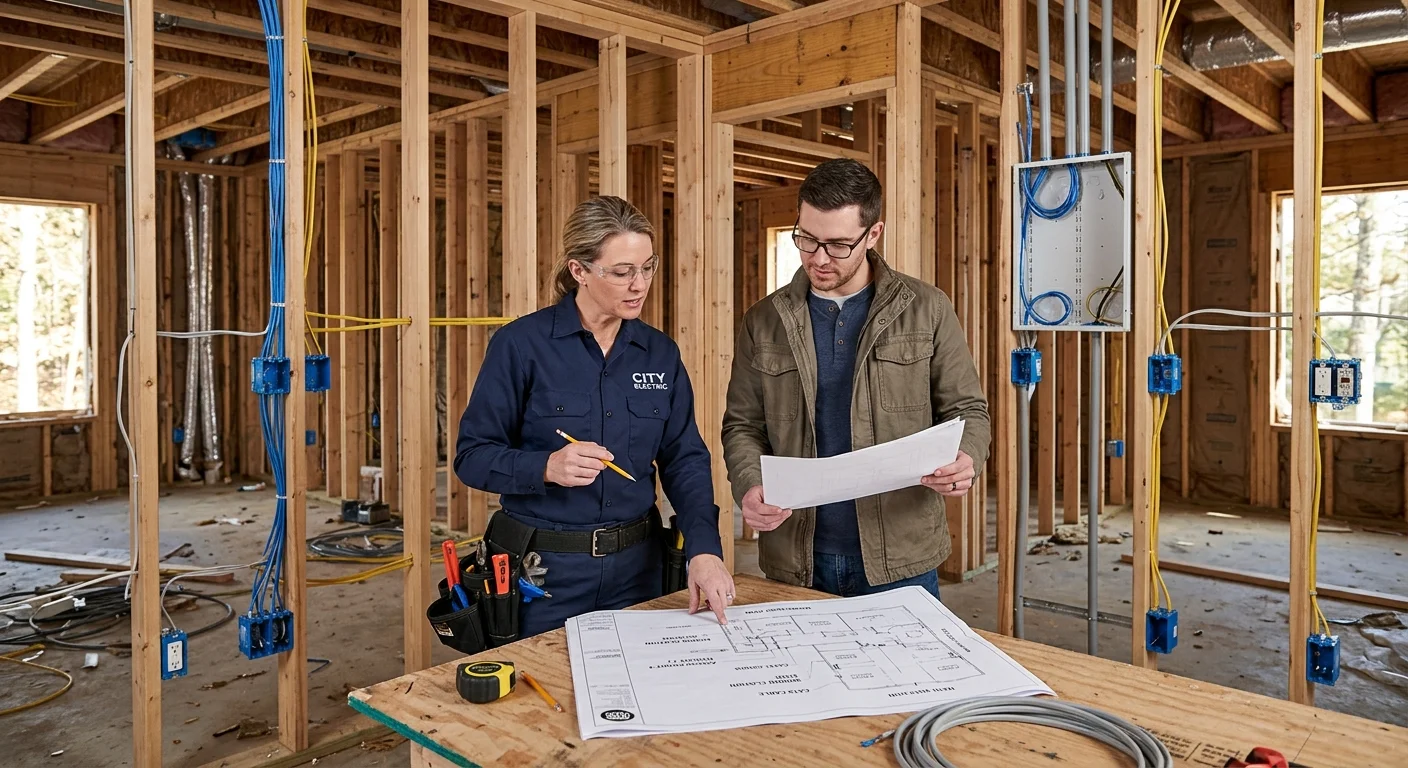
Start with the devices and rooms being planned
Walk the house before anyone names a brand. Write rooms, then write what should happen in each one. Kitchen, primary bedroom, garage, backyard, office. Skip the shopping cart until that list is boring and complete.
A Clairemont or North Park two-story is not a Carlsbad tract from the 2000s. About 49.6% of housing units in the City of San Diego were built before 1978. El Cajon sits near 62.5%. La Mesa near 68.7%. San Marcos is closer to 23.8%. Older stock often means fewer spare conductors in switch boxes, plaster or stucco that soaks up wireless, and panels that were never sized for extra always-on gear. Newer inland homes in San Marcos and parts of Carlsbad usually have more attic path and more open-wall chances during a remodel.
Name jobs, not logos. Lights you still want to dim from a paddle. A thermostat that stays powered. A TV wall with a receptacle and a data jack. A desk that should not share Wi-Fi with the microwave. Outdoor lighting that needs a weather-rated box. Cameras and a doorbell can sit on the same conversation, but a security alarm is a different system. Do not fold arming, sirens, or monitoring into a general hub plan.
If this is new construction or a gut, keep our smart home wiring for new construction notes next to this one. If you are still deciding whether to start small, use starting a smart home in San Diego as the companion.
The list of rooms is the spec. Rankings of hubs are not.
What a hub changes and what it doesn’t
A smart home hub is a coordinator. Separate apps talk to one device at a time. A hub is supposed to sit in the middle so a lock, a light, and a thermostat can follow one routine without you opening three phones.
That is the software idea. The wiring does not care which voice assistant you like this year.
A hub does not replace a stable circuit for devices that stay on. It does not replace a ventilated shelf or closet with an unswitched receptacle. It does not replace a data path to rooms that cannot shrug off a dropped Wi-Fi packet. It does not replace a permit when the work is an electrical installation or alteration.
A speaker with Alexa, Siri, or Google can already command some devices. You may not need a second box on the shelf. You still need power at that speaker, and you still need coverage in the rooms you actually use. A hub also does not turn a screw-in bulb into a wall switch. If you want a paddle that works when the phone is dead, that is a switch and a box.
Platforms get discontinued. Cloud logins fail during an outage even when a neighbor still has lights. If the block is dark, check the map on SDG&E. A hub that needs the internet to flip a hall light is a planning choice, not a wiring defect. Local control, when a product actually has it, is a manufacturer claim you confirm on that product. We are not certifying any brand’s offline behavior.
Keep lighting scenes and intrusion systems on separate plans. A convenience routine and an alarm response are not the same job.
Which devices still need dependable power or data
Wireless is easy until the wall is two-coat stucco, the stream is a TV, or the access point is in a hall closet on one floor of a Santee or Poway two-story. Plan power and data as if the favorite app will change.
Treat these as on-site conversations with a licensed electrician, not as a weekend project:
- The hub and router: constant power, not a half-hot receptacle on a light switch
- Access points: power, and usually a data drop, on each occupied floor
- Wall switches you still want to use with your hand
- The thermostat, including whether a common wire is present
- TV and desk walls: a receptacle plus a data jack
- Outdoor boxes you actually intend to use
We are not publishing cable categories, watt budgets, or protocol lists. Those change by product. Confirm the device maker’s current sheet with the electrician in the room that will hold the gear.
Older San Diego switch boxes often have no spare conductor for a smart switch. That is a box condition. See smart switch, no neutral wire before you buy a stack of in-wall devices. Thermostats have the same trap. C-wire work is a site check, not a shopping-cart assumption.
For media walls, decide ethernet versus leftover coax on purpose. The coax outlet versus ethernet jack post is the remodel version of that choice.
Kitchen countertop receptacles under California’s adopted electrical code need GFCI protection (CEC §210.8(A)(6)). Receptacles within 6 feet of a sink need it too (CEC §210.8(A)(7)). A smart plug in those spots does not erase that. Local building departments can add rules. Ask the authority for that address.
If the panel is already full, a hub will not invent capacity. That is a panel and load conversation, not an automation one.
What should be decided before walls close
Drywall, insulation, and stucco are expensive to open twice. Mark locations while the cavities are open.
On paper, lock in:
- Hub and network gear, with unswitched power
- Every wall switch that must remain a wall switch
- Spare device boxes for a later keypad or blank plate
- Data jacks at desks, TVs, and high-wall or ceiling access points
- Outdoor boxes you will actually terminate
- Anything that may need its own circuit, which is a site call (see when you need a dedicated circuit)
In the City of San Diego, electrical installation, alteration, addition, or replacement needs an electrical permit unless San Diego Municipal Code §129.0303 exempts it. A Simple No-Plan path is still a permit. Minor replacement of a switch or receptacle of the same size and general type can be exempt in the City, with limits. A device that changes how the circuit is used is not automatically that swap. Chula Vista, El Cajon, Poway, and the other incorporated cities run their own building departments. Unincorporated places such as Ramona, Lakeside, Fallbrook, and Alpine go through County Planning & Development Services. Use the agency on the parcel, not the mailing city. Read when an electrical permit is required for the City-versus-County split.
Owner-occupants can pull some City permits. Most people still want a licensed electrical contractor on the work. Check the business on the CSLB license lookup before anyone opens a wall. California’s minor-work dollar threshold does not turn electrical alterations into casual handyman work. For that hiring line, see can a handyman do electrical work in California.
Matched independent electricians do the physical smart home wiring. Bright Pro Electric matches you with those pros. It does not pull cable, open panels, or hold the trade license for the job.
How future platform changes affect the wiring plan
You will change apps. You might change hubs. You will not want to recut every wall in Encinitas or Chula Vista to do it.
The stable layer is boxes, conductors, and data paths a later device can use. The unstable layer is the brand, the voice assistant, and the cloud login.
Do not hardwire a plan that only works if one company’s puck stays in production. Put the coordinator on a shelf or in a closet with power and a data jack. Put control in the wall as ordinary device boxes, so a later switch, keypad, or blank plate still fits. If the electrician can leave a pull path or spare capacity while the wall is open, put that on the proposal as a line item. It is not a promise that any future wireless standard will arrive.
Matter, Thread, Zigbee, Z-Wave, and Wi-Fi marketing all shift. We are not picking a winner. Ask the electrician and the device maker what the current gear needs. Keep the walls from depending on the answer.
A future phone app cannot add a conductor that was never pulled. That is the reason to decide this before tape and texture.
For general electrical-safety reading, ESFI is a long-standing nonprofit resource. Specific product steps still come from the device maker and the electrician on site.
What to compare in prewiring proposals
Get the same scope in writing from more than one licensed electrical contractor. CSLB’s consumer guidance is at least three written bids on the same plans.
Compare room-by-room device-box and data-jack counts, not a vague “smart home” lump. Compare the hub and network location, including constant power. Compare who pulls the permit in that city or in the County. Compare what is excluded: low-voltage versus line-voltage, cameras, alarm, whole-home audio. Compare whether switch boxes will be opened and checked for a spare conductor. Compare how a later TV wall gets priced.
Do not rank bids on a single number copied from the internet. This site does not publish a countywide smart-wiring average.
Ask who performs the work, the license number of the contracting business, and insurance evidence. A license is not a warranty of workmanship, and it does not by itself prove a policy will pay a claim. Walk the identity steps in our license verification guide.
If the proposal mixes lighting, receptacles, and data, keep outlet and switch work visible as electrical work. It is not a gadget install.
Frequently asked questions
What does a smart home hub do?
It coordinates compatible devices and routines in one place. Separate apps still control their own gear. A hub does not replace circuits, permits, or a wall switch you want to keep.
What is the best smart home hub?
There is no single best unit for every San Diego house. Match the hub to the devices you already own, then confirm current compatibility with the manufacturer. Rankings expire. Your room list does not.
Is it worth getting a smart hub?
It is worth it when several devices must act together and you will keep the hub powered. A few Wi-Fi bulbs in one room can live on their own app. Whole-home scenes usually cannot.
Do I need a smart home hub with Alexa?
Not always. Many Alexa speakers already send commands to compatible devices. You still plan power, coverage, and any in-wall switches. Add a separate hub only if your devices or routines need it.
Will a hub work if the internet is down?
Some products keep local routines. Many do not. Treat that as a product question, not a wiring promise. Lights with a physical switch still work when the cloud does not.
When to call us
Call when you are opening walls, adding in-wall switches, or planning power and data for a hub before drywall. The electricians we connect you with handle the licensed electrical work. Call us at (858) 988-5580 and we’ll connect you with a licensed local electrician.