A multi-wire branch circuit (MWBC), the shared-neutral run, is two hot conductors that share one neutral back to the panel. It was a common way to feed a kitchen or a pair of rooms in older San Diego houses. It is still legal when it is built to the listing and the adopted code. It is a problem when someone treats those two breakers as independent, or lands a single-pole AFCI on one half. Bright Pro Electric matches you with a licensed electrician. We do not rewire it from a photo.
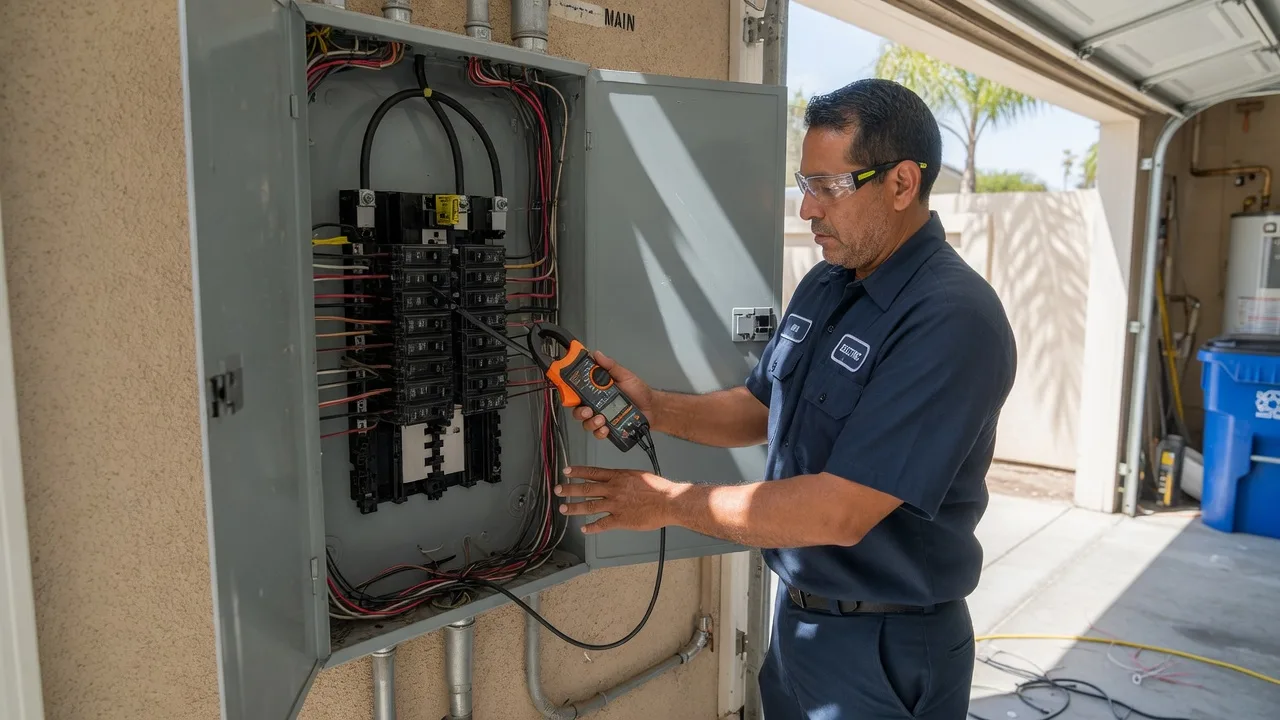
AFCI nuisance trips that mention a shared neutral sit on arc-fault breaker tripping. This page is the circuit type itself: what it is, why two rooms die together, and what not to DIY.
How you notice it
Two breakers in the panel sit next to each other and both have to be off to make a receptacle dead. Unplugging one kitchen counter still leaves voltage in the box because the other hot is live. A single-pole AFCI on one of those hots trips as soon as load hits the shared neutral. An inspector writes “handle tie” or “MWBC” on a correction notice.
Older Lemon Grove, La Mesa, and El Cajon stock (high pre-1978 shares) is where these runs show up in kitchens and bedrooms. Newer tracts use more home-runs. Age is a clue. It is not a diagnosis. The electrician meters the pairing.
The two hots have to land on opposite phases so the neutral carries the difference, not the sum. A tandem stuffed onto the same phase turns the shared neutral into an overloaded conductor. That is why “just add a tandem” is the wrong repair. See tandem breakers.
Do not open the panel to “see if they share.” Do not lift a neutral in a live MWBC. The remaining hot can put the full load on a conductor you thought was dead.
What the electrician actually changes
Handle-tied or two-pole breakers so both hots de-energize together. A two-pole AFCI when AFCI is required on that occupancy and the MWBC stays. Splitting the circuit into two true home-runs when the remodel has the walls open. Replacing a cheater tandem that put both hots on one phase.
This page does not cite a code section number for handle ties. The electrician applies the 2025 California Electrical Code (in effect January 1, 2026) and the inspector on the permit. Local departments can add rules.
Permits apply when the circuit is altered. City of San Diego Development Services, County PDS for unincorporated parcels, and each city’s department set the track. If a new 15- to 45-amp circuit is added in the City, the published Simple permit for the first five is $176.57.
This page does not publish an MWBC repair price.
Check the contractor on the CSLB license lookup.
Frequently asked questions
Why do two breakers trip together?
They may be an MWBC with a handle tie, or two independent circuits that share a fault. Have it traced. Do not remove the tie so “only one trips.”
Can I put AFCI on one half of a shared neutral?
A standard single-pole AFCI on one hot of an MWBC sees imbalance on the shared neutral and trips. That is a mismatch, not proof the wiring is on fire. The electrician picks a two-pole device or splits the run.
Is a shared neutral illegal now?
No as a blanket. It has to be identified and protected as a pair. An unlabeled MWBC in a kitchen remodel is a correction waiting to happen.
When to call us
Call when an inspector wrote MWBC, when two rooms die together, or when an AFCI will not hold on a kitchen split. Call (858) 988-5580. Hours are Monday through Saturday, 7am to 7pm. After hours, leave a message on the contact page.