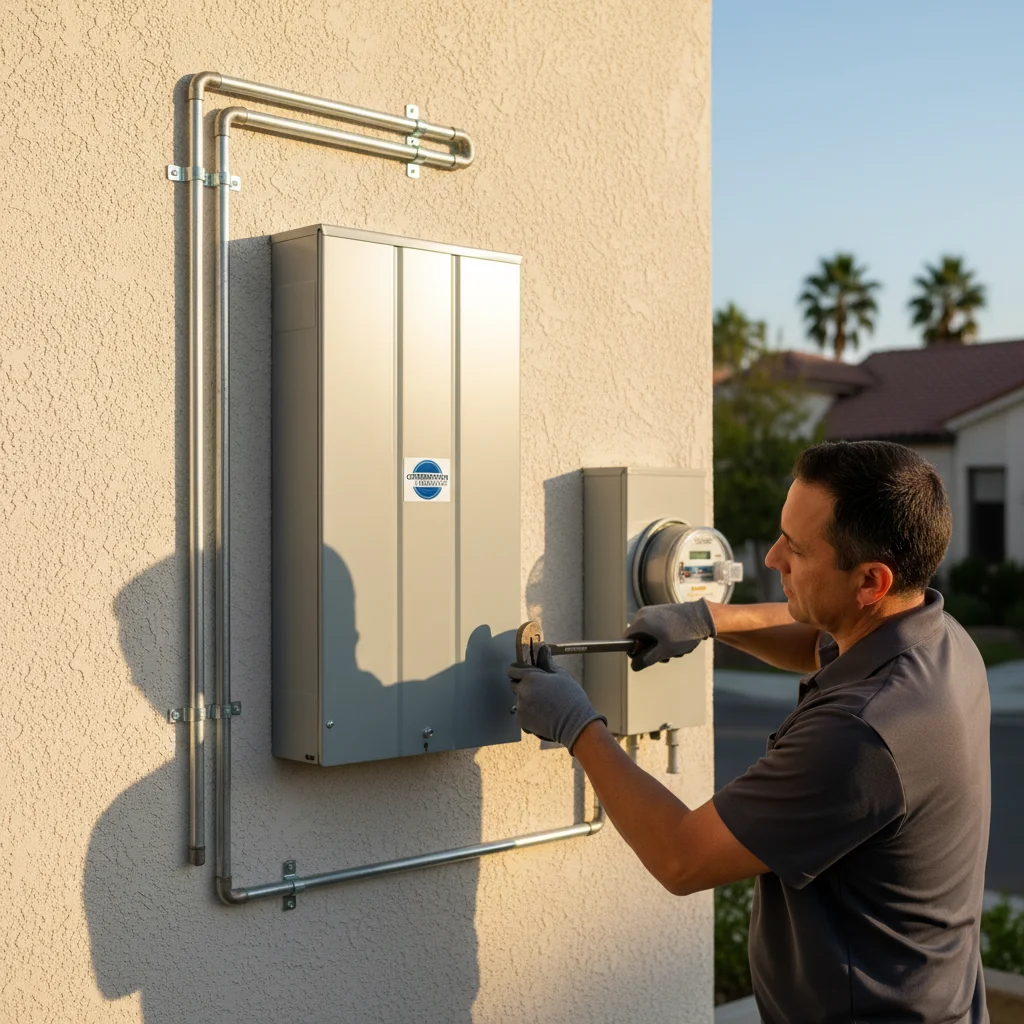
The clearest current local planning range for smart electrical panel installation San Diego projects is $3,500 to $6,500 when Span or Lumin is added to coordinated EV, solar, or service work. That range comes from current Carlsbad and La Costa project guidance on this site. It is a parked neighborhood example, not a county quote. Span replaces the main panel. Lumin’s current architecture must be confirmed on the manufacturer page. Require the existing-panel nameplate, solar/EV scope, and a written split of smart-panel vs related upgrades.
Those two designs solve different problems. Your existing panel, solar equipment, battery plans, and EV load should drive the choice. A product-specific quote should separate the smart-panel scope from every related upgrade.
Span vs. Lumin in plain terms
Span is a full main-panel replacement. Its circuit monitoring and app controls live in the service equipment itself. That makes Span the larger project. It can make sense when the existing main panel is already part of the planned work.
Lumin takes another path. It adds a subpanel beside the existing main panel. Selected circuits move through that equipment for monitoring and control. The original main panel stays in place.
That distinction matters more than the logo. A homeowner keeping a suitable main panel may not need Span’s full replacement scope. A homeowner already planning panel work may prefer one integrated system instead of adding another enclosure.
| Comparison point | Span | Lumin |
|---|---|---|
| Basic design | Replaces the main electrical panel | Adds a controlled subpanel beside the main panel |
| Existing main panel | Removed as part of the project | Stays in place |
| Circuit approach | Control is built into the main equipment | Selected circuits move through the added equipment |
| Project scope | Higher scope because the main panel changes | Lower scope when the existing main panel can stay |
| Local price basis | Grouped with Lumin in the $3,500 to $6,500 coordinated-project range | Grouped with Span in the same coordinated-project range |
| Stronger fit | A planned main-panel replacement and broad circuit control | Keeping the current main panel and controlling selected loads |
The current local range groups both products together. It shouldn’t be treated as a standalone Span price or Lumin price. Ask for a product-specific breakdown before comparing bids.
Smart electrical panel installation San Diego costs by scope
The $3,500 to $6,500 figure is the cleanest local smart-panel planning range we have right now. It comes from coordinated EV and solar guidance for Carlsbad and La Costa. The smart panel is an added project component there, not the entire project.
Other local examples show why total bids spread wider. In San Elijo Hills, a coordinated project with EV charging, solar work, and a smart-panel option is listed at $5,200 to $9,500. In Mount Helix, a service upgrade with EV, solar, and a smart-panel option runs $7,500 to $14,000. Those totals include work beyond the smart panel.
Rancho Peñasquitos adds another useful comparison. Local guidance places subpanel work with an EV circuit and charger at $1,800 to $3,200. A broader service-expansion scope runs $5,500 to $8,500. A smart-panel option can sit inside that planning decision, but those figures aren’t product-only prices.
| Local planning example | Published range | What the range covers |
|---|---|---|
| Carlsbad and La Costa | $3,500 to $6,500 added | Span or Lumin added to coordinated EV and solar work |
| San Elijo Hills | $5,200 to $9,500 total | Coordinated EV, solar, and possible smart-panel scope |
| Rancho Peñasquitos | $1,800 to $3,200, or $5,500 to $8,500 | Subpanel plus EV scope, or broader service expansion |
| Mount Helix | $7,500 to $14,000 total | Service upgrade, EV, solar, and smart-panel option |
Don’t average these figures into one countywide promise. They describe different bundles. Your quote should identify the product, retained equipment, moved circuits, and related EV or solar work.
Why circuit data matters under SDG&E time-of-use rates
San Diego time-of-use windows give circuit-level data a practical use. Confirm the current SDG&E EV-TOU-5 or CCA delivery and generation charges on the utility tariff pages. This article does not publish a cents-per-kWh table. A smart panel can show when monitored circuits draw power so you can check that window against your current tariff.
Solar and storage still need their own planning. If they’re part of the project, read the San Diego solar cost guide and the home battery backup guide. Those guides cover the adjacent equipment and NEM 3.0 questions.
When Span, Lumin, or neither makes sense
Choose Span when replacing the main panel is already under consideration. It puts monitoring and control into the new main equipment. Start with the 200-amp panel guide if panel capacity is still unclear.
Choose Lumin when the existing main panel can remain and selected circuits need control. This can narrow the project around an EV charger, battery-backed loads, or other chosen circuits. The electrician should confirm which circuits belong in the Lumin subpanel.
Choose neither when the problem is much smaller. If one EV charger is the only new load, a bolt-on device may address that narrower need. The load management device cost guide explains DCC-10 and NeoCharge options without treating them like smart panels.
A smart panel also isn’t a battery or generator. It doesn’t create backup power. For a Mount Helix or eastern San Marcos household planning around outages or PSPS events, circuit control becomes useful only when a compatible backup source also supplies the home.
What a useful local quote should cover
The first item is the existing panel. The quote should say whether it stays, gets replaced, or feeds a new controlled subpanel. That single answer usually separates Span from Lumin.
The next item is the circuit plan. Ask which loads will be monitored and controlled. Include the EV charger, solar equipment, battery system, and any loads you may add later.
If an EV charger is involved, ask how the electrician evaluated the existing load. NEC 220.87 is a standard practice reference for that calculation. It helps assess whether an EV charger can be added to the existing panel.
The quote should also separate the smart-panel work from related service, EV, solar, or battery work. That prevents a bundled total from looking like a product-only price.
Finally, confirm the local approval path. In Carlsbad and La Costa, visible exterior equipment may raise an HOA architectural-review question. Span can change the main equipment, while Lumin may fit beside an existing panel inside a garage. HOA rules vary, so ask the association before equipment is ordered. Ask the electrician which local building department will review the exact scope and who will handle that step.
Frequently asked questions
How much does a smart panel cost in San Diego?
Use $3,500 to $6,500 as a local planning range when Span or Lumin is added to a coordinated EV, solar, or service project. Get a product-specific quote because current local data groups both systems together. Larger project totals may include service expansion, EV wiring, or solar work.
What’s the difference between Span and Lumin?
Span replaces the home’s main electrical panel. Lumin adds a controlled subpanel beside the existing main panel. Span suits a broader panel-replacement project, while Lumin can suit selected circuit control without changing the main panel.
Does a smart panel replace my electrical panel?
Span does replace the main panel. Lumin doesn’t. It works as an added subpanel for selected circuits, so the existing main equipment remains.
Is a smart electrical panel worth it?
It can be worth comparing when a home combines EV charging, solar, batteries, or several large loads. Circuit-level data is especially useful under SDG&E time-of-use pricing. A bolt-on load-management device may be the better value when one EV charger is the only issue.
Do I need a permit or HOA approval?
That depends on the equipment, mounting location, and local review path. Ask the electrician to identify the reviewing building department in the quote. If exterior equipment will change, check your HOA’s architectural rules before ordering it.
Do Span and Lumin work with solar and battery systems?
They can be planned alongside solar and battery equipment, but the exact configuration matters. Give the electrician the model details for every connected system. Ask for a circuit plan showing what will be monitored, controlled, and backed up.
Compare the right scope before buying
A smart-panel quote should solve the home’s actual load plan, not just add another connected device. The electricians in our network can compare Span, Lumin, a standard panel upgrade, and a smaller load-management device.
Use contact to get connected with a local pro. They’ll review the existing panel, planned circuits, and related EV, solar, or battery work before quoting the project.