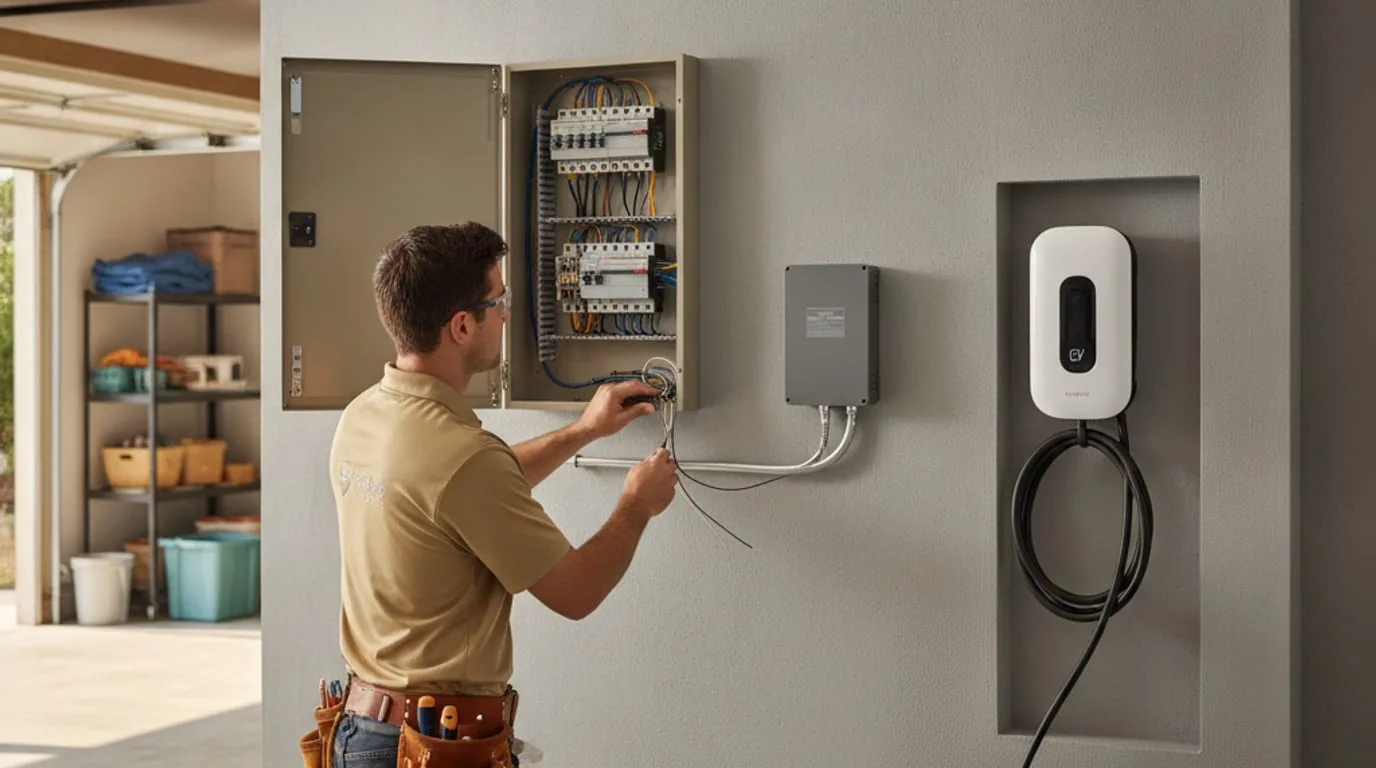
A load management device in San Diego costs $600 to $1,200 installed on this page for a listed bolt-on EVEMS or circuit-sharing product (DCC-10 or NeoCharge style). That is not a service load calculation, not a smart main panel, and not utility permission. Separate those jobs. A 200A service upgrade on this page runs $2,500 to $4,500 for a different problem.
TL;DR
- Bolt-on EVEMS / circuit sharing: $600 to $1,200 installed. Confirm the listing for the charger and panel. Treat that as a published range on this page.
- A load calculation (NEC 220 / CEC) decides whether the service can take a new load. A throttle device does not replace that math unless the listing and the inspector allow it.
- Span-style smart panels replace or rebuild service equipment. That is a $3,500 to $4,500+ panel job on related pages, not a bolt-on.
- Utility involvement and permits are address- and scope-specific. Bright Pro Electric does not pull permits.
- Upgrade the panel instead if the wiring is old (knob-and-tube, aluminum) or you’re electrifying heavily in the next few years.
What is a load management device, and why do San Diego homes need one
A load management device is a small unit wired into your main panel that watches total household electrical draw and manages how much power your EV charger gets in real time. Most San Diego homes still run 100A electrical service, built decades before anyone planned to charge a car in the garage. Add a 40A or 50A Level 2 charger to that panel and the math on paper says you’re over capacity, even though your dryer, oven, and EV charger rarely max out all at once in real life. A load management device solves that on the software side instead of the hardware side: it lets the charger draw full power when there’s room, and throttles it back when the rest of the house is working hard.
That distinction matters because the alternative, a full panel upgrade, is a bigger job and a bigger bill. A load management device is the cheaper way to get an EV charger installed on an older panel without touching the service size at all.
How much does a load management device cost in San Diego
Installed pricing depends heavily on which device you’re getting, since the category covers everything from a $300 sensor to a full panel replacement.
| Device | What it is | Device cost | Typical installed cost |
|---|---|---|---|
| DCC-10 (RVE) | Current-sensing cutout, the budget staple, simple and well-proven | $300 to $400 | $600 to $900 |
| NeoCharge Smart Splitter | Plug-and-play, shares an existing 240V outlet (dryer or EV outlet) | $400 to $500 | $700 to $1,200 |
| Span Smart Panel | Full main panel replacement with whole-home monitoring and per-circuit control | Panel-level pricing | $3,500 to $4,500+ |
The DCC-10 and NeoCharge are what most people are asking about when they search “load management device cost.” Both are standalone add-ons that sit alongside your existing panel. Span is a different category entirely: it isn’t bolted onto your panel, it replaces it, so budget it like a panel job, not a device purchase.
What drives the cost
A few things move the price around inside that $600 to $1,200 range.
Panel access and open breaker space. If your panel has room for the device and an open double-pole breaker slot, the job is straightforward, usually 2 to 4 hours of labor at $90 to $140 per hour for a licensed C-10 electrician. A cramped or maxed-out panel takes longer.
Device tier. A DCC-10 install runs cheaper than a NeoCharge in most cases, mainly because of how each one wires into the existing circuit.
Permit. A load management install is a permitted electrical job in most San Diego jurisdictions, and permit fees add to the total. Confirm the fee with your electrician or the local jurisdiction before the job starts.
Condition and age of the existing panel. An older panel that needs minor prep work before the device can go in adds time. A panel in good working condition keeps the job on the low end of the range.
Subpanel or circuit work. If your EV outlet is on a subpanel or needs new wiring to reach the main panel, that’s additional labor outside the base device install.
Load management device vs. a panel upgrade: the cost math
Here’s the comparison most San Diego homeowners are actually trying to make.
| Option | Typical cost | What you get |
|---|---|---|
| Load management device | $600 to $1,200 | Full-speed EV charging most of the time, throttled during peak household demand |
| 200A service upgrade | $2,500 to $4,500 | More total capacity, no throttling, room for future electrification |
The device is the right call when your panel is otherwise in good shape and you just need to fit an EV charger onto it without a major project. The panel upgrade is the smarter long-term spend when the home has 1960s-era wiring like knob-and-tube or aluminum, or you’re planning to add a heat pump (the electrical side of a heat pump water heater is its own decision), induction range, home battery, and EV charging within the next 3 to 5 years. Stacking that much electrification onto a device-managed 100A panel usually means you’re back here again in a couple of years anyway. For a closer look at how the two options stack up beyond just price, see our panel upgrade vs. load management comparison, and our panel upgrade cost guide for what the bigger job runs.
Do you need a permit, and does SDG&E get involved
A load management device install usually requires a permit in San Diego city and county jurisdictions, since it’s a change to your electrical panel. Permit fees generally run $100 to $250, but confirm the exact number with your electrician or the local building department, since it varies by jurisdiction.
Confirm with SDG&E and the inspector whether that device and load need utility notification. Some bolt-on listings stay on your side of the meter. A full panel upgrade usually involves a meter pull. The electrician who takes the job says which path you have. Bright Pro Electric does not file that paperwork.
Frequently asked questions
How much does a load management device cost installed in San Diego?
A load management device costs $600 to $1,200 installed in San Diego, covering the hardware (typically $300 to $500) and 2 to 4 hours of licensed electrician labor at $90 to $140 per hour. That range applies to bolt-on devices like the DCC-10 or NeoCharge. A Span Smart Panel is a different animal since it replaces your entire main panel, running $3,500 to $4,500 or more.
Will a load management device let me charge my EV at full speed?
Yes, most of the time. The device only throttles your charger when combined household demand approaches your panel’s capacity, which usually means dinner time with the AC and stove running. Overnight, when household draw is typically just 1 to 3 kW, your charger runs at full amperage. Most EV owners never notice the throttling because it happens during the hours they’re least likely to be charging anyway.
Do I need a permit for a load management device in San Diego?
In most San Diego jurisdictions, yes. Installing a load management device is a change to your electrical panel, which typically requires a permit and inspection. Fees usually run $100 to $250 depending on the city or county, so confirm the exact cost with your electrician before the job starts.
Is a load management device or a panel upgrade the better deal?
For most homeowners adding a single EV charger to an otherwise healthy panel, the load management device is the better deal at $600 to $1,200 versus $2,500 to $4,500 for a full service upgrade. The upgrade is worth the extra cost if your wiring is old (knob-and-tube, aluminum) or you’re planning to electrify multiple big appliances in the next few years.
Can I remove a load management device later if I upgrade my panel?
A DCC-10 or NeoCharge is standalone hardware, so yes, it comes out cleanly if you upgrade to a 200A panel down the road. A Span Smart Panel is different since it replaced your main panel in the first place, so removing it means installing another panel, not just pulling a device.
Licensed electricians in the matching network install bolt-on load management devices and full panel upgrades. Ask which one fits the panel and the electrification plan. Bright Pro Electric matches you with that electrician. It does not install, credit a free assessment, or staff emergency dispatch.
Use the contact page. Hours are Monday through Saturday, 7am to 7pm. After hours, leave a message. For more on the EV side of this decision, see EV charger and panel upgrade bottleneck, EV charger installation cost, and the panel upgrade and EV charger installation matching pages.