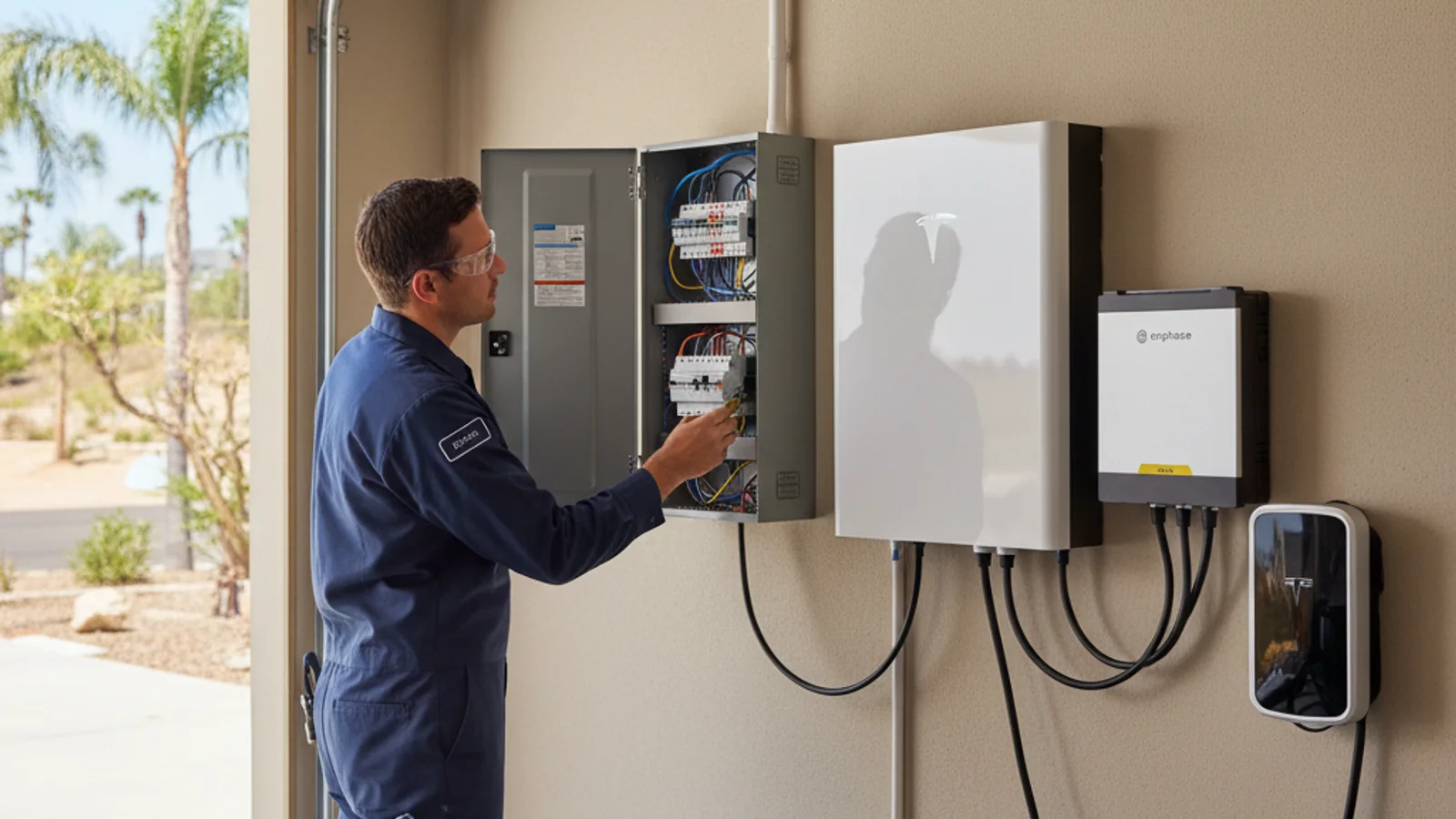
Bright Pro Electric matches San Diego County homeowners with licensed electricians for battery and solar interconnection work. It does not install batteries, pull permits, or hold a C-10. Whether a battery pays off depends on that customer’s tariff, load shape, and solar profile, not a county-wide NEM 3.0 slogan. PSPS exposure is an address and circuit question on SDG&E’s outage tools, not a fire-corridor class. This page does not rank battery jobs as a market-frequency claim.
What whole-home battery backup actually does
A home battery backup system stores electricity, either from your solar panels or from the grid, and releases it when you need it most. That could mean powering your house through an overnight PSPS shutoff, covering the peak-pricing window from 4 to 9 p.m. when SDG&E’s time-of-use rates are highest, or providing an instant transition during an unplanned outage.
The key distinction from a portable generator is the experience during an outage. A battery system detects a grid interruption and switches to stored power in a fraction of a second, fast enough that most appliances don’t notice. There’s no startup sequence, no fuel to manage, and no engine noise. Your refrigerator keeps humming, the router stays on, and your family doesn’t scramble in the dark.
The tradeoff is finite capacity. A single battery unit holds a set amount of energy, measured in kilowatt-hours. Once it’s depleted, it needs to recharge, which means you either need enough solar generation to refill it during daylight hours or you wait for the grid to come back. For multi-day outages in mountain communities like Alpine or Julian, a standby generator often pairs better with batteries than replaces them.
Why NEM 3.0 changed the economics in San Diego
Under the old NEM 2.0 rules, solar owners could export excess electricity to the grid during the day and draw it back in the evening at close to the same rate. The grid acted like a free battery. That arrangement ended for new customers when NEM 3.0 (also called the net billing tariff) took effect.
Under NEM 3.0, also called the net billing tariff, surplus solar you export is credited at an export rate that is often far below the retail rate you pay to import power in the evening. That is the whole change: daytime export is no longer a near 1:1 bill credit the way NEM 2.0 treated it. The gap depends on your tariff, season, and when you actually use power. Storing on-site can be worth modeling against those three inputs because a kilowatt-hour kept for the 4 to 9 p.m. peak can offset a high import rate instead of earning a low export credit. It is not automatic. If you’re starting from zero with panels plus a battery, our solar panel installation cost guide for San Diego walks through the electrical-interconnection questions most quotes skip.
For existing solar owners who enrolled before the cutoff, NEM 2.0 status is locked in for a set period. For anyone adding solar now, run the tariff and load numbers before treating a battery as required.
SDG&E’s time-of-use rates compound this. Peak pricing during the late afternoon and evening hours means every kilowatt-hour you pull from a battery during that window instead of the grid is saving you the most expensive electricity on your bill.
Tesla Powerwall 3 vs. Enphase IQ Battery vs. FranklinWH
These three systems show up often on San Diego residential battery quotes. Each has real strengths. Bright Pro Electric does not install any of them.
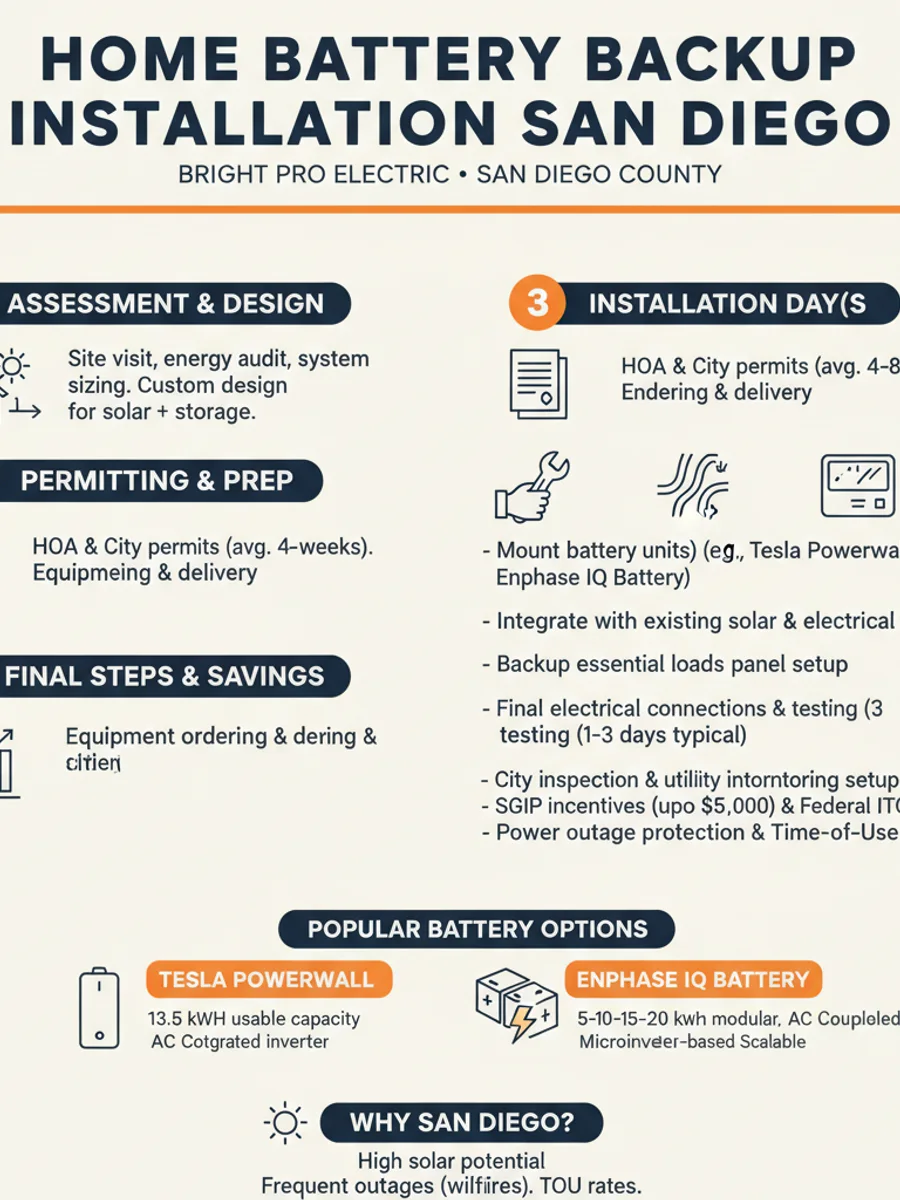
Tesla Powerwall 3 is the most integrated whole-home backup option. The Powerwall 3 combines the battery and solar inverter in a single unit, which simplifies installation if you’re pairing it with a new solar system. It stores 13.5 kWh and can deliver up to 11.5 kW of continuous power, enough to run most of a typical San Diego home including AC. The gateway hardware handles grid-independence mode, automatic backup, and time-of-use optimization. Installed cost for a single Powerwall 3 with gateway hardware typically runs $10,000 to $15,000 depending on site complexity. Multiple units stack for more capacity.
Enphase IQ Battery 5P is the modular choice. Enphase builds a microinverter-based system, so each battery unit (5 kWh per module) connects to an IQ System Controller that also manages your solar microinverters. If you already have an Enphase solar system, adding IQ batteries integrates natively. The 5P model offers meaningful power output relative to its size. Single-unit installed cost typically runs $8,000 to $12,000. Stacking three or four units gives you 15 to 20 kWh, which is a practical range for all-day backup with solar recharging.
FranklinWH aPower is worth knowing about for larger homes and higher-power demands. The aPower unit stores 13.6 kWh and is designed to stack. FranklinWH positions itself as a whole-home backup solution with higher surge capacity than some competitors, which matters if you want to run well pumps, large AC compressors, or sub-zero refrigerators reliably during an outage. Installed cost for a single unit typically runs $14,000 to $19,000. It’s a stronger option for households in rural San Diego County where well pumps and large loads are common.
No single system is right for every home. The decision depends on whether you’re adding solar simultaneously, the size of your home’s critical loads, your panel capacity, and budget.
Battery backup vs. standby generator: honest tradeoffs
Our whole-house generator guide covers generators in detail, and the PSPS shutoff comparison lays out all three backup options side by side. Here’s the condensed version for battery-specific decisions.
Where batteries win: Silent operation, no fuel storage, instant transfer (under 20 milliseconds vs. 10-30 seconds for a generator ATS), no permits for the generator itself, eligible for the federal 30% tax credit and SGIP rebates. They also double as daily energy management tools under NEM 3.0, which a generator never does.
Where generators win: Runtime. A natural gas standby generator runs indefinitely as long as gas flows. A PSPS event in Alpine that stretches three days is within a generator’s range without any special preparation. A battery system covering a whole home for three days requires either very large battery capacity or strong solar recharging during the outage. For households in high-fire-risk zones who depend on continuous power, a generator may be the more reliable anchor.
Why many San Diego homeowners are choosing both: A battery handles the daily economics (storing solar, riding through peak pricing, bridging short outages silently), while a generator provides the insurance policy for extended outages. The systems can coexist. The electrician’s job is to wire them so they work together without backfeed conflicts.
SGIP rebates: what they are and who qualifies
California’s Self-Generation Incentive Program (SGIP) provides upfront rebates for battery storage systems. The rebate amount varies by tier and changes as program funds are allocated.
The most valuable tier is the Equity Resiliency incentive, designed for customers in high fire-threat districts or who rely on power for medical needs. This tier pays a substantially higher per-kWh rebate than the standard tier and is specifically relevant to many San Diego County homes in SDG&E’s PSPS footprint. If you’re in a Tier 2 or Tier 3 fire hazard zone and meet the program criteria, the Equity Resiliency rebate can cover a meaningful portion of your battery system cost.
The standard SGIP tier is open to a broader set of customers, with rebate amounts that depend on how much funding remains in the current step. SGIP is administered by the utilities including SDG&E. Your installer coordinates the SGIP application, but you apply as the system owner.
The federal Investment Tax Credit (ITC) also applies to standalone battery systems (not just solar-plus-storage), as long as the battery charges primarily from solar. This is a 30% credit on the qualified system cost, taken on your federal return. The combination of ITC plus SGIP can significantly reduce net installed cost, especially on larger systems.
What the electrical install actually involves
Battery backup installation is not plug-and-play. The electrical work is substantial, and it’s what determines whether the system performs reliably during an actual outage.
Backup gateway or automatic transfer switch. Every battery system needs a gateway that monitors grid status and switches the home to battery power during an outage. Tesla’s Backup Gateway and Enphase’s IQ System Controller both serve this function. The gateway installs between your utility meter and your main panel.
Main panel interconnection. The battery system connects to your main electrical panel. If your panel is older, undersized, or already at capacity, this is where a panel upgrade may be necessary before or alongside the battery installation. A licensed electrician assesses panel condition on the site visit. Bright Pro Electric does not assess the panel.
Critical-loads subpanel (partial-home backup). If you want a cost-effective installation that protects your most important circuits without backing up the entire home, the electrician installs a critical-loads subpanel. This is a secondary panel fed by the battery, containing the circuits you’ve chosen: refrigerator, lighting, router, medical equipment, a few outlets. The rest of the home draws from the grid normally. Critical-load configurations cost less upfront and require smaller battery capacity for the same runtime.
Whole-home backup configuration. For full-home backup, the gateway protects every circuit on your main panel. This requires higher battery capacity and sometimes a panel upgrade to handle the interconnection properly. Powerwall 3’s integrated inverter simplifies this configuration compared to systems that require a separate inverter.
Pairing with EV charging. Some homeowners adding a battery also want to add or upgrade an EV charger. The combination of solar plus battery plus EV charger can be optimized so the car charges from solar or stored battery power rather than peak-rate grid power. The load management wiring for this is more complex. Our EV charging guide for San Diego covers the charger side in detail.
Permits and SDG&E interconnection
Every battery backup installation in San Diego County requires a building permit. The permit covers the electrical work: gateway installation, panel modifications, and the battery mounting and wiring. A licensed electrician pulls the permit when that is in their written scope, schedules the inspection, and stays on site for sign-off. Bright Pro Electric does not pull permits or manage the packet.
SDG&E interconnection and permission to operate (PTO) is a separate step. If you’re installing a battery-only system (no solar), interconnection is simpler. If you’re adding solar simultaneously or modifying an existing solar interconnection, SDG&E reviews the combined system before issuing PTO. PTO typically takes two to eight weeks after the work passes city inspection, depending on current queue times at SDG&E. The matched electrician files those applications when they are in the written scope. Bright Pro Electric does not manage the paperwork.
Don’t let a contractor start your system before PTO is granted on a grid-tied installation. Operating a grid-tied inverter before SDG&E approves it puts you out of compliance with your interconnection agreement.
What does home battery backup installation cost in San Diego?
Installed costs vary by system size, whether a panel upgrade is required, and the configuration (whole-home vs. critical loads).
Single battery unit, critical-loads only: A single Powerwall 3 on this page is $10,000 to $15,000 installed, before rebates. A single Enphase IQ 5P is $8,000 to $12,000. That setup protects a refrigerator, key lighting, a router, and medical equipment through a typical overnight outage. Bright Pro does not size the bank.
Two battery units, partial-home backup: Two Powerwall 3 units or two to three Enphase IQ modules covering larger critical loads runs $18,000 to $28,000 installed before rebates. This is enough to keep most of a modest home running through a full day if solar is recharging during daylight hours.
Whole-home backup with full capacity: Three or more units sized for full-home coverage, including AC, runs $25,000 to $40,000 installed before rebates. FranklinWH stacked systems at this scale are common for larger homes in coastal and inland communities.
Panel upgrade if required: Add $2,500 to $6,000 if your panel needs upgrading to support the battery interconnection. See our panel upgrade cost guide for San Diego for a breakdown of what drives that cost.
After a 30% federal ITC and SGIP rebates where applicable, the net cost on a mid-size system can come down meaningfully. The exact numbers depend on your system cost and which SGIP tier you qualify for. The matched electrician can walk through rebate math on the site visit. Bright Pro Electric does not file SGIP.
Frequently asked questions
Does battery backup work without solar?
Yes. A battery system can charge from the grid during off-peak hours and discharge during peak pricing periods or outages. This is called grid-only mode or time-of-use optimization. It works, but the economics are less favorable than pairing with solar. The federal ITC also requires solar pairing for the battery to qualify.
How long will a Powerwall 3 power my San Diego home?
One Powerwall 3 stores 13.5 kWh. A typical San Diego home uses between 20 and 40 kWh per day. In whole-home backup mode without solar recharging, one unit runs the home for roughly 8 to 16 hours depending on AC usage and the time of year. With solar recharging during daylight, you can extend that indefinitely for moderate loads on a sunny San Diego day.
Will battery backup power my air conditioning during an outage?
It depends on the battery’s continuous power output and your AC system’s size. A Powerwall 3 at 11.5 kW continuous is enough to run a standard 3-ton AC system alongside other home loads. A 4 or 5-ton system at startup surge may require two units or a battery with higher peak output. The electrician verifies AC compatibility during the site visit.
Do I need a panel upgrade for battery backup?
Not always, but often. Older 100-amp panels and panels that are already full generally need upgrading before a battery system can interconnect properly. Modern 200-amp panels with available breaker space often accommodate battery installation without an upgrade. The electrician assesses the panel on the first visit. Bright Pro Electric does not.
Can battery backup and a generator coexist?
Yes, with proper wiring. The systems need to be configured so they don’t back-feed each other during an outage. The electrician designs that interconnection so the generator and battery operate safely together. That pairing is common in PSPS-prone communities where homeowners want both redundancy and silent daily operation.
How to get matched
Home battery backup in San Diego is a complex electrical project, and the design has to match the listing, the panel, and the tariff. The wrong battery size, an undersized panel, or a poorly wired gateway can leave a system that fails during an outage.
Bright Pro Electric matches San Diego County homeowners with licensed electricians for a battery site visit. It does not install batteries, pull permits, assess the panel, or promise a same-day estimate. Hours are Monday through Saturday, 7am to 7pm. After hours, leave a message. Use the contact page to get matched.