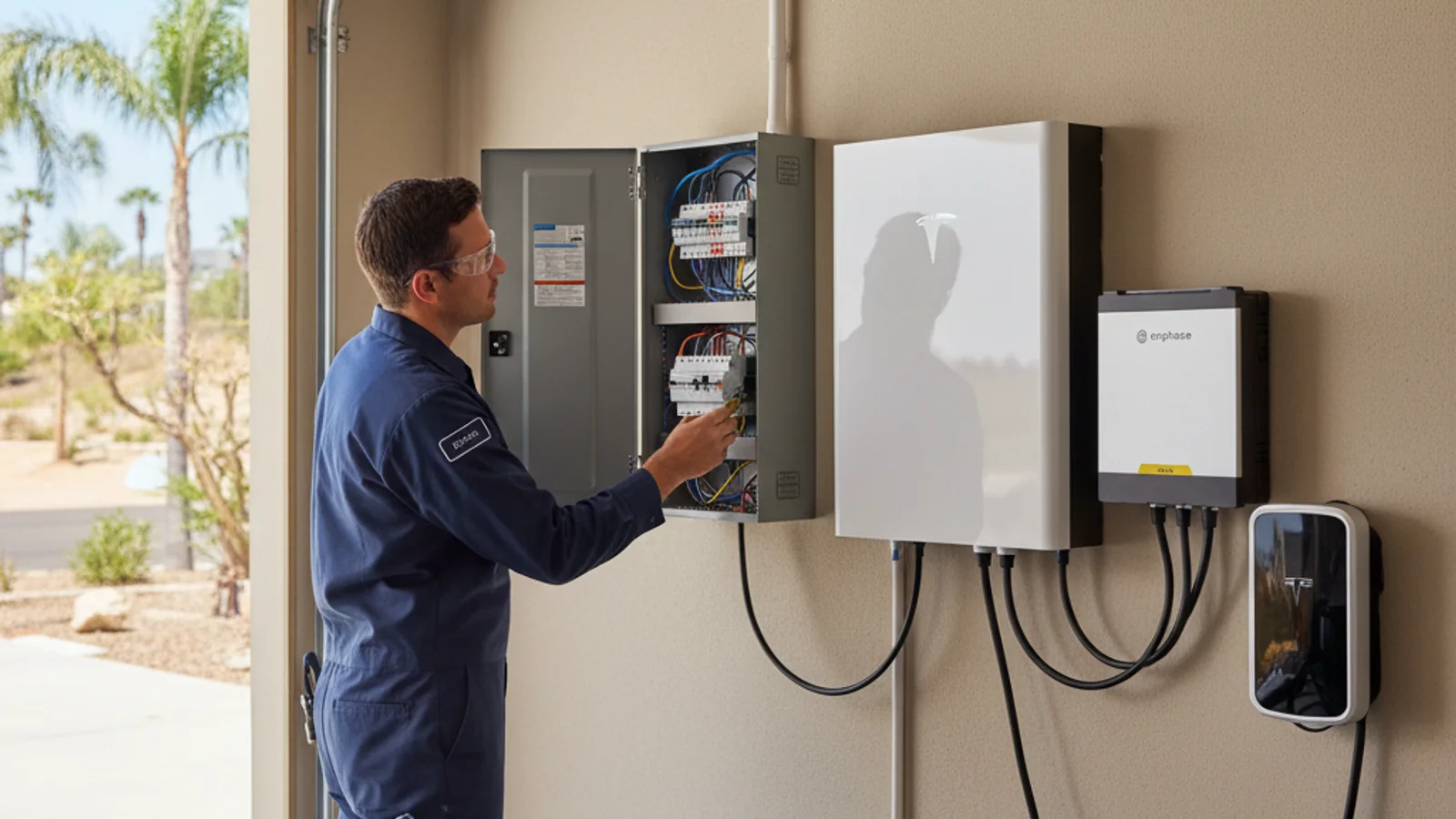
A residential solar installation in San Diego in 2026 is priced from the array size you actually buy, the inverter, racking, interconnection, and whether the panel can take the backfeed. Published $2.50–$3.50 per watt and 6–8 kW / $15,000–$28,000 bands on this page are parked examples, not a typical-home size. After a 30% federal credit the parked net is $10,500–$19,600. Confirm the current IRS and SDG&E interconnection pages. Those ranges do not include every electrical upgrade a quote might skip.
TL;DR
- Keep the electrical-interconnection and panel-capacity questions. Size from customer kWh, tariff, and the utility interconnection package, not a 6–8 kW default.
- NEM 3.0 / net billing changed export credits. A battery is an input to model, not mandatory.
- Battery systems add $10,000–$18,000 on this page. Park that.
- Homes with 100-amp services may need panel or load-management work before interconnection. That is a calculation. A parked main-panel upgrade band on this page is $3,000–$5,000.
- A C-10 licensed electrician handles the panel work and interconnection wiring. The solar company handles the panels themselves. Bright Pro Electric matches. It does not sell arrays or install.
What a solar system costs in San Diego by size
System size drives cost more than any other single variable. San Diego homes vary widely: a 1,200 sq ft condo in Clairemont draws far less power than a 3,500 sq ft home in Rancho Bernardo with a pool pump, EV, and central AC.
Here are typical 2026 installed ranges for San Diego County before the 30% federal Investment Tax Credit (ITC):
| System size | Typical installed cost | After 30% ITC |
|---|---|---|
| 4 kW | $10,000–$14,000 | $7,000–$9,800 |
| 6 kW | $15,000–$21,000 | $10,500–$14,700 |
| 8 kW | $20,000–$28,000 | $14,000–$19,600 |
| 10 kW | $25,000–$35,000 | $17,500–$24,500 |
| + Battery (1 unit) | $10,000–$18,000 | $7,000–$12,600 |
The ITC is a dollar-for-dollar federal income tax credit, not a deduction, not a rebate check. You claim it on your tax return for the year the system goes live. It applies to panels, inverter, labor, and battery storage if installed in the same project. Confirm your tax situation with an accountant; the credit only helps if you have a tax liability to offset.
San Diego does not currently have a state rebate stacked on top of the federal credit for most residential solar installs (SGIP applies specifically to battery storage). The California Solar Initiative (CSI) ran out of funding years ago. The main financial lever on the solar side remains the 30% ITC.
What NEM 3.0 changed for new San Diego installs
If you talked to a solar salesperson before April 2023, their math no longer applies.
California’s old net metering program (NEM 2.0) let solar homeowners export excess power to SDG&E and receive a credit at close to the retail rate, roughly $0.30–$0.40/kWh depending on time of use. That made solar economics straightforward: produce during the day, bank the credits, draw them back at night.
NEM 3.0, now formally called the Net Billing Tariff (NBT), cut those export rates by roughly 75%. SDG&E now pays what’s called an “Avoided Cost Calculator” rate for exported solar, typically $0.05–$0.08/kWh during midday hours, the peak production window. That’s a fraction of what you’d pay to buy the same power back.
What this means practically: solar power you export is worth far less than power you self-consume. A system designed around exporting surplus no longer pencils out the way it once did. The only way to capture the value of your solar production is to use it directly or store it.
That’s why a battery belongs in the model for many new San Diego quotes, not as a mandate. A battery lets you shift midday generation to evening peak hours when SDG&E rates are highest ($0.55–$0.65/kWh in summer on some TOU plans). Self-consumption with storage is one way the numbers can work under NEM 3.0. Some homes still pencil without storage. Confirm against the current tariff and the utility interconnection package.
If a solar company is still pitching you on NEM 2.0 economics without discussing battery storage, that’s a problem.
The electrical work inside a solar quote that homeowners miss
The electrical interconnection is the part a C-10 electrician scopes. Bright Pro Electric matches homeowners with that electrician. It does not sell solar and it does not install the array. Solar companies install the panels, racking, and inverter. Every solar project still touches the home’s electrical system in ways a lot of quotes underexplain, or underprice.
Main panel upgrade
Older San Diego homes built before the mid-1980s often have 100-amp electrical service. Solar interconnection requires capacity in your main panel for the new circuits, and a 100-amp panel frequently doesn’t have room. It may also be undersized for the total load once solar and a battery system are added.
A main panel upgrade from 100 to 200 amps typically costs $3,000–$5,000 in San Diego, including permit, labor, new meter can if required, and SDG&E coordination. Some projects can use a “derate” approach, documenting that existing load plus solar doesn’t exceed panel capacity, instead of a full replacement. A licensed C-10 electrician evaluates which path applies to your home.
When solar quotes don’t line-item the panel upgrade separately, it either means your panel was assessed and doesn’t need one (good), or it means it was never checked (not good). Always ask.
For a full breakdown of what a panel upgrade involves and costs, see our electrical panel upgrade cost guide for 2026.
Interconnection wiring
The solar inverter connects to your main panel through a dedicated circuit breaker. That wiring run, from the inverter to the panel, often through conduit on an exterior wall or through the attic, is electrical work that requires a C-10 license and a permit. It’s not something the roofing crew handles.
The interconnection wiring cost is sometimes wrapped inside the solar company’s quote and sometimes broken out as a subcontracted line item. Ask who pulls the electrical permit and who performs the panel work. If the answer is vague, that’s worth clarifying before you sign.
Battery backup integration
Adding a battery system isn’t a plug-and-play addition. A home battery backup installation involves a backup gateway (or automatic transfer switch), a critical-loads subpanel in most configurations, and interconnection wiring between the battery, inverter, and your main panel.
That’s multiple permits, coordination between the solar company and the electrician, and a specific inspection sequence. When a solar company says they’ll “handle the battery too,” confirm whether they have a C-10 license for the electrical side or whether they subcontract it. Unlicensed battery wiring is a real safety issue, and a permit problem.
Solar plus EV charger coordination
Many San Diego homeowners are combining solar with a Level 2 EV charger. The load calculations need to account for both at the same time. A 50-amp EV charger circuit draws continuously during charging; solar production varies by time of day. Adding both to an existing 200-amp panel without a load analysis can create a capacity problem.
If you’re installing solar and an EV charger in the same project, coordinate the electrical scope with one licensed electrician who sees the full picture. Our EV charger installation cost guide walks through the panel capacity question in detail.
How to vet the electrical line items in a solar quote
Most homeowners compare solar quotes on price per watt and system size. Few check the electrical scope line by line. Here’s what to look for.
Panel assessment. A legitimate solar quote documents your current panel amperage and whether an upgrade is needed. If the quote doesn’t mention your panel at all, that’s an omission.
Who holds the electrical permit. The C-10 license holder pulls the electrical permit. Ask for their contractor license number and verify it at CSLB.ca.gov. A solar company using an unlicensed crew for panel work is a liability.
Battery wiring scope. If a battery is included, confirm the quote covers the backup gateway, critical-loads subpanel (if applicable), and all interconnection wiring, not just the battery hardware.
Permit fees. San Diego City and County require permits for solar installation, electrical interconnection, and battery storage separately in some cases. Permit fees should appear as line items. Bundled “all-in” pricing can hide whether permits were included.
Inspection sign-off. SDG&E requires Permission to Operate (PTO) before you can export power or use the battery for grid interaction. The installation needs to pass inspection first. Ask who coordinates PTO and what the typical timeline is (often 4–8 weeks after inspection in San Diego currently).
Frequently asked questions
How much does solar panel installation cost in San Diego in 2026?
A typical 6–8 kW residential solar system in San Diego runs $15,000–$28,000 installed before incentives. After the 30% federal Investment Tax Credit, the net cost is roughly $10,500–$19,600. Battery storage adds $10,000–$18,000 on top of the system cost. Under NEM 3.0, many new quotes include a battery so the export math is modeled. That is not a requirement that every home must add storage.
Do electricians install solar panels?
Solar panels are installed by licensed solar contractors (C-46 in California). What a C-10 licensed electrician handles is the electrical side of the project: main panel upgrade when needed, interconnection wiring from the inverter to your panel, battery backup system wiring, and any subpanel work. Most solar projects need both a solar installer and a licensed electrician. Some solar companies hold both licenses; others subcontract the electrical work.
What did NEM 3.0 change for San Diego solar owners?
NEM 3.0, which took effect in April 2023 for new solar customers in California, replaced the old net metering credit with the Net Billing Tariff. Export rates dropped roughly 75% from NEM 2.0 levels. Midday solar exports now earn $0.05–$0.08/kWh instead of near-retail rates. This shift makes battery storage an input to the model for new San Diego solar quotes: self-consumption often beats exporting. It is not a mandate.
Does my panel need to be upgraded for solar?
Not always, but often. Homes with 100-amp electrical service, common in San Diego homes built before the mid-1980s, typically need a panel upgrade to 200 amps before solar can interconnect safely. Homes with 200-amp service may still need the upgrade if the panel is full or if adding battery storage and an EV charger creates a capacity issue. A licensed electrician assesses this before any work begins. The upgrade typically runs $3,000–$5,000 in San Diego.
Is the 30% federal solar tax credit still available in 2026?
Yes. The federal Investment Tax Credit (ITC) for residential solar is 30% through 2032 under current law. It applies to the full installed cost of the system, including panels, inverter, labor, and battery storage if installed in the same project year. It’s a tax credit, not a rebate: it reduces your federal income tax liability dollar for dollar. Confirm your eligibility with a tax professional.
How do I coordinate solar and EV charger installation in San Diego?
The most efficient approach is to plan both at the same time with one licensed electrician overseeing the electrical scope. The load calculation needs to account for the EV charger draw alongside the solar system and battery. Installing them in the same project can also consolidate permit fees and inspection visits. See our SDG&E EV charger rebate guide for 2026 for rebate stacking options.
When to call us
Bright Pro Electric is a referral matcher, not a solar sales office and not the C-10 on the job. The electricians we connect you with handle panel work, interconnection wiring, and battery wiring that sits behind a solar project, when that scope is in the written proposal. If your solar quote includes a panel upgrade or battery system and you want a second look at the electrical line items, or if you are coordinating solar plus an EV charger and want one licensed electrician managing the electrical side, get in touch.
Bright Pro Electric matches homeowners across San Diego County, including Rancho Bernardo, Poway, Chula Vista, El Cajon, and coastal communities.