A Rivian Wall Charger install runs $800 to $2,000 in San Diego, and the number one thing that decides where you land in that range is whether your panel already has a clean 60-amp slot open.
TL;DR
- The Rivian Wall Charger delivers up to 48 amps (11.5 kW) and needs a dedicated 60-amp circuit with 6 AWG copper wire.
- Install runs $800-$2,000 when the panel has capacity. Add $2,500-$4,500 if it doesn’t and you need a panel upgrade first.
- R1T and R1S owners can also charge on any J1772 Level 2 unit using the adapter Rivian includes, so the Wall Charger isn’t the only path.
- Every install needs a city permit. San Diego typically issues EV charger permits as a same-day Simple permit.
- Older 100A panels in North County and the older west side of Chula Vista and La Mesa are the homes most likely to need extra work.
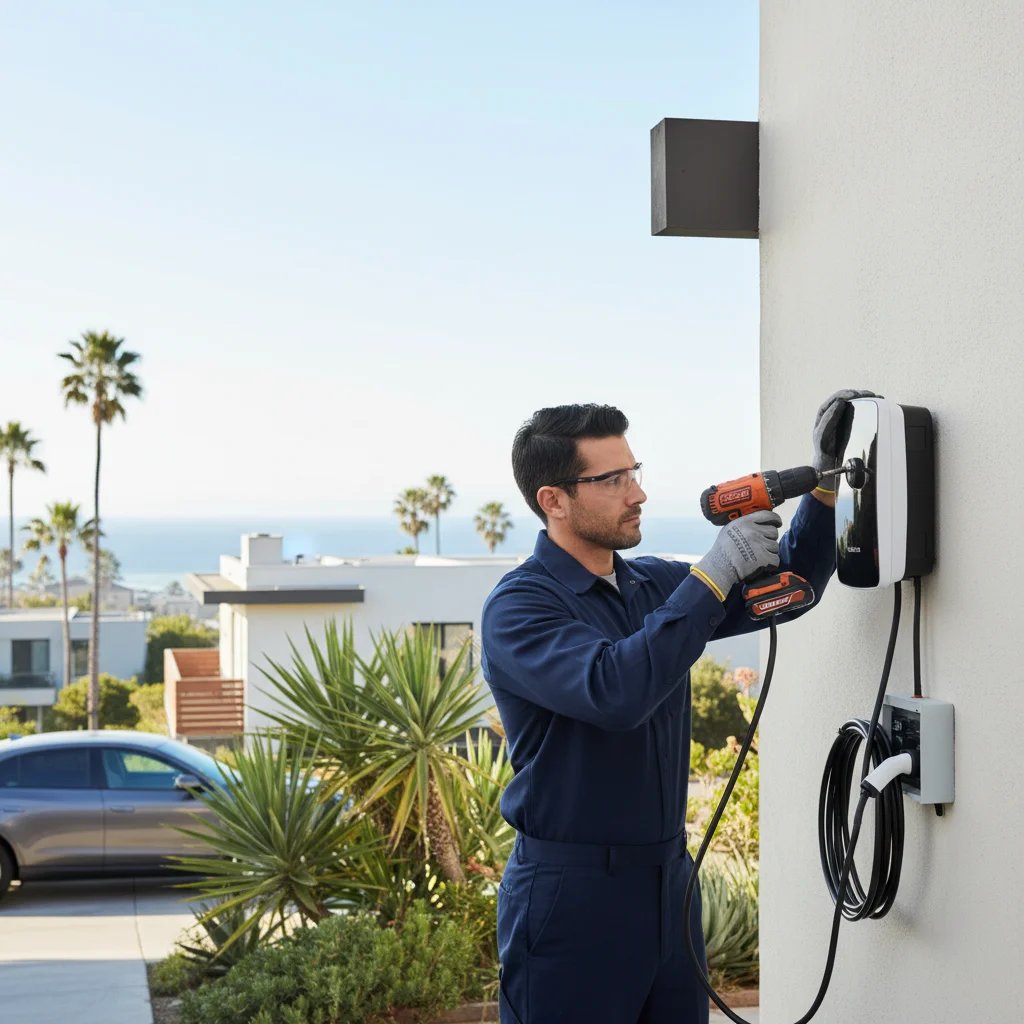
What the Rivian Wall Charger actually needs
The Rivian Wall Charger is a hardwired Level 2 unit rated up to 48 amps and 11.5 kW, built for the R1T and R1S. That output means it needs a dedicated 60-amp circuit. Under NEC rules, a charger drawing 48 amps continuously requires a breaker sized at 125% of that load, which lands you at 60 amps. The wire has to match: 6 AWG copper minimum, stepped up for longer runs to keep voltage drop in check.
That circuit can’t share space with anything else in the garage or the house. It runs alone from the panel to the charger. An electrician tapping an existing circuit to save a step isn’t code-compliant.
Rivian also ships every vehicle with a mobile charger and a J1772 adapter, so an R1T or R1S can plug into any standard Level 2 charger, not just the Rivian-branded one. If you already have a NEMA 14-50 outlet or a non-Tesla Level 2 unit in the garage, you may not need the Wall Charger at all. It’s the fastest home option Rivian sells, but not the only way to charge at home. Our Level 2 vs. Level 1 EV charger guide covers what different charging speeds mean day to day.
What it costs in San Diego
Most Rivian Wall Charger installs in San Diego fall between $800 and $2,000 for labor, materials, and the permit, assuming the panel has an open 60-amp slot and the garage run is reasonable.
Here’s what moves the number inside that range:
- Run length. A charger mounted close to the panel, inside 20-25 feet, sits at the low end. A detached garage or a charger on the far side of the house adds conduit and labor.
- Trenching. If the run has to cross a driveway or yard underground, add $500 or more depending on distance and surface.
- Wire gauge on long runs. Past a certain distance, 6 AWG steps up to keep the 60-amp circuit within voltage drop limits.
- Weatherproofing. Coastal air in Encinitas, Carlsbad, and Oceanside is hard on outdoor conduit fittings, so exterior runs there use rated hardware.
The Wall Charger hardware is separate from install labor. We quote labor, wire, breaker, permit, and inspection coordination; you supply the unit or we can source it.
For the full breakdown of what drives EV charger pricing across every brand, see our EV charger installation cost guide.
When you need a panel upgrade first
A 60-amp circuit is a real load. Older San Diego homes on 100A service, common across Clairemont, Rancho Bernardo, and older parts of El Cajon, often don’t have that much headroom left once you count central AC, an electric range, and a water heater.
A load calculation settles it either way. If there’s room, the Wall Charger goes in as a straightforward add. If there isn’t, a panel upgrade to 200A comes first, typically $3,500-$6,500 in San Diego County including the panel, breakers, wiring, and permit. That’s a separate project from the charger install, and any electrician quoting you a Wall Charger job should tell you upfront if a panel upgrade is likely before they touch anything. Our EV panel upgrade bottleneck guide covers exactly this scenario in more depth.
Permits and inspection
San Diego requires a permit for any new 60-amp circuit, no exceptions. Most EV charger work here qualifies for a Simple, over-the-counter permit through the city’s Development Services Department, meaning it’s issued same-day without engineered plan review. A panel upgrade tied to the same job may need a bit more coordination, but it still moves fast for a licensed contractor.
Skipping the permit isn’t a shortcut worth taking. Unpermitted electrical work shows up at resale and can give a homeowner’s insurance carrier grounds to deny a claim. Our EV charger permit guide for San Diego covers the process from application to final inspection.
You can also check into current rebates and the federal tax credit before you commit to a scope. Our EV charger rebates guide for San Diego covers what’s currently available and how permitted work factors in.
Rivian Wall Charger vs. the alternatives
The Wall Charger’s 48-amp output puts it at the top of the Level 2 range alongside chargers like the Tesla Wall Connector, which runs the same amperage and circuit requirements. If your household has an R1T and a Tesla, both chargers need the same 60-amp circuit backbone, so the panel capacity question is identical either way.
Owners who want more flexibility across a smaller panel sometimes look at an adjustable unit instead. Our general EV charger installation guide compares hardwired versus plug-in options and how to think about brand choice before the electrician shows up.
Frequently asked questions
How much does it cost to install a Rivian Wall Charger in San Diego?
Most installs run $800 to $2,000 when the panel already has room for a 60-amp circuit. If a panel upgrade is required first, add $3,500-$6,500 for that separate project. Detached garages or long conduit runs push the charger install itself toward the higher end of the range.
What size circuit does the Rivian Wall Charger need?
The Wall Charger draws up to 48 amps continuously, which requires a 60-amp dedicated circuit under NEC sizing rules. The wire needs to be 6 AWG copper minimum, sized up for longer runs to control voltage drop.
Can I charge my Rivian without the Wall Charger?
Yes. Rivian includes a J1772 adapter with every vehicle, so an R1T or R1S can charge on any standard Level 2 charger, including a NEMA 14-50 plug-in unit. The Wall Charger is the fastest home option Rivian sells, but it’s not required if you already have Level 2 charging capacity in your garage.
Do I need a permit for a Rivian Wall Charger install in San Diego?
Yes. Any new 60-amp circuit needs a city permit. Most EV charger installs qualify for a same-day Simple permit through San Diego’s Development Services Department. Skipping it can create problems at resale and with your homeowner’s insurance.
Will my 100-amp panel handle a Rivian Wall Charger?
Maybe. It depends on what else is already on the panel. A load calculation tells you exactly how much headroom is left. Many older 100A homes in San Diego are close to capacity once AC, a range, and a water heater are accounted for, in which case a panel upgrade comes first.
When to call us
A Rivian Wall Charger install touches your main panel, needs a dedicated 60-amp circuit, and has to pass city inspection. That’s licensed electrician work from the load calculation through sign-off. Call us at (858) 988-5580 for a same-day estimate.