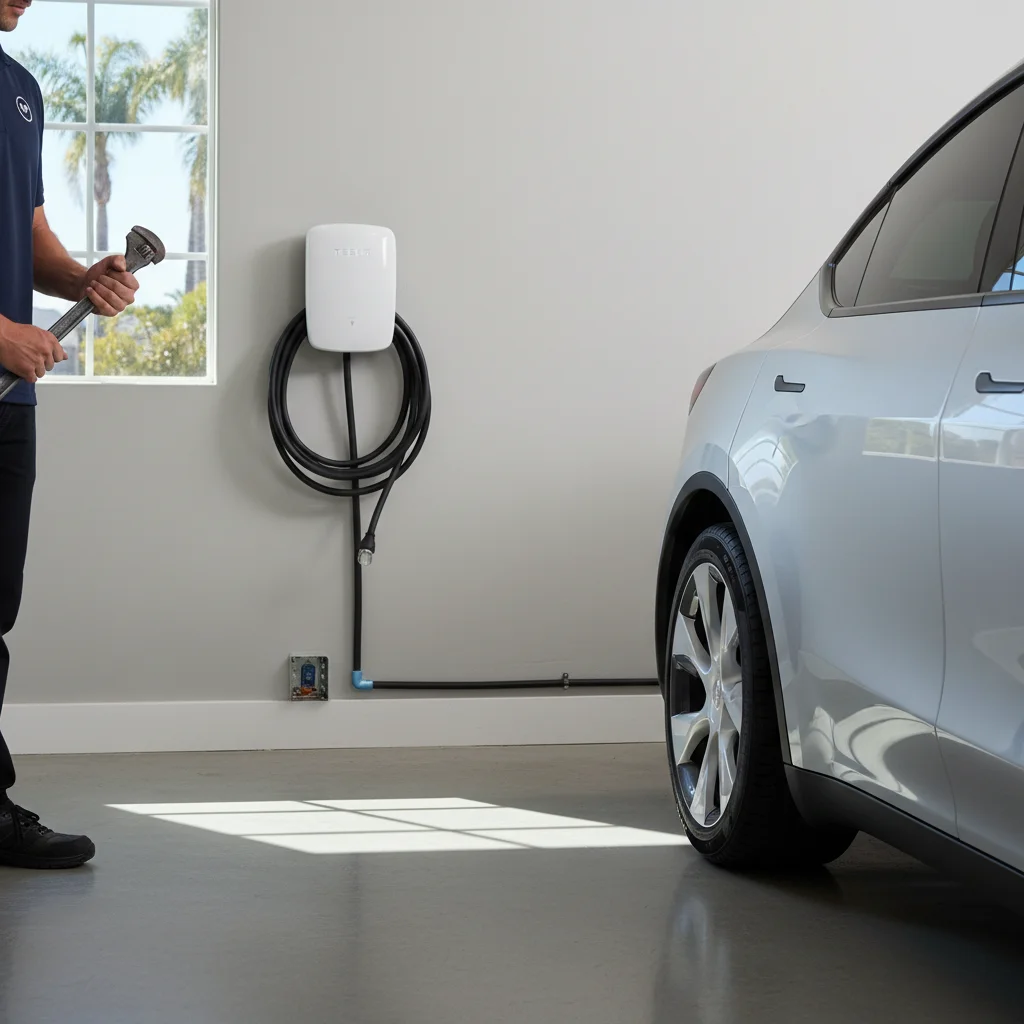
A Tesla Wall Connector installation in San Diego is a permitted 240-volt circuit. Breaker and conductor size follow the amperage you commission in the Tesla instructions and the adopted 125% continuous-load rule. A Gen 3 unit set to 48 amps is a common example that lands on a 60-amp breaker and 6 AWG copper. A NEMA 14-50 outlet is the slower Mobile Connector path. Bright Pro matches Tesla owners with licensed C-10 electricians. You hire and pay the electrician directly. We are not a Tesla certified-installer listing.
TL;DR
- Miles-per-hour figures are examples. Confirm onboard-charger limits for that vehicle.
- Set the Wall Connector amperage per Tesla’s instructions, then size breaker and conductor to that setting and the adopted code.
- Most San Diego Wall Connector installs run $500-$1,200 when the panel has capacity and the garage run is under 25 feet.
- Confirm the city permit and current SDG&E rebate pages. Bright Pro does not pull permits.
- If two Wall Connectors share a circuit, size the home run for the shared listing, not a guess.
Wall Connector vs. mobile connector vs. NEMA 14-50
Tesla ships every vehicle with a mobile connector, the cable that lets you plug into a standard outlet or a 240V receptacle. It works, but it’s slow. On a NEMA 5-15 household outlet you’re adding roughly 3 miles of range per hour. On a 240V outlet (NEMA 14-50) you get closer to 30 miles per hour at 32 amps. That’s decent for most daily drivers.
The Gen 3 Wall Connector pushes up to 48 amps, which translates to about 44 miles of range per hour for a Model 3 Long Range or Model Y. For a Cybertruck or Model S Plaid pulling the full 11.5 kW onboard charger, that matters. The Gen 3 also connects to your home Wi-Fi, supports Tesla’s power-sharing feature across multiple units, and has a cleaner flush-mount profile than anything you’ll get from a receptacle and a dangling plug.
Daily miles and overnight dwell time decide the hardware. If overnight charging covers your usual driving, a NEMA 14-50 outlet can be enough. If you need faster Level 2 charging, more than one Tesla, or native load sharing, the Wall Connector is the Tesla-branded path that supports sharing without a separate controller.
Amperage settings and breaker sizing for your panel
The Gen 3 Wall Connector is configurable from 15 to 48 amps. You set the limit in the device itself during commissioning. The NEC requires the breaker feeding an EV charger to be sized at 125% of the continuous load, so a Wall Connector set to 48 amps needs a 60-amp breaker, and a Wall Connector set to 40 amps needs a 50-amp breaker.
Most San Diego homes built before 2000 have 100-amp or 125-amp panels. Once you add up AC, a dryer, a range, and a water heater, there may not be a clean 60-amp slot available. That doesn’t automatically mean you need a full panel upgrade in San Diego. Sometimes a tandem breaker swap or a load calculation shows you have more headroom than you think. But sometimes you don’t, and trying to squeeze a 60-amp circuit into an overloaded 100-amp panel is exactly the kind of shortcut that fails inspection.
Wire gauge matters just as much as breaker size. A 60-amp circuit needs 6 AWG copper or 4 AWG aluminum at minimum. The run length from your panel to the garage also matters. Longer runs may require you to step up a gauge to keep voltage drop within acceptable limits. If the charger is on an outside wall or in a detached garage, conduit type and weatherproofing requirements kick in too.
If your panel is already running close to capacity, check out our post on EV panel upgrade bottlenecks in San Diego. It covers exactly this scenario.
Single vs. multi-unit wiring (load sharing)
If you have two Teslas, or you’re planning to add a second, the Gen 3 Wall Connector supports power sharing natively. You wire both units on the same circuit and link them with a short communication cable. Tesla’s firmware dynamically splits the available amperage between whichever vehicles are actively charging.
For example: two Wall Connectors on a shared 60-amp circuit. If only one car is charging, it gets the full 48 amps. If both are charging simultaneously, each gets 24 amps. No additional hardware required, no separate load management device.
The wiring topology for this matters. The second unit is daisy-chained from the first, not run back to the panel on its own circuit. That means the home run wire needs to be sized for the full shared load, not split between two runs. Your electrician needs to understand this wiring configuration or you’ll end up with two separate circuits where one would do, or worse, a shared circuit wired in a way that the firmware can’t control correctly.
Permit and SDG&E inspection in San Diego
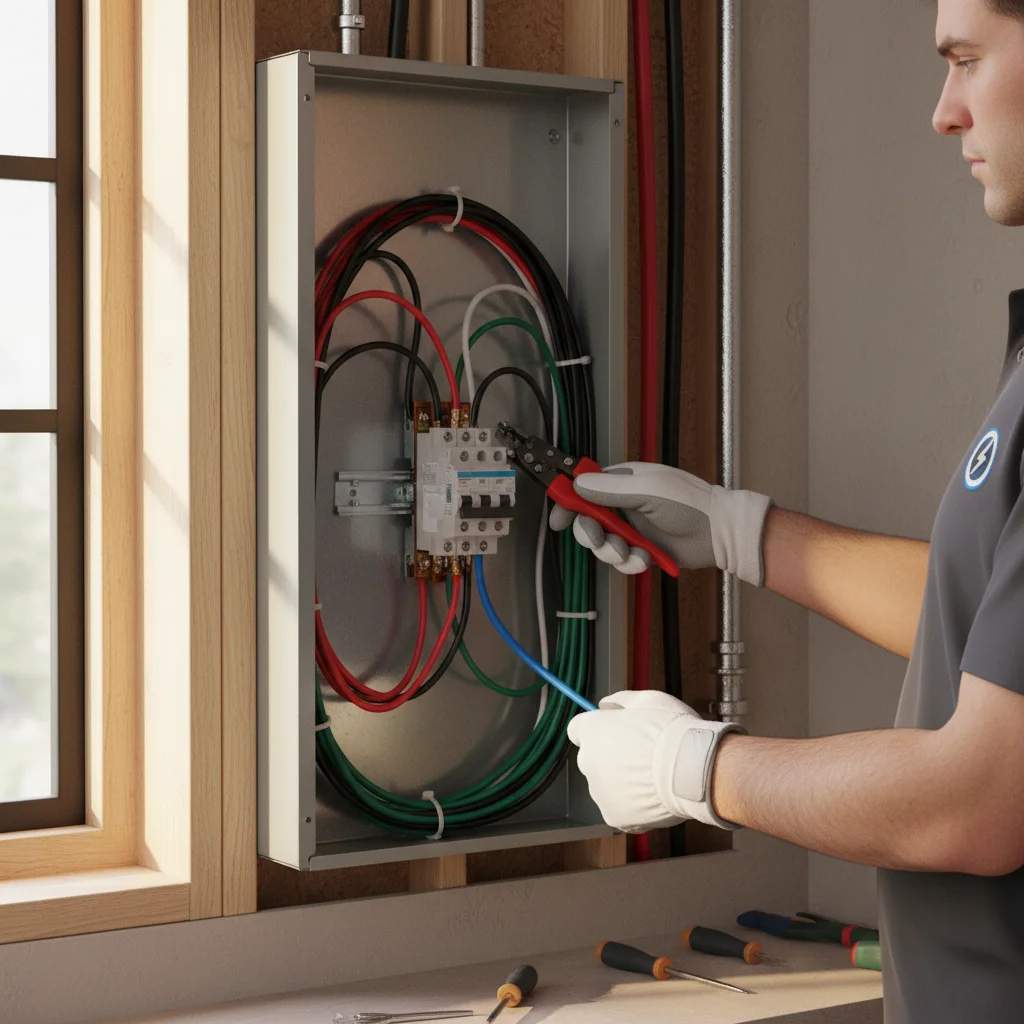
Every Wall Connector installation in San Diego requires a permit. This is not optional and it’s not just a technicality. San Diego’s Development Services Department enforces electrical permits on EV charger work. An unpermitted install can create problems when you sell the home and won’t be covered by your homeowner’s insurance if something goes wrong.
The permit process here is straightforward for a licensed contractor. The electrician pulls the permit, schedules the inspection, and the city inspector signs off on the completed work. In most cases the inspection happens within a few days of the install.
SDG&E also has a role. If you’re in SDG&E’s service territory, which covers most of San Diego County, they require notification for new EV charging circuits above a certain load threshold. SDG&E also offers rebates that can offset part of the installation cost. Current rebate amounts live in our SDG&E EV charger rebate guide for 2026. The short version: the rebates are real, they require the permit to be in place, and unpermitted installs don’t qualify. If you want more detail on what the permit process looks like from application to final inspection, see our guide on EV charger permits in San Diego.
One more thing worth knowing: if your installation requires a panel upgrade to support the new circuit, that upgrade also needs its own permit and SDG&E coordination. It’s more work, but it’s the right way to do it, and a licensed electrician handles all of it.
You can verify any electrician’s license through the California Contractors State License Board before you hire.
What a typical install costs in 2026
Most Wall Connector installations in San Diego fall between $500 and $1,200 for labor and materials when the panel has capacity and the garage is straightforward. That range assumes a standard garage install, a panel with available breaker space, and a run of 25 feet or less from panel to charger.
Here’s what pushes the price up:
- Long conduit runs. A detached garage or a charger on the far side of the house from the panel can add $200 to $400 in materials and labor.
- Trenching. Outdoor underground runs to a detached structure can add $500 or more depending on distance and whether you hit concrete.
- Panel capacity issues. If you need a subpanel or a full upgrade, expect to add $1,500 to $4,000 depending on scope. See the panel upgrade cost guide for current numbers.
- Drywall or stucco work. Older San Diego homes with finished garages sometimes require fishing wire through walls, which adds time.
The Wall Connector itself costs $475 from Tesla directly. You own the hardware. The matched electrician supplies labor, materials, permit fees, and inspection coordination when those items are in the written scope. Bright Pro Electric does not supply that labor.
For a broader cost comparison across charger brands and installation types, our EV charger installation guide covers the full picture. The EV charger installation service page explains how matching and written scopes work.
Common mistakes that fail inspection
The same problems show up on unpermitted or DIY installs when a licensed electrician is later hired to get the circuit listed and inspected.
Undersized wire. The most common one. Someone runs 10 AWG on a 60-amp circuit because they had a spool in the garage. That’s a 30-amp wire. It fails immediately.
No dedicated circuit. Sharing a circuit with another appliance, even a rarely-used one, violates NEC requirements for EV chargers. The circuit must be dedicated.
Wrong breaker type. Some San Diego homes have older panels that require specific breaker brands. Mixing breaker brands in a Square D panel, for example, can create a hazard and will fail inspection.
Missing weatherproofing. If any part of the conduit or the charger itself is exposed to weather, it needs to be rated for wet locations. The Gen 3 Wall Connector is rated for outdoor use, but the conduit fittings and junction boxes in the run also need to match.
Skipping the permit. Inspectors in San Diego’s city limits and unincorporated county areas are active. Unpermitted work can be flagged during utility visits. The cost to retroactively permit and correct unpermitted work is almost always higher than doing it right the first time.
Frequently asked questions
Do I need a permit to install a Tesla Wall Connector in San Diego?
Yes. Every Wall Connector installation in San Diego requires an electrical permit from the city or county Development Services Department. This isn’t optional, unpermitted installs can create problems at resale, may not be covered by homeowner’s insurance, and disqualify you from SDG&E rebates. A licensed electrician handles the permit application, schedules the inspection, and coordinates with SDG&E on new load notifications.
What breaker size does a Tesla Wall Connector need?
The NEC requires the breaker feeding an EV charger to be sized at 125% of the continuous load. A Wall Connector set to its maximum 48 amps needs a 60-amp breaker. If you configure it to 40 amps (a common choice when panel space is tighter), a 50-amp breaker is correct. Wire gauge must match: 6 AWG copper minimum for a 60-amp circuit, with larger gauge required for runs over 50 feet.
My San Diego home has a 100-amp panel. Can I still install a Wall Connector?
Maybe. A load calculation will show whether you have 50-60 amps of usable headroom after accounting for your existing circuits. Many 100-amp homes in San Diego are tapped out once you add AC, a dryer, and a range. In that case, a subpanel or full panel upgrade is the path forward. The electrician you hire assesses this on a site visit so the written scope is known before work starts. Bright Pro Electric does not assess panels.
How does Tesla Wall Connector load sharing work for two cars?
The Gen 3 Wall Connector supports power sharing natively. Both units are wired on the same 60-amp circuit, with a short communication cable linking them. The firmware dynamically splits the available amperage, if one car charges, it gets up to 48 amps; if both charge simultaneously, each gets 24 amps. The key wiring detail: the home run from your panel must be sized for the full 60-amp load, not divided between two separate runs.
When to call us
Tesla Wall Connector installation touches your main electrical panel, requires a city permit, and needs to be done to NEC standards to pass SDG&E inspection. That’s licensed electrician work, not because of complexity alone, but because the permit and inspection process requires it. Get in touch and we’ll connect you with a vetted local electrician. Bright Pro Electric matches. It does not install Wall Connectors.