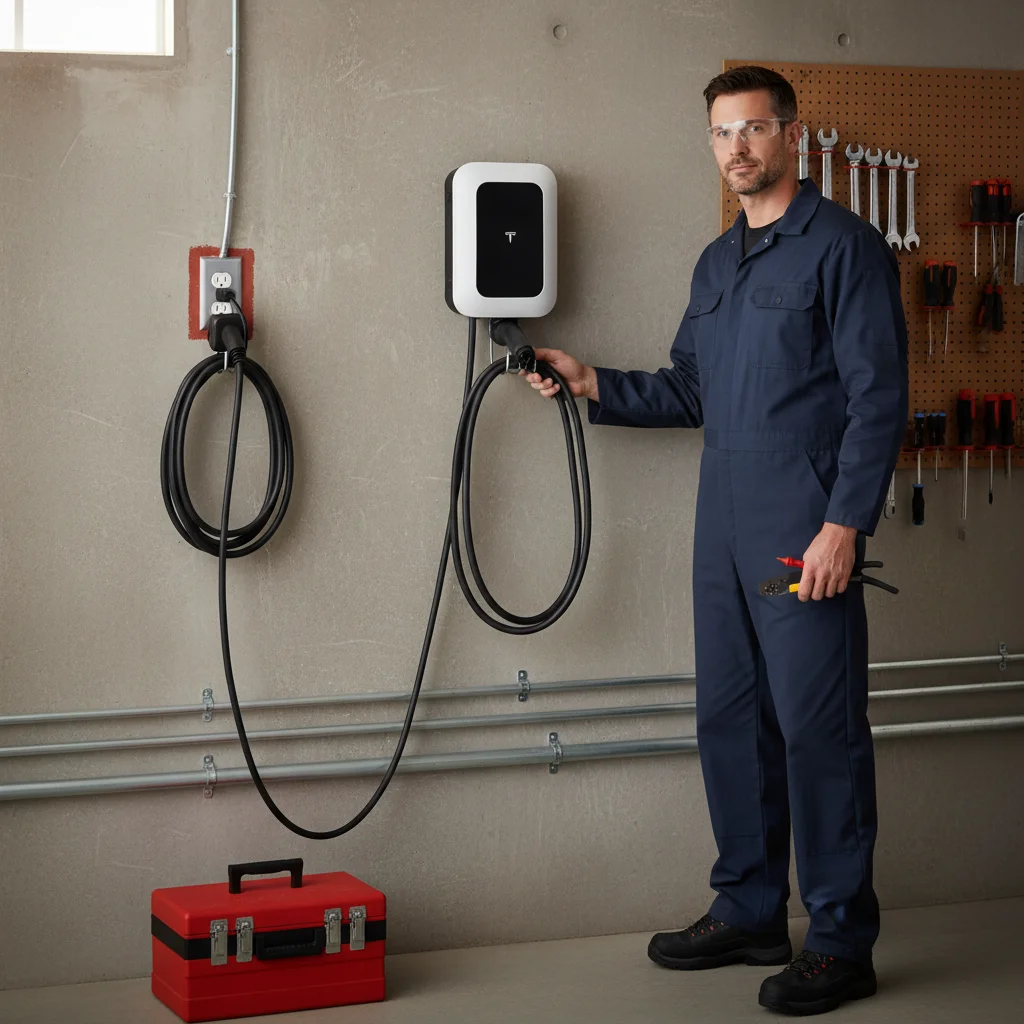
You just brought home your new electric vehicle, and now you’re staring at the charging cord that came with it, then at the standard outlet in your garage. The decision is whether the included Level 1 cord covers daily miles or whether a Level 2 charger belongs on a dedicated circuit. That is the core choice for many new EV owners in San Diego.
TL;DR
- Start from the vehicle’s onboard-charger limit and the kWh you actually need overnight, not a miles-per-hour rule.
- Level 1 (120V) and Level 2 (240V) charge-rate figures in this article are examples. Confirm them against the car and the EVSE listing.
- A Level 2 installation in San Diego typically costs $1,000 to $2,500 including the charger hardware, labor, and permit.
- Older San Diego homes (pre-1980s) with 100-amp panels may need a load calculation before a Level 2 circuit can be added.
- A 40-amp charger on a 50-amp circuit is one common example. Match breaker and conductor to the selected amperage and the car’s onboard limit.
The right answer depends on the onboard charger, overnight energy need, the panel, and budget. Charge-rate bands below are examples.
Level 1: what you get with the included cord
Every new electric vehicle comes with a Level 1 charging cord. Think of it as the “mobile charger” for your car. It’s designed to be simple and universal, plugging directly into any standard 120-volt wall outlet, the same kind you use for your phone or a lamp.
How it works: A Level 1 charger uses the basic electrical circuit that’s already everywhere in your home. There’s no special installation required. You just plug one end into the wall and the other into your EV.
Charging speed: This convenience comes at a cost: speed. Level 1 charging is slow. It typically adds between 3 to 5 miles of range for every hour it’s plugged in. That means if you plug your car in for 10 hours overnight, you can expect to add about 30 to 50 miles of range. For a fully electric vehicle with a 250-mile range, a full charge from empty could take two days or more.
The verdict: For some San Diego drivers, this is perfectly fine. If you have a plug-in hybrid (PHEV) with a small battery or a short daily commute, Level 1 can easily replenish what you use each day. But if you have a long commute, drive for work, or want the flexibility to recover from a long trip quickly, you’ll find Level 1 charging frustratingly slow. It’s a great backup or travel option, but often isn’t a practical primary solution for a fully electric lifestyle.
Level 2: charging speed and daily-driving math
A Level 2 charger is the most common home charging solution for EV owners. It operates on a 240-volt circuit, the same type of power used by your electric clothes dryer or oven. This jump in voltage makes a massive difference in charging speed.
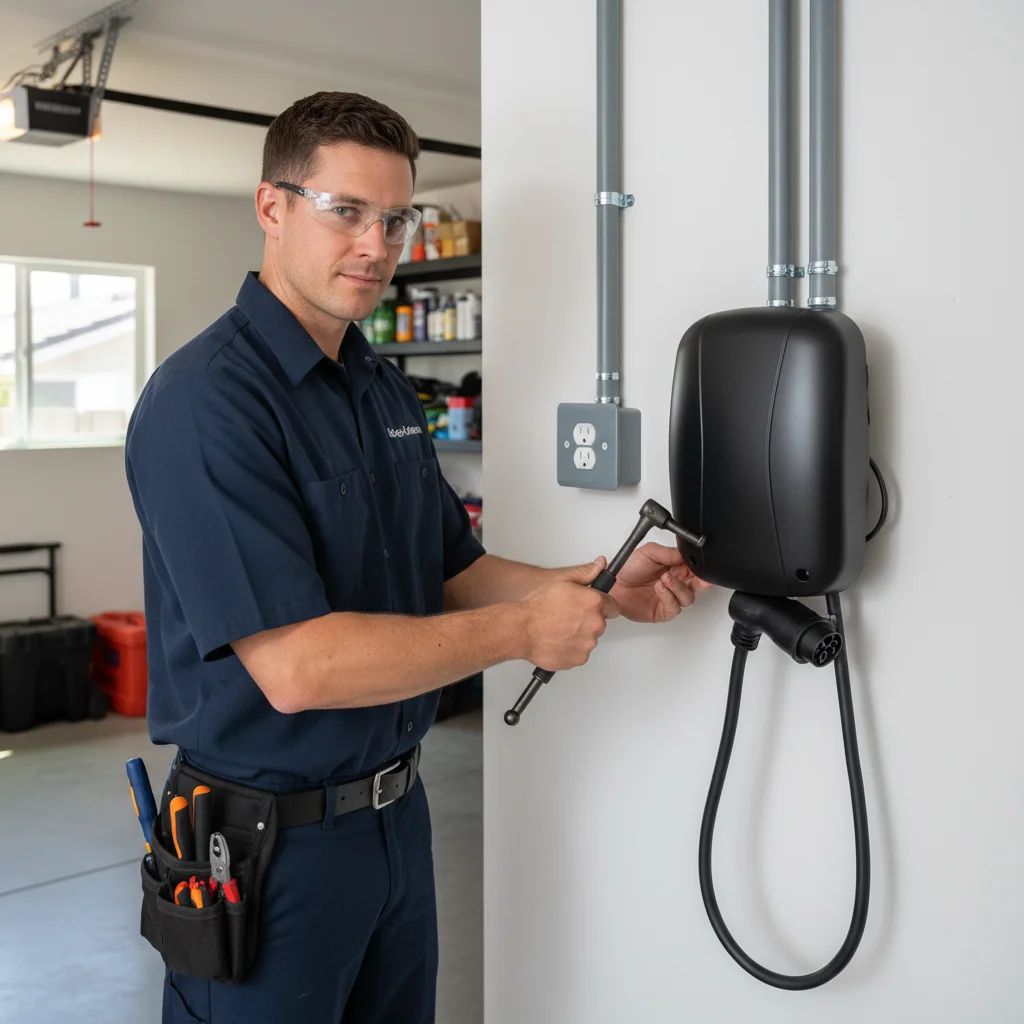
How it works: Instead of a standard outlet, a Level 2 charger requires a dedicated 240-volt circuit run from your main electrical panel to your garage or driveway. The charger can either be a “plug-in” model that connects to a 240V outlet (like a NEMA 14-50) or a “hardwired” unit that’s permanently connected to the circuit. Both options require professional EV charger installation by a licensed electrician.
Charging speed: This is where the upgrade pays off. A Level 2 charger can add anywhere from 25 to 60 miles of range per hour, depending on the amperage of the circuit and your car’s onboard charger capacity. Let’s do some simple San Diego driving math.
- Average San Diego commute: Roughly 30-40 miles round trip.
- Level 1 replenishment: To add 40 miles of range, you’d need to charge for 8-10 hours. This works if you get home at 6 PM and leave at 6 AM.
- Level 2 replenishment: To add 40 miles of range, you’d need to charge for about 1-1.5 hours.
The difference is clear. With Level 2, you can get home from work, plug in, and have more than enough range for an evening out in just a short time. If you get home with a nearly empty battery after a long day trip to Julian or Temecula, a Level 2 charger ensures your car is fully charged and ready to go by the next morning. It transforms your EV from a car you have to plan around to one that’s always ready for your life.
Cost to install each in a San Diego home
The financial difference between Level 1 and Level 2 charging is as significant as the performance gap. One is often free, while the other is a planned home improvement project.
Level 1 Installation Cost: $0 (usually) Since a Level 1 charger uses a standard 120-volt outlet, the cost is typically zero. You use the cord that came with your car and an existing outlet in your garage. The only time a cost might be involved is if you don’t have an outlet conveniently located and need an electrician to install a new one. Even then, it’s a relatively minor electrical job.
Level 2 Installation Cost: $1,000 - $2,500+ The cost for a Level 2 charger installation in San Diego can vary widely based on several factors:
- The Charger Itself: The hardware (the EVSE unit) typically costs between $400 and $800. Popular brands include Tesla, ChargePoint, JuiceBox, and Wallbox.
- Installation Labor and Materials: This is the main variable. The cost depends on the distance from your electrical panel to the charger location, the current capacity of your panel, and whether you choose a plug-in or hardwired setup.
- Electrical Panel Condition: If your main panel is full or doesn’t have enough capacity to handle the new 30-amp to 60-amp circuit, you might need a subpanel or a full panel upgrade. A panel upgrade is a more significant project that can add several thousand dollars to the cost.
A straightforward installation, where the panel is in the garage and has ample capacity, will be on the lower end of the price range. A more complex job requiring a long conduit run across the house and a panel upgrade will be on the higher end. You can learn more about the specifics in our breakdown of the cost to install a 240V outlet.
When level 1 is genuinely enough
Level 1 charging is enough for a specific subset of San Diego drivers. Treating every garage as a Level 2 install is not honest. You might be fine with the included cord if you fit one of these profiles:
1. You have a short, predictable commute. If your daily round trip is 30 miles or less, say from Clairemont to Sorrento Valley, you only use a small fraction of your battery each day. Plugging in for 8-10 hours overnight on a Level 1 charger will easily replace the energy you used, leaving you with a full or near-full battery every morning. You never start the day with a “range deficit.”
2. You drive a Plug-in Hybrid (PHEV). PHEVs like the Toyota Prius Prime or Chrysler Pacifica Hybrid have much smaller batteries than full EVs. Their all-electric range is typically between 25 and 50 miles. A Level 1 charger can fully replenish these batteries overnight, often in just 5-8 hours. Since you have a gas engine as a backup, there’s no range anxiety.
3. You can charge at your workplace. Many San Diego employers now offer free or low-cost Level 2 charging as a perk. If you can reliably charge your car while you’re at the office, the need for fast charging at home diminishes greatly. You can use a Level 1 charger at home for occasional top-ups on weekends or evenings.
4. You’re on a tight budget. An EV is a major purchase. If spending another $1,500 on a Level 2 installation right away isn’t feasible, starting with Level 1 is a completely valid choice. You can live with it for a few months, see if it meets your needs, and decide to upgrade later if you find it too limiting.
When the panel forces a level 2 decision
Sometimes, the choice between Level 1 and Level 2 isn’t just about convenience. It’s about electrical reality. Your home’s main electrical panel is the heart of its power system, and its capacity can be the deciding factor in your EV charging setup. This is especially true in some of San Diego’s older homes.
Many homes built before the 1980s, particularly in neighborhoods like North Park, La Mesa, or older parts of Chula Vista, were built with 100-amp electrical panels. At the time, this was plenty of capacity. But today, with central air conditioning, electric appliances, and now an EV, a 100-amp panel can be easily overloaded.
An EV charger is a “continuous load,” meaning it draws a large amount of power for hours at a time. A typical Level 2 charger requires a dedicated circuit of 40 to 60 amps. Adding this kind of load to an already-strained 100-amp panel is often impossible without risking tripped breakers or, in worse cases, an electrical hazard.
A licensed electrician performs a load calculation to see whether the panel has spare capacity. Bright Pro Electric does not. If it doesn’t, two common options:
- Stick with Level 1: A Level 1 charger only draws about 12 amps on a shared 120V circuit, a load any modern panel can handle easily.
- Upgrade your panel: This is often the best long-term solution. Upgrading to a 200-amp panel not only provides plenty of power for your EV charger but also future-proofs your home for other electrical needs, like an induction stove or an electric heat pump.
For a deeper dive into this topic, our complete EV charger installation guide for San Diego covers panel considerations in more detail. Once you’ve decided on Level 2, our EV charger rebates guide for San Diego shows how to stack SDG&E and federal incentives to cut the net cost significantly.
How to pick amperage: 32A, 40A, 48A, or 60A
If you’ve decided a Level 2 charger is right for you, the next question is what speed, or amperage, to get. Level 2 chargers aren’t one-size-fits-all. They come in various power levels, and choosing the right one involves balancing your car’s capabilities, your panel’s capacity, and your future plans.
Amperage (A) dictates charging speed. Higher amps mean faster charging. Here’s a breakdown of the common options:
32-Amp Charger (on a 40-Amp Circuit)
- Speed: Adds about 25-30 miles of range per hour.
- Best for: Most EVs on the market. This is a solid, reliable baseline that’s a huge step up from Level 1 and meets the daily needs of most drivers. It’s often a good fit for homes with 100-amp or 150-amp panels that have limited spare capacity.
40-Amp Charger (on a 50-Amp Circuit)
- Speed: Adds about 35-40 miles of range per hour.
- Best for: This is the sweet spot for many homeowners. It provides a noticeable speed boost over a 32A unit and is often installed with a NEMA 14-50 outlet for plug-in flexibility. It’s a great choice for long-range EVs and drivers who want to quickly top up.
48-Amp Charger (on a 60-Amp Circuit)
- Speed: Adds about 40-45 miles of range per hour.
- Best for: Future-proofing. This is currently the fastest charging speed most home EVs can accept. According to the National Electrical Code, chargers at this level must be hardwired, not plugged into an outlet. This provides a safer, more permanent connection. If you’re already upgrading your panel, installing a 60-amp circuit for a 48-amp charger is a smart move.
60-Amp Charger (on an 80-Amp Circuit)
- Speed: Adds 50+ miles of range per hour.
- Best for: A small number of high-performance vehicles (like the Ford F-150 Lightning with the extended range battery) that can accept this much power. This is less common for residential installs and requires a reliable electrical service (typically 200 amps or more).
The deciding factor: Your car has a maximum charging speed it can accept. Plugging a Tesla Model 3 into a 60-amp charger won’t make it charge any faster than its 48-amp maximum. Always check your vehicle’s specs. The goal is to match your charger to your car’s capability and your home’s electrical capacity.
Frequently asked questions
Is Level 1 charging enough for a San Diego commute?
It depends on your daily mileage. The average San Diego commute is roughly 30 to 40 miles round trip. Level 1 adds about 3 to 5 miles per hour, so a 40-mile commute takes 8 to 10 hours to replenish. If you get home at 6 PM and leave by 6 AM, you’ll be back to full most mornings. If your commute is longer or more variable, or if you drive a full EV with a 200+ mile battery, Level 1 will leave you with a persistent range deficit.
What does it cost to install a Level 2 EV charger in San Diego?
Most homeowners pay $1,000 to $2,500 total. That includes the EVSE unit ($400 to $800 for popular brands like ChargePoint, JuiceBox, or Wallbox), installation labor, and the permit. The biggest variable is how far the electrician needs to run a new 240V circuit from your panel to the charger location. A panel that sits in the garage and has available capacity keeps costs low. A panel at the opposite end of the house or one that needs a subpanel addition pushes costs higher.
Do I need a permit to install a Level 2 EV charger in San Diego?
Yes. Any new 240V circuit typically requires an electrical permit from your local jurisdiction. Confirm for that address. The permit process checks wire size, breaker rating, and listing. A licensed electrician pulls the permit when it is in their scope. Bright Pro Electric does not. Skipping a required permit leaves the work uninspected. Ask the insurer how they treat it. This page does not decide a claim.
How do I know if my panel can handle a Level 2 EV charger?
An electrician performs a load calculation to determine available capacity. A 32-amp continuous EVSE is commonly installed on a 40-amp circuit. In the load calc that continuous load is taken at 125 percent, which is 40 amps of calculated load, not 50 amps of spare headroom on a 40-amp circuit. Many older San Diego homes (North Park, La Mesa, Chula Vista neighborhoods built before 1980) have 100-amp panels that are already near capacity. If yours is full, options include a subpanel, a load management device, or a full panel upgrade to 200 amps.
When to call us
Deciding between Level 1 and Level 2 is driving need, overnight kWh, and budget. Once you choose Level 2, a 240-volt circuit is licensed electrical work. The electrician who takes the job runs the load calculation, sizes amperage to the car and the panel, and installs to the listing. Bright Pro Electric matches you with that electrician. It does not perform the load calc or the installation, and it does not pull permits.
Use the contact page. Hours are Monday through Saturday, 7am to 7pm. After hours, leave a message.