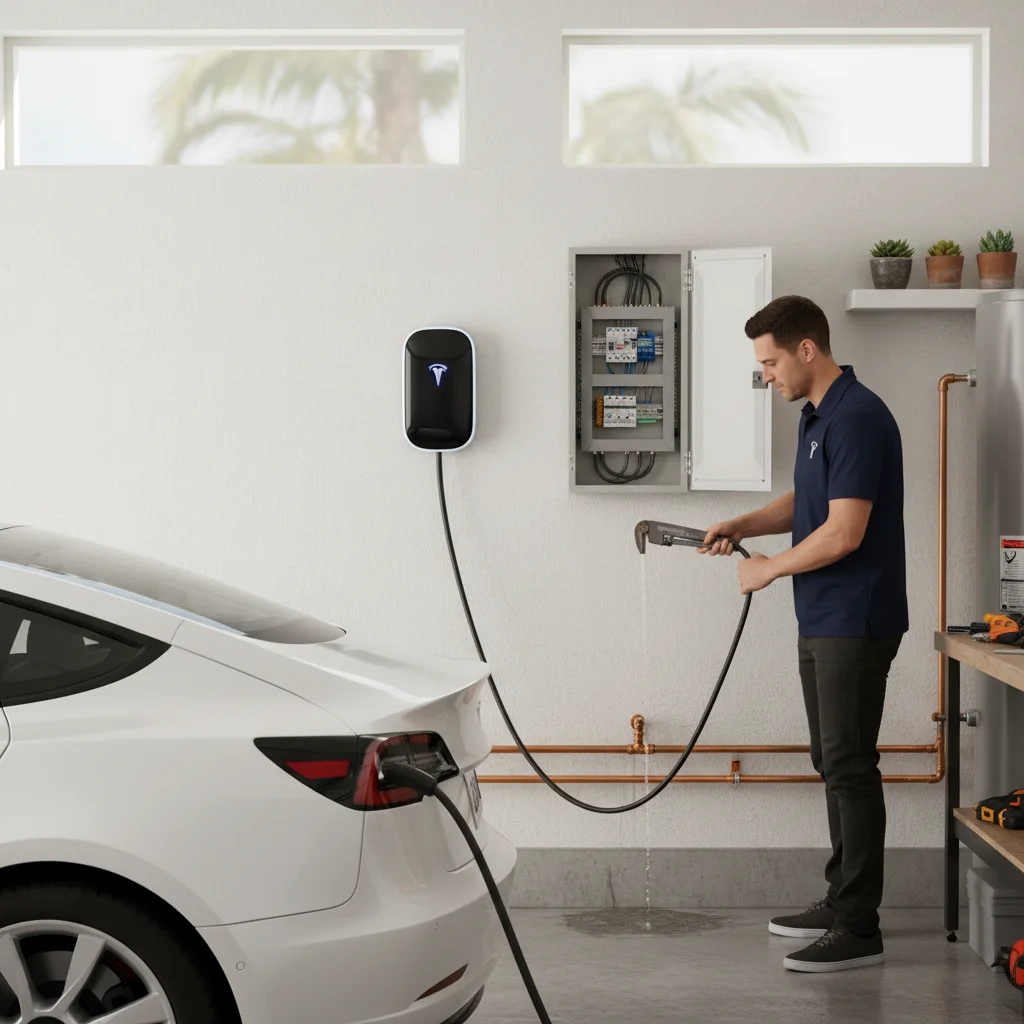
You just bought an EV and your dealer mentioned “Level 2 home charging” like it’s a weekend errand. Then you get a quote for $1,800 and another for $650, and no idea why they’re so far apart. Here’s what’s actually inside those numbers, broken down line by line so you can compare quotes fairly.
If you’re still deciding on charger brand, install approach, or whether your panel can handle it, our complete EV charger installation guide for San Diego covers all of that in one place. This post is purely about the cost side.
TL;DR
- Attached garage, panel within 15 feet: $400 to $850 total including permit, wire, breaker, and labor.
- Detached garage or long conduit run (40 to 80 feet): $1,100 to $2,500 depending on trenching and conduit type.
- Panel upgrades from 100 to 200 amps add $2,500 to $4,500 on top of the charger install if your panel can’t handle the new load.
- Permit fees in the City of San Diego run approximately $150 to $300; don’t let any contractor skip this step.
- A load management device ($600 to $1,200 installed) can keep a marginal 100-amp panel code-compliant without a full upgrade.
What a level 2 EV charger install actually costs in San Diego
The honest answer is $400 to $2,500 for most San Diego homes, with real outliers on both ends. That wide range isn’t contractor price-gouging. It reflects genuinely different scopes of work.
Here are two common scenarios with realistic 2026 numbers:
Attached garage, panel within 15 feet
This is the best-case job. The panel is close, the run is short, and no outdoor conduit is needed. A licensed electrician pulls a dedicated 50-amp 240V circuit, mounts the EVSE, and schedules the city inspection. Total cost: $400–$850. That includes labor, wire, a 50-amp double-pole breaker, and the permit.
The charger itself is separate. A quality 48-amp hardwired unit (ChargePoint, Emporia, Enel X) runs $350–$700 depending on features. A plug-in NEMA 14-50 setup saves on the charger cost but adds a receptacle line item, roughly a wash.
Detached garage or long conduit run (40–80 feet)
This is the more typical San Diego scenario: a separate casita, a detached garage, or a panel on the opposite side of the house from where you park. Expect 40–80 feet of conduit, possibly underground if crossing a driveway.
Total cost: $1,100–$2,500, depending on trenching, conduit type, and whether the run crosses hardscape. Underground PVC conduit with pull wire costs less to trench than cutting through concrete. EMT surface conduit avoids trenching but isn’t ideal for exposed outdoor runs in San Diego’s UV climate.
Don’t forget to check whether you qualify for the SDG&E EV charger rebate in 2026. It can offset $500 or more of your total cost.
Line items that move the price: panel, run length, conduit, permits
Every quote should break down into these components. If it doesn’t, ask.
Wire and conduit. A 50-amp 240V circuit needs 6 AWG copper (or 4 AWG aluminum for longer runs). Wire alone on a 60-foot run costs $80–$140 in materials. Conduit adds $60–$200 depending on EMT, PVC, or flexible liquid-tight.
Labor rate. San Diego licensed electricians typically bill $95–$145/hour. A simple attached-garage job takes 2–3 hours. A trench-and-pull detached-garage job runs 5–8 hours.
Permit fees. San Diego city permit fees for an EV charger circuit run approximately $150–$300. Some contractors include this; others invoice it separately. Always ask. Skipping the permit isn’t a savings. It’s a liability when you sell the house or file an insurance claim.
The charger hardware. Many contractors don’t supply the unit by default. Confirm whether the quote is supply-and-install or install-only.
Trenching. Soft soil (common in inland SD neighborhoods) runs $8–$15/linear foot. Cutting asphalt or concrete adds $25–$50/linear foot.
The EV charger installation service page lists the job types a licensed electrician typically prices. Bright Pro does not issue that quote.
When you’ll need a panel upgrade or load management device
This is where quotes diverge most dramatically. A $650 quote assumes your panel can handle the load. A $2,200 quote might mean it can’t.
A Level 2 charger on a 50-amp circuit draws up to 9,600 watts continuously. If your main panel is a 100-amp service, common in San Diego homes built before 1980, adding that load might push you over capacity, especially if you have central AC, an electric range, or an electric water heater.
Three situations that require extra work:
-
Panel is full. No open breaker slots. You’ll need a tandem breaker ($30–$80), a subpanel ($600–$1,200 installed), or a full panel upgrade.
-
Service is 100A or under. A panel upgrade to 200A in San Diego typically runs $2,500–$4,500 all-in with permit. Read more in our breakdown of the EV panel upgrade bottleneck in San Diego.
-
You want to avoid an upgrade. Load management devices (like Emporia’s smart EVSE or a dedicated load management relay) can throttle charger output when other big loads are running. Published installed range on this page is $600 to $1,200, the same band as the TL;DR. Hardware-only listings are not that installed figure.
A good electrician will do a load calculation before quoting. If they skip that step, that’s a problem.
SDG&E permit timelines and inspection in 2026
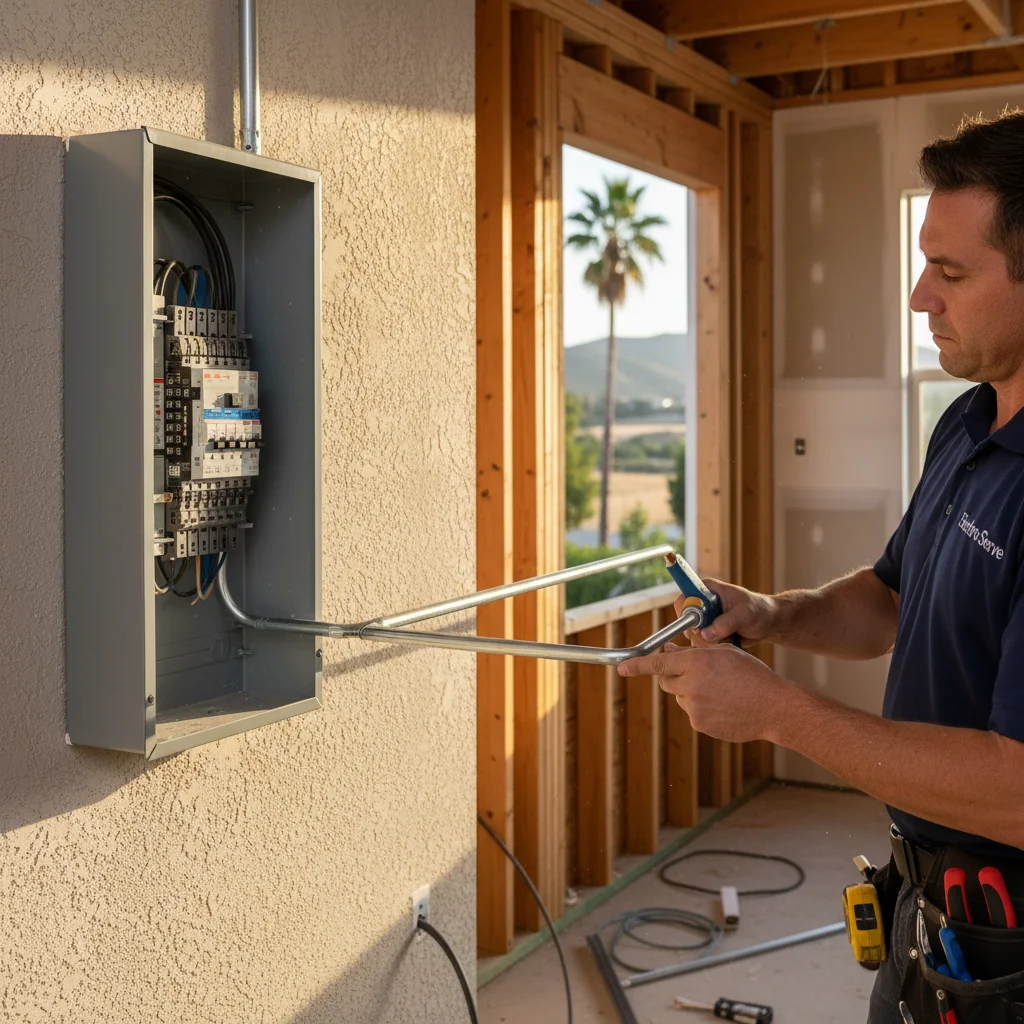
San Diego requires a permit for any new 240V circuit, no exceptions. The California Electrical Code (based on NEC) requires it, and SDG&E may require proof of permitted work before processing utility rebates.
Here’s the typical 2026 timeline for a residential EV charger permit in the City of San Diego:
- Online permit application: 1–3 business days for over-the-counter approval on straightforward jobs
- Rough or final inspection: Usually schedulable within 3–7 business days after rough-in or completion
- Total project timeline: Most jobs wrap up in 1–2 weeks start to finish, including inspection
Santee and El Cajon are incorporated cities with their own building departments. Unincorporated communities such as Spring Valley and Lakeside go through County Planning & Development Services (PDS), not City of San Diego DSD and not a county DPW EV counter. Confirm the address before you file. Timelines can be similar; fee schedules differ.
One important note: SDG&E’s rebate programs sometimes require the charger to be listed on their approved equipment list and installed by a licensed contractor. Skipping the permit can disqualify you. You can review current programs directly at sdge.com. For the full permit process from application to inspection sign-off, see our guide on EV charger permits in San Diego.
Want to verify your contractor’s license before signing anything? The CSLB license lookup takes about 30 seconds.
Red flags in low-ball quotes
A $400 quote for a detached garage job with 60 feet of underground conduit should stop you cold. Here’s what’s likely missing:
No permit line item. Unpermitted work voids your homeowner’s insurance coverage for related claims and creates problems at resale. California is strict about this.
No load calculation. If the contractor didn’t ask about your current panel size, appliances, or square footage, they didn’t do a load calc. That’s a code requirement, not a courtesy.
Vague scope. “Install EV charger, $550” tells you nothing. A real quote should list the circuit size, wire gauge, conduit type, run length estimate, permit inclusion, and charger hardware (or note it’s owner-supplied).
No mention of inspection. Final inspection isn’t optional. If the quote doesn’t mention it, ask explicitly who schedules it and whether the fee is included.
Unlicensed or out-of-state licensed. California requires a C-10 electrical contractor license for this work. Check the CSLB before handing over a deposit.
How to compare three estimates apples-to-apples
Getting three quotes is smart. Making sense of them takes a little structure.
Build a simple comparison grid with these columns: total price, permit included (yes/no), hardware included (yes/no), run length assumed, conduit type, load calculation performed (yes/no), and warranty on labor.
A few things to normalize:
Strip out the charger cost. If one contractor is supplying a $700 ChargePoint Flex and another is installing your owner-supplied unit, the quotes aren’t comparable until you account for that delta.
Ask each contractor the same scenario. “50-amp dedicated circuit, 40-foot run from main panel to attached garage, hardwired charger I supply, permit included.” Same spec, three prices. Now you’re comparing labor and overhead, not apples and oranges.
Weight permit handling. A contractor who pulls the permit and attends the inspection is doing more work than one who says “permits are the homeowner’s responsibility.” That’s a real value difference, not just paperwork.
Check the warranty. Most reputable electricians in San Diego offer 1–2 years on labor. Some offer more. Get it in writing.
If your job involves a panel upgrade, compare that scope separately. It’s essentially a second project. Our electrical panel upgrade cost guide for 2026 breaks that piece down in detail.
Related guides
For the full install picture beyond cost, our San Diego EV charger installation guide covers hardwired vs. plug-in, charger brand comparisons, rebate stacking, and panel capacity checks.
Frequently asked questions
Why are two EV charger quotes so far apart in price?
The most common reason is that one contractor is assuming your panel has capacity and the other isn’t. A quote that skips the load calculation can come in hundreds of dollars lower because it ignores whether your existing panel can safely handle the new circuit. Panel upgrades, trenching for underground conduit, and permit fees are the three biggest variables that separate a $650 quote from a $2,200 one.
Does EV charger installation in San Diego require a permit?
Yes. Any new 240-volt circuit requires a permit from the relevant city or county jurisdiction. SDG&E also requires proof of a permitted installation to process rebate applications. The permit fee is typically $150 to $300 and should be a line item on any legitimate quote, not hidden in overhead.
What wire gauge is required for a 40-amp EV charger?
A 40-amp continuous load requires a 50-amp circuit (breaker and wire must be sized at 125% of the continuous load under NEC). That means a 50-amp double-pole breaker and 6 AWG copper wire, or 4 AWG aluminum for longer runs. Any contractor suggesting smaller wire to save money is cutting a corner that creates fire risk and will fail inspection.
Can I install an EV charger if my panel is full?
A full panel doesn’t automatically require a new panel. Options include a tandem breaker ($30 to $80) if your panel supports them, a subpanel ($600 to $1,200 installed), or a load management device ($600 to $1,200) that keeps the existing panel compliant by throttling charger output during peak home demand. A full service upgrade to 200 amps ($2,500 to $4,500) is only needed when the panel is genuinely undersized for the total load.
When to call us
If you’re getting competing quotes that don’t match, or you’re not sure whether your panel can handle a Level 2 charger without an upgrade, that’s exactly when it pays to talk to a licensed electrician before committing. A matched independent licensed electrician can review panel, run length, and charger choice. Use contact.