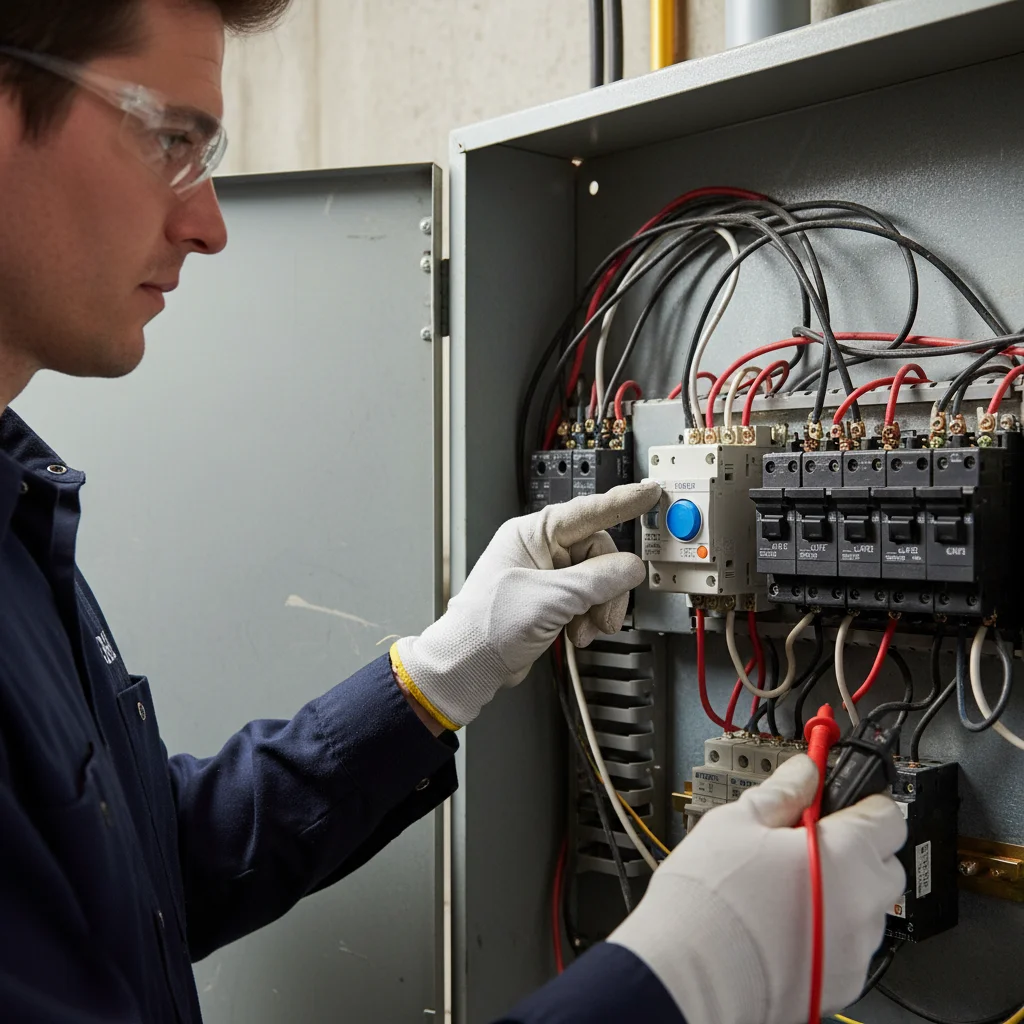
An AFCI watches for fire. A GFCI watches for shock. They are not the same device, and you cannot swap one for the other to stop a trip. If the breaker in your panel has a colored test button and it is protecting a bedroom or living room, it is almost always an AFCI. If a kitchen, bath, garage, or outdoor outlet has TEST and RESET on the receptacle face, that is a GFCI.
Bright Pro Electric matches San Diego County homeowners with licensed C-10 electricians. You hire and pay the electrician directly.
What each one is for
A GFCI (ground-fault circuit interrupter) opens the circuit when current leaks to ground, the path that can go through a person. It belongs where water is present: kitchens, bathrooms, garages, laundry, and outdoor receptacles. That is shock protection.
An AFCI (arc-fault circuit interrupter) watches the waveform for the sputtering signature of an arc inside a cord or a wall. That is fire protection. The National Electrical Code requires AFCI protection in most living spaces. It does not replace GFCI in wet rooms.
Combination AFCI/GFCI breakers exist. Those go in the panel and cover both jobs on that circuit. A combination breaker is not permission to skip GFCI at a wet-location receptacle if the electrician’s load and listing still call for one.
How to tell them apart in the house
Look at where it resets.
- AFCI: reset at the panel. The breaker usually has a colored test button. It does not reset at the outlet.
- GFCI receptacle: TEST and RESET on the outlet itself. Downstream outlets on that same run may be protected without their own buttons.
- GFCI breaker: also in the panel, used when the electrician protects a whole wet-location circuit from the can.
If you are standing in a bedroom with a dead outlet and the only reset is a tripped breaker, read AFCI breaker keeps tripping next. If an outdoor or kitchen GFCI will not take RESET, that is a different job: outdoor GFCI that keeps tripping.
What not to do
Do not replace a required AFCI with a standard breaker because a vacuum trips it. That is a code violation and it removes fire protection.
Do not replace a required GFCI with a plain receptacle because it will not reset. A GFCI that will not stay reset is often a real ground fault. Kill the circuit if the device is warm, wet, or scorched, and treat it as emergency electrical if you smell burning plastic.
A licensed electrician can tell you whether the trip is the appliance, a shared-neutral AFCI incompatibility, a wet-location fault, or a combination device that belongs in the panel. Call (858) 988-5580 and say which room went dead and whether the reset is on the outlet or in the panel.