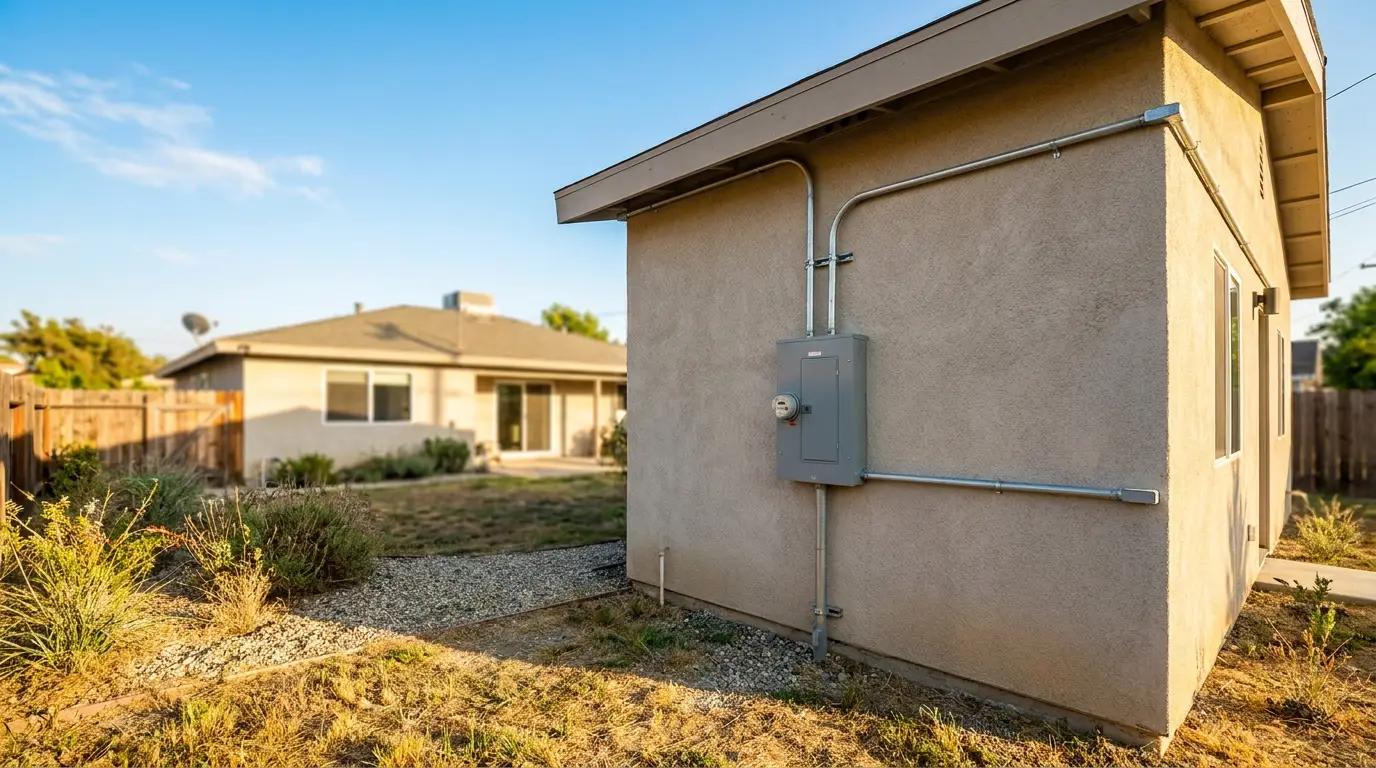
Most San Diego ADUs get their power from a subpanel fed off the main house panel, not from a separate SDG&E meter. State law doesn’t let the utility force a second meter on you, so the real electrical question is capacity: can your existing service carry a whole new dwelling? On the 100A panels most older San Diego homes still run, the honest answer is often no, and the biggest line item on the electrical side ends up being a 200A service upgrade at $2,500 to $4,500 before the ADU subpanel even goes in.
TL;DR
- An ADU (accessory dwelling unit, granny flat, or casita) is almost always powered by a subpanel fed from your main house panel.
- You do not need a separate SDG&E meter. California ADU law bars the utility from requiring one, and a shared service is cheaper anyway.
- A dedicated ADU subpanel typically runs 60A to 100A, sized from a load calculation on the ADU’s own appliances.
- Subpanel install runs roughly $1,500 to $3,500 in San Diego; a detached ADU adds trenching for the underground feeder.
- The hidden cost is the main panel. A 100A service often can’t carry an ADU, so a 200A upgrade ($2,500 to $4,500) comes first.
- Every ADU electrical job needs a permit and inspection, and new detached ADUs are increasingly required to be all-electric.
Does an ADU need its own electrical panel in San Diego
Yes, an ADU needs its own subpanel, but not its own utility service. The standard San Diego setup runs a feeder from your main house panel out to a dedicated subpanel inside or on the ADU. That subpanel then feeds all the ADU’s circuits: lighting, outlets, the mini-split, the range, the water heater. It keeps the ADU’s wiring cleanly separated from the main house on its own breakers, which is what the inspector wants to see.
A separate meter is a different thing, and you almost never need one. California’s ADU law prevents SDG&E from requiring a separate utility connection or meter as a condition of building the ADU. You can add a second meter voluntarily if you want to bill a tenant directly, but it’s an added expense and a longer utility timeline, so most homeowners skip it and feed the ADU from the existing service.
What size electrical does an ADU need
Most San Diego ADUs land on a 60A or 100A subpanel, and the exact size comes from a load calculation, not a guess. A licensed electrician runs the numbers under NEC Article 220 based on what’s actually going into the unit.
| ADU type | Typical loads | Common subpanel size |
|---|---|---|
| Studio or junior ADU | Mini-split, small kitchen, tankless or small water heater | 60A |
| 1-bedroom detached | Mini-split, electric range, heat pump water heater | 100A |
| 2-bedroom all-electric | Heat pump HVAC, range, water heater, EV charger | 100A, sometimes with load management |
The all-electric case is where San Diego ADUs get demanding. When the unit has heat pump heating and cooling, an electric range, a heat pump water heater, and maybe EV charging, the ADU alone can call for close to 100A. Stack that on top of a main house that’s already on a 100A service and the total blows past what the existing panel can carry.
The real cost driver: your main panel
Here’s what catches most San Diego homeowners off guard. The subpanel itself isn’t the expensive part. The expensive part is whether your main service can handle the new load at all.
| Electrical scope | Typical San Diego cost | When it applies |
|---|---|---|
| ADU subpanel, attached or close to main panel | $1,500 to $2,500 | Main service already has spare capacity |
| ADU subpanel, detached with trenched feeder | $2,500 to $3,500+ | Backyard ADU needs an underground run |
| 200A main service upgrade | $2,500 to $4,500 | Existing 100A panel can’t carry the ADU |
If your home already runs a 200A service with open capacity, powering an ADU is mostly the subpanel and feeder run. If you’re on the 100A service that a lot of San Diego homes built before 1990 still have, a load calculation will usually show the ADU tips you over, and the panel upgrade comes first. That’s why an honest quote starts with the main panel, not the ADU. For the full breakdown of that job, see our panel upgrade cost guide and our 200-amp panel guide on when the bigger service makes sense.
There’s also a lighter path in some cases. If your panel is close but not quite there, a load management device can let the ADU and an EV charger share capacity without a full upgrade. We cover that trade-off in the EV charger and panel upgrade bottleneck guide.
Do ADUs have to be all-electric in San Diego
New detached ADUs increasingly do, because California energy code (Title 24) heavily favors all-electric new construction, and San Diego jurisdictions have moved the same direction. A converted-garage or attached ADU may keep gas appliances, but a ground-up detached unit is usually designed all-electric: heat pump HVAC, heat pump water heater, and an electric or induction range.
All-electric matters for your panel math. Every gas appliance you replace with an electric one adds load, which is exactly why so many ADU projects trigger a service upgrade. Plan the electrical around the all-electric assumption and you won’t get surprised at permit time. Confirm the current requirement with your designer or the local building department, since energy code updates on a cycle.
Permits and inspection
Every ADU electrical job in San Diego needs a permit and inspection, no exceptions. The electrical permit is part of the broader ADU building permit, and the work gets inspected at rough-in (before walls close) and again at final. A subpanel feeding a separate dwelling is not a job to do unpermitted, since an unpermitted ADU creates problems at resale and can void a homeowner’s insurance after a fire.
A licensed C-10 electrician pulls the electrical permit, sizes the subpanel from a real load calculation, and coordinates the rough-in inspection timing with the rest of your ADU build. If the job needs a main service upgrade, SDG&E has to pull and reset the meter, which adds a utility scheduling step your electrician handles. For a wider look at when permits are required, see our guide on when electrical permits are required in San Diego.
Frequently asked questions
Does an ADU need a separate electrical meter in San Diego?
No. California’s ADU law prevents SDG&E from requiring a separate utility meter as a condition of building your ADU. Most San Diego ADUs run on a subpanel fed from the main house service instead. You can add a second meter voluntarily, usually to bill a tenant, but it adds cost and a longer utility timeline, so most homeowners skip it.
How much does ADU electrical cost in San Diego?
The subpanel and feeder for an ADU typically run $1,500 to $3,500 in San Diego, with a detached backyard unit landing at the higher end because of the trenched underground run. The bigger variable is your main panel. If your 100A service can’t carry the ADU, a 200A upgrade at $2,500 to $4,500 comes first. Interior ADU wiring, fixtures, and devices are priced separately as part of the build.
What size subpanel does an ADU need?
Most San Diego ADUs use a 60A or 100A subpanel, sized from a load calculation under NEC Article 220. A studio with a mini-split and small kitchen often fits on 60A. A one-bedroom or all-electric ADU with heat pump HVAC, an electric range, and a heat pump water heater usually needs 100A.
Can my existing 100A panel power an ADU?
Sometimes, but often not. A 100A main service already running a full house frequently can’t absorb a whole new dwelling’s load, especially an all-electric ADU. A licensed electrician runs a load calculation to tell you for sure. When the numbers don’t fit, a 200A service upgrade is the fix, and it’s the single biggest electrical cost on most San Diego ADU projects.
Do I need a permit for ADU electrical work?
Yes. All ADU electrical work in San Diego requires a permit and inspection as part of the ADU building permit. The work is inspected at rough-in before the walls close and again at final. Skipping the permit creates disclosure problems at resale, and insurers can deny claims tied to unpermitted or unlicensed work, so this is not a job to do off the books.
Electricians in the Bright Pro Electric San Diego network handle the whole ADU electrical scope: the load calculation, the subpanel and feeder, and the 200A service upgrade when your panel needs it first. They serve all of San Diego County and will tell you honestly whether your existing panel can carry the unit or not. Call (858) 988-5580 to be matched with an electrician for your ADU scope, or see our panel upgrade and smart home wiring service pages. For related planning, check our guides on garage electrical upgrades, what it costs to rewire a house, and how much an electrician costs in San Diego.