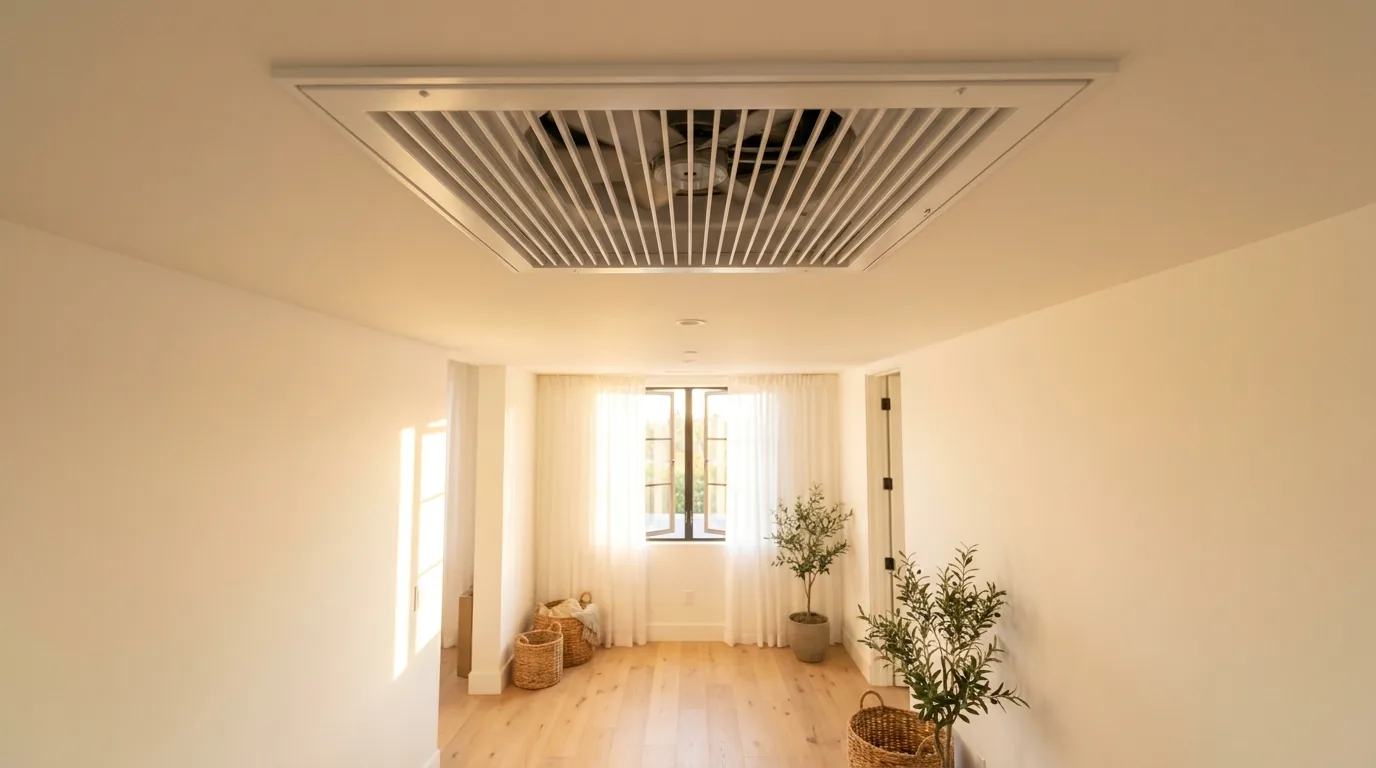
A whole-house fan mounts in a hallway ceiling, pulls evening air in through open windows, and pushes hot air out through the attic. Whether it replaces AC for an evening depends on that night’s temperature and the attic vents. Published installed ranges on this page run $1,200 to $3,500, from a hallway fan on existing attic wiring to a larger or dual-fan system. Attic venting is the check that decides whether the fan can dump heat.
TL;DR
- A whole-house fan cools your living space by drawing cool outside air in through open windows and exhausting hot air through the attic. It is not the same as an attic fan.
- Installed cost in San Diego is published here as $1,200 to $3,500: $1,200 to $2,600 for a hallway fan with existing wiring or a new circuit, and $2,400 to $3,500 for a larger or dual-fan system. Treat those as published ranges on this page.
- Size, amp draw, switch type, and attic venting come from the selected fan’s installation instructions, not a countywide rule of thumb.
- It runs when evening air is cooler than the house. Pairing with a ceiling fan is a comfort choice, not a bill guarantee.
How does a whole-house fan work in San Diego
A whole-house fan pulls cool outside air in and pushes hot inside air out, using open windows as the intake. You open a few windows, switch the fan on in the evening once the outside air has dropped below your indoor temperature, and it draws that cool air across the living space and up into the attic, where it vents out through the roof. Within a few minutes the whole house has swapped its hot, stale air for cool night air.
This is exactly the climate San Diego has. Coastal and near-coastal neighborhoods cool off fast after sunset even on a hot day, so a whole-house fan often replaces the AC entirely for the evening and overnight hours. Inland and in the East County valleys where afternoons hit triple digits, you run it hardest in the early morning and late evening to flush the day’s heat, then close up and let the AC handle the peak. Either way, every hour the fan runs instead of the compressor is money off your SDG&E bill.
How much does whole-house fan installation cost in San Diego
Real installed pricing across San Diego County:
| Scope | Typical San Diego cost |
|---|---|
| Standard install, ties into existing attic wiring, hallway location | $1,200 to $1,800 |
| Install with a new dedicated circuit and wall timer switch | $1,800 to $2,600 |
| Larger or dual-fan system for a 2,500+ sq ft home | $2,400 to $3,500 |
| Added attic venting (roof or gable vents) if the attic is undervented | $300 to $700 |
The fan unit itself is a modest part of the cost. What moves the number is the electrical: whether there’s already a usable circuit in the attic, whether a new switch leg has to be run down the wall, and how easy the attic is to work in. A cramped or low attic adds labor. The other variable is venting. If your attic can’t exhaust what the fan moves, an honest quote includes adding vent area, because installing a big fan over a sealed attic just makes noise.
What size whole-house fan does my house need
Use the manufacturer’s CFM table for the model you are buying. Department of Energy whole-house-fan guidance talks about air changes per hour as a planning idea. The listed CFM, motor amps, and control for your unit override a 2 CFM per square foot shortcut. Inland heat does not change the listing. If the instructions warn against oversizing past attic vent area, follow that warning. An oversized fan on a tight attic can be loud and can backdraft a gas appliance.
Starting-point CFM guesses some electricians use. Use the model sheet, not this table as a coastal vs inland rule.
| Home size | Example at ~2 CFM/sq ft | Example at ~2.5 CFM/sq ft |
|---|---|---|
| 1,200 sq ft | ~2,400 CFM | ~3,000 CFM |
| 1,800 sq ft | ~3,600 CFM | ~4,500 CFM |
| 2,500 sq ft | ~5,000 CFM | ~6,250 CFM |
Bigger isn’t automatically better. An oversized fan on an undersized attic can’t move the air it’s rated for, and it pulls harder than the vents can feed, which makes it loud and can backdraft a gas water heater or furnace. The right size is the one your attic can actually exhaust, which is why sizing the fan and checking the venting happen together.
Do I need a dedicated circuit for a whole-house fan
The amp draw, whether the unit may share a lighting circuit, and the listed control (timer, multi-speed, wireless) are in the selected fan’s instructions. Many residential units are a modest 120V load. That does not make a shared circuit correct if the listing calls for a dedicated circuit. Do not improvise a light switch if the manufacturer specifies a timer or listed control. Panel upgrades are uncommon for this load, but only a licensed electrician confirms the circuit against the listing and the adopted code.
The detail that makes or breaks it: attic venting
Follow the fan’s venting table. A common planning ratio in some manuals is about 1 square foot of net free vent area for every 750 CFM. Screens and louvers reduce net free area. If the listing for your model uses a different ratio, use that. An assessment starts in the attic because a sealed attic cannot exhaust the listed CFM.
This is the step most botched whole-house fan jobs skip. If the attic is sealed up tight, the fan pressurizes it instead of venting it, hot air backs up under the roof, and in the worst case it pulls air the wrong way down a water-heater flue. That’s why an assessment starts in the attic, not at the ceiling. If the venting is short, adding a couple of roof or gable vents is a straightforward fix and it’s what makes the whole system actually cool your house.
Whole-house fan vs attic fan: they’re not the same thing
People use the names interchangeably, but they do different jobs. A whole-house fan cools the living space you occupy by drawing cool outside air through your open windows and across the rooms. An attic fan (or powered roof vent) only moves air inside the attic to lower the attic temperature, with your windows closed. An attic fan can take some load off your AC by keeping the attic cooler, but it does nothing to cool the air you’re breathing. In San Diego’s climate, the whole-house fan is usually the bigger win, because our evenings are cool enough that flushing the living space with night air replaces real AC runtime.
For the hottest San Diego afternoons when it’s still warm outside, a whole-house fan and a ceiling fan work together. The ceiling fan keeps you comfortable at a higher thermostat setting during the peak, and the whole-house fan takes over the moment the outside air drops below your indoor temperature. We cover the AC-offset math on the ceiling side in our guide to how ceiling fans cut San Diego cooling bills.
Permits and who should install it
A whole-house fan install is minor electrical work, but the switch and any new circuit are still permit-eligible in most San Diego jurisdictions, and the venting and framing should be done right. A licensed C-10 electrician handles the wiring, the timer switch, and the circuit, and works with the fan’s cut-in so the ceiling opening is framed and sealed cleanly. For a broader look at what needs a permit, see our guide on when electrical permits are required in San Diego. The parts to leave to a pro are the same ones that cause problems when they’re skipped: the switch wiring, a correctly sized fan, and enough attic venting to let it breathe.
Frequently asked questions
How much does it cost to install a whole-house fan in San Diego?
Installed, a whole-house fan runs about $1,200 to $2,600 in San Diego. The lower end is a standard fan tied into existing attic wiring in a hallway location. The higher end includes a new dedicated circuit and wall timer switch, or a harder attic to work in. A larger or dual-fan system for a 2,500-plus square foot home can run $2,400 to $3,500, and adding attic venting when the attic is undervented is another $300 to $700.
Does a whole-house fan need its own electrical circuit?
Follow the listing. Many units draw 1 to 10 amps on 120V. If the instructions call for a dedicated circuit and a listed timer, that is the install. A plain light switch is only correct if the manufacturer lists it.
What size whole-house fan do I need for my San Diego home?
Use the CFM table in the selected fan’s instructions. A 2 CFM per square foot coastal shortcut is only a starting guess. Do not oversize past what the attic can vent per that listing.
Will a whole-house fan actually cool my house in San Diego?
Yes, and San Diego is close to the ideal climate for it. Because our evenings and mornings cool off quickly, running the fan after sunset pulls that cool air through the house and often replaces the AC entirely for the evening and overnight. On the hottest inland afternoons you still use AC at the peak, but every hour the fan runs instead of the compressor is money off your SDG&E bill.
Is a whole-house fan the same as an attic fan?
No. A whole-house fan cools your living space by drawing cool outside air in through open windows and out through the attic. An attic fan only vents the attic itself to lower its temperature, with your windows closed, and doesn’t cool the air you’re in. In San Diego’s climate the whole-house fan is usually the bigger comfort and cost win.
Independent licensed electricians matched through Bright Pro Electric install whole-house fans against the selected model’s instructions: attic venting, listed CFM, and listed control. Bright Pro does not install fans or offer a free assessment. Use contact for a match, or see ceiling fan installation. Related: ceiling fan installation costs and how much an electrician costs.