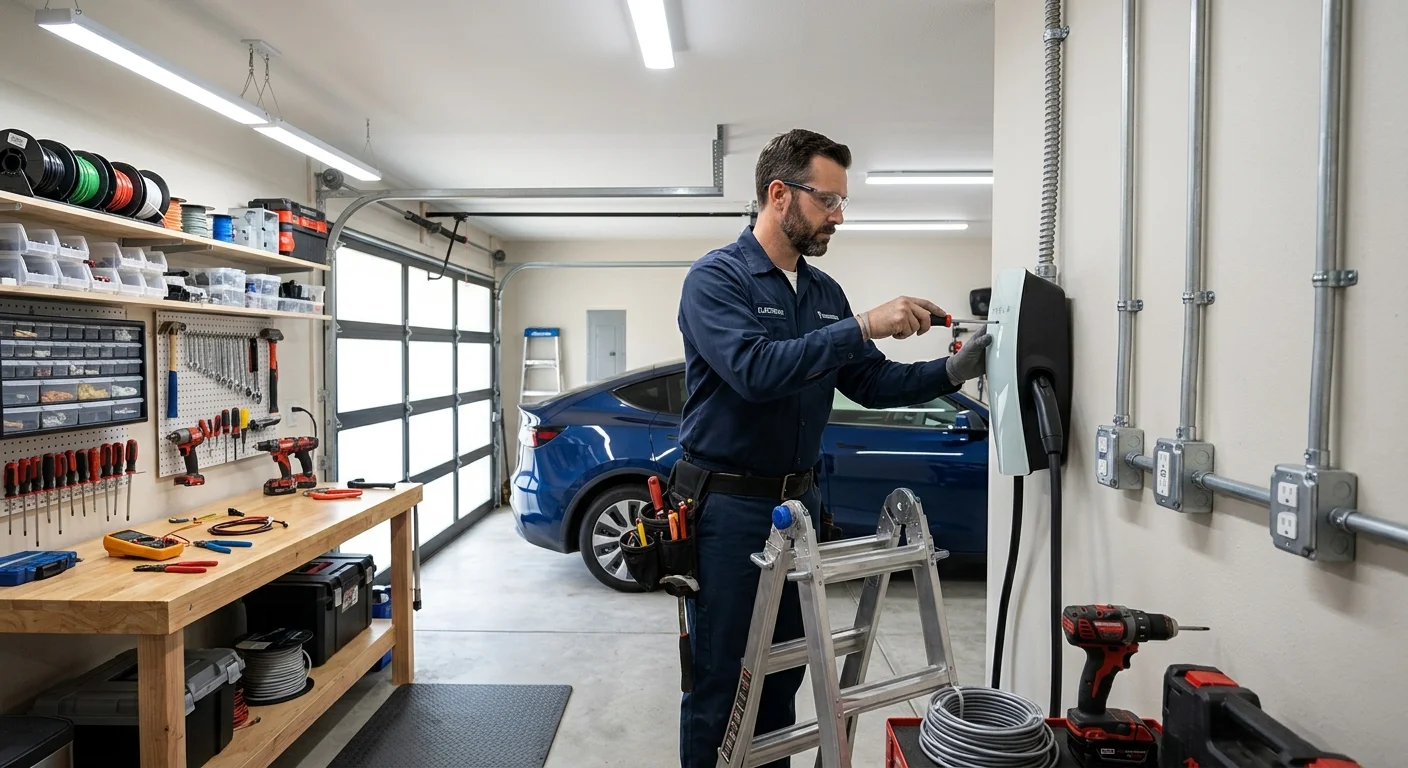
A San Diego garage that still runs on one lighting circuit and a couple of 15-amp receptacles was sized to park a car, not to run a table saw, a freezer, and a Level 2 charger. Upgrade planning starts with how you will use the space, then a load calculation, then the permit your city actually issues.
TL;DR
- Many older garages share one or two 15-amp circuits among opener, lights, and a receptacle. That is a starting point, not a countywide survey.
- Published ranges on this site: a single 20-amp dedicated circuit $300 to $600; a garage subpanel $1,500 to $3,500; EV-related garage work often $1,000 to $5,000 depending on scope. Those figures stay parked.
- Adopted code requires GFCI protection on the 15- and 20-amp 125-volt garage receptacles that the code section covers. It is not a claim that every device in the building is a GFCI receptacle.
- Level 2 charging needs a circuit sized to the charger nameplate (often 240 volts). Level 1 overnight charging uses 120 volts. Not every EV install is a 240-volt homerun.
- New circuits, panel changes, and most 240-volt work need an electrical permit in the City of San Diego unless an exemption applies. Bright Pro does not pull permits.
Why so many garages feel under-powered
Pre-2000 houses often fed the garage from leftover capacity on a house circuit. That was enough for an opener and a lamp. Tools, welders, gym equipment, and refrigeration each add continuous or motor-start load. Extension cords and power strips are a symptom, not a circuit. If you already have trips, flicker, or warm devices, start with electrical troubleshooting before you design a shop.
20-amp circuits, tools, freezers, and chargers
A 20-amp, 120-volt circuit is 2,400 watts at the math, with continuous-load sizing still applying. Whether a saw, freezer, or treadmill needs its own circuit comes from the nameplate and how many other loads share the run, not from a Bright Pro “we often recommend several dedicated circuits” list.
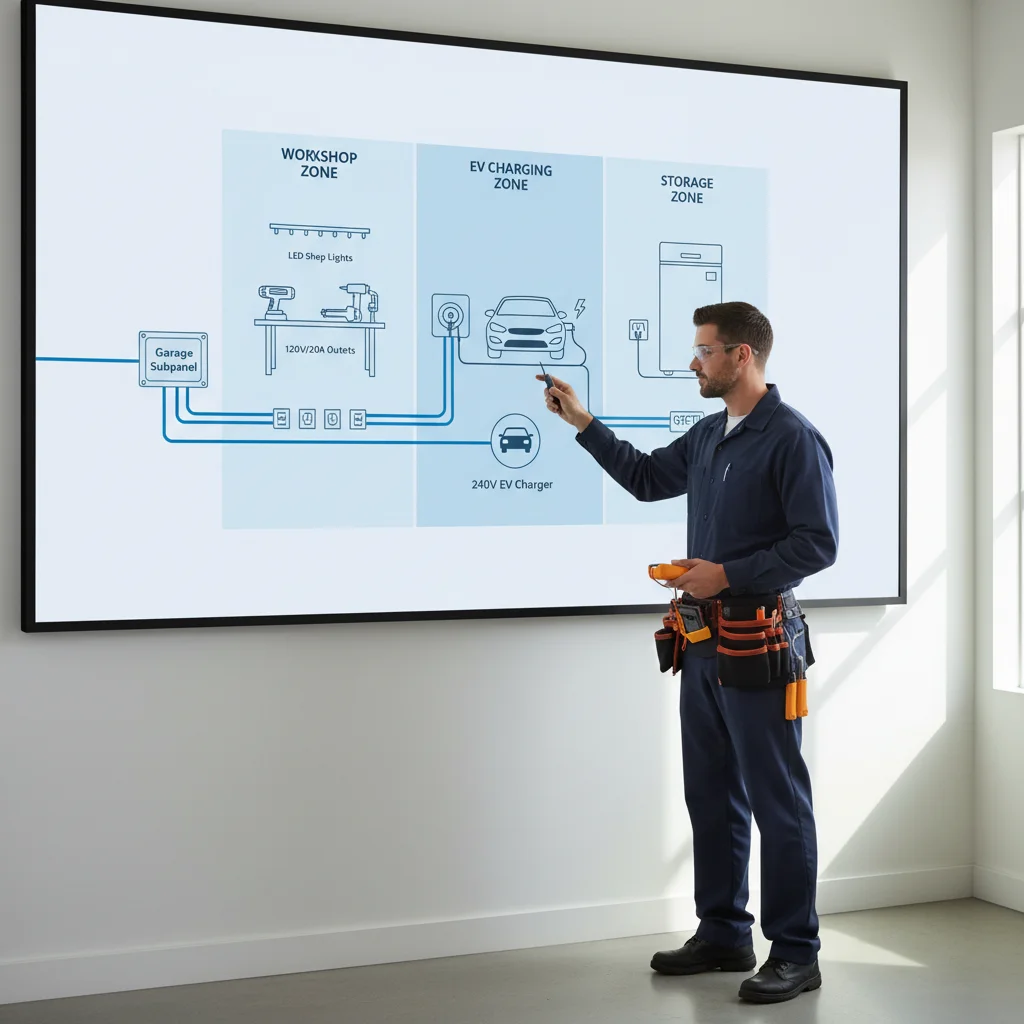
Level 2 EVSE is usually 240 volts on a dedicated circuit sized at 125% of continuous current. Hardwired vs plug-in (NEMA 14-50) is an equipment choice. See EV charger installation and the San Diego EV charger guide. For when a dedicated circuit is the right category, see dedicated circuits. New receptacles are outlet and switch installation.
Lighting
LED shop lights and switched wall controls are a use decision: task light over a bench, ambient light for parking. Energy use is lower than old incandescent or aging fluorescent, but this page does not publish a percent savings. Lighting installation is licensed work when it is new wiring, not a bulb swap.
GFCI in the garage
GFCI devices open when they see a difference between hot and grounded conductor current. Adopted NEC/CEC rules require GFCI protection for 125-volt, 15- and 20-amp receptacles in garages for work under that code cycle. Protection can be at the receptacle or upstream (GFCI breaker or feed-through). A garage GFCI can also feed other receptacles; a trip in the garage can darken an adjacent room. See why a breaker keeps tripping and GFCI costs and requirements.
When a garage subpanel is on the table
A subpanel is a distribution choice when you need several new branch circuits and the main is full, far away, or both. A single EV circuit plus one tool receptacle may still homerun to the main. A shop conversion with several 20-amp circuits, lighting, and 240-volt equipment often justifies a garage can. That is still an onsite call. Main-service limits can mean a panel upgrade instead of or in addition to a subpanel. Cost context: panel upgrade cost.
Rough costs (parked)
These are this site’s published ranges, not a quote:
- Single new 20-amp dedicated circuit: $300 to $600. Long or finished runs cost more. See cost to add an outlet.
- LED shop lights installed: $100 to $300 per fixture, depending on type and wiring.
- GFCI device as part of a larger job: $75-$150 per outlet on this site’s range.
- EV charger circuit (240V): $800 to $2,000 or more, distance and panel capacity driven.
- Garage subpanel: $1,500 to $3,500 or more.
- Broader garage overhaul: $1,000 to $5,000+.
Permits are extra line items in most quotes. Verify the installer’s CSLB number at CSLB lookup. Bright Pro Electric is not the licensee.
Frequently asked questions
Does my San Diego garage need GFCI outlets?
For new 15- and 20-amp 125-volt garage receptacles under the adopted code, GFCI protection is required. Existing older receptacles are a different conversation (repair vs remodel). Moisture and concrete floors are why the rule exists.
When do I need a subpanel versus circuits from the main?
When you are adding several high-draw circuits and the main is full or the garage is a long run. One EV circuit plus a couple of receptacles often stays on the main. A full workshop is the usual subpanel case. Distance, slot count, and calculated load decide it.
How much does a garage electrical upgrade cost in San Diego?
Single 20-amp circuit $300 to $600. LED fixtures $100 to $300 installed. 240-volt EV circuit $800 to $2,000. Subpanel $1,500 to $3,500. Combined work $1,000 to $5,000 or more. Panel work is separate.
Does a garage electrical upgrade require a permit in San Diego?
New circuits, panel modifications, and 240-volt outlets generally need an electrical permit in the City of San Diego unless SDMC 129.0303 exempts that specific task. Other cities and the County have their own counters. Bright Pro does not file those applications. The licensed contractor or, where allowed, the owner does.
When to call
New circuits, subpanels, and 240-volt EV work are not weekend wiring. Bright Pro Electric matches you with an independent licensed electrician. Hours are Monday through Saturday, 7am to 7pm. Use the contact form.