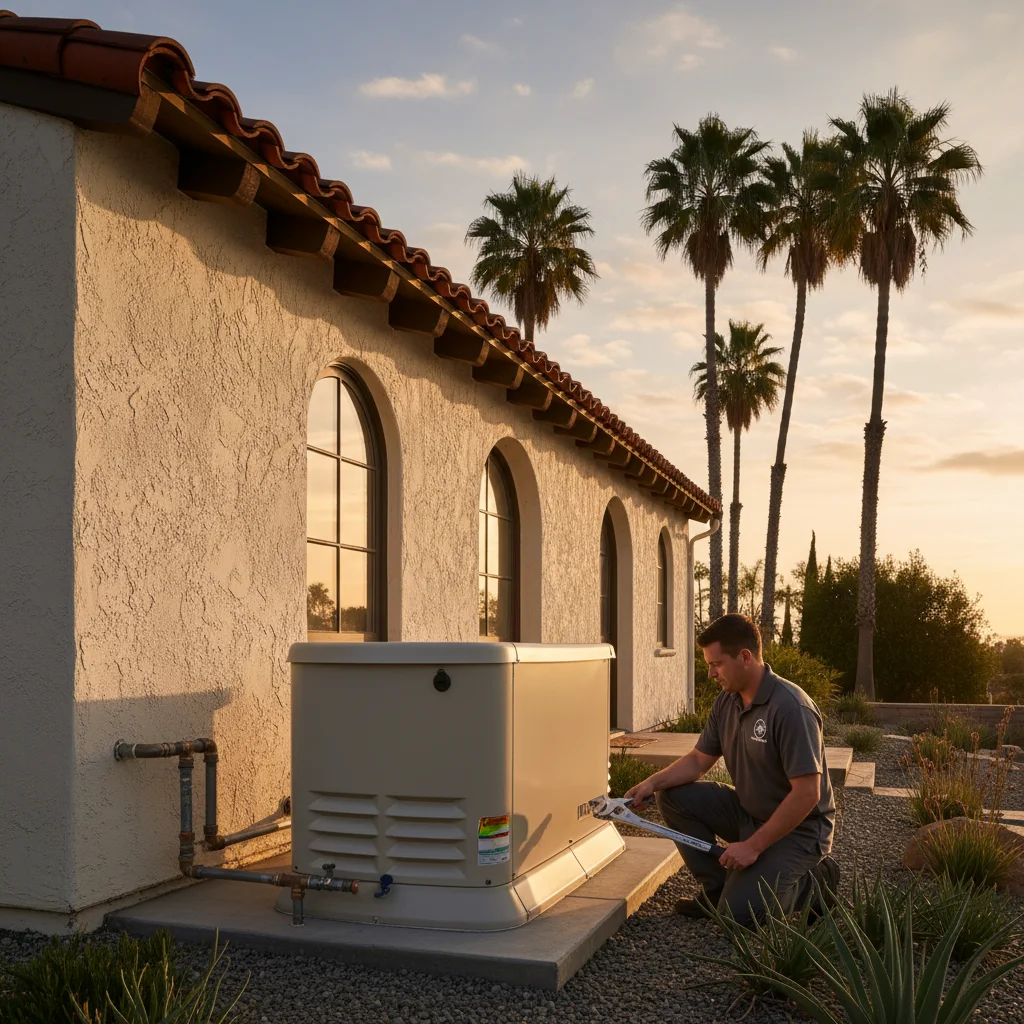
Start with three facts: which loads must stay on (medical devices, well pump, refrigerator), what fuel you already have, and which building department reviews the pad and transfer switch. PSPS events make those questions urgent. They do not set a countywide outage duration. This guide covers fuel, sizing, permits, and a typical install sequence.
TL;DR
- A 13-20 kW natural gas standby generator with transfer switch typically costs $6,000-$12,000 on this page. Pad, permits, gas line, and labor stay separate until the electrician’s quote says otherwise. That is a published range, not a Bright Pro all-in package.
- Natural gas is one fuel path for San Diego homes already on SoCalGas, with no on-site tank to manage. Whether the gas system stays up during a PSPS event is the utility’s, not a promise on this page.
- Size by load calculation, not guesswork. Read the AC nameplate.
- Every installation needs a permit from the reviewing authority for your address, covering electrical and usually gas. Unpermitted work can complicate a sale. Ask your insurer about coverage. It is not automatically denied.
- An automatic transfer switch (ATS) detects an outage and switches over in 10-15 seconds without any action required.
When a whole-house generator makes sense in San Diego County
A portable generator handles a few lights and a phone charger. A whole-house standby generator, think Generac, Kohler, or Cummins units mounted permanently on a concrete pad, starts automatically within seconds of an outage and powers everything your home normally runs.
That distinction matters most for specific households. If someone in your home relies on a CPAP, oxygen concentrator, dialysis machine, or refrigerated medication, a standby generator isn’t a luxury. It’s a safety baseline. The same applies to home offices where a few hours of downtime costs real money, or to households with well pumps (common in Ramona and Valley Center) that lose water pressure the moment the grid goes dark.
San Diego’s fire-risk maps affect where utilities shut power. They do not tell you how many days your street will be dark. PSPS shutoffs and generator options covers policy. This page stays on protected loads, fuel, and the reviewing authority.
Cost ranges vary by system size. A 13–20 kW natural gas unit with a transfer switch typically runs $6,000–$12,000 on this page. Larger 22–26 kW systems for bigger homes can reach $15,000 or more. Those are published ranges, not a Bright Pro quote and not a manufacturer MSRP. Pad, permit fees, gas line work, and labor are separate line items until the electrician’s quote says otherwise.
Natural gas vs. propane vs. diesel for our climate
Fuel choice shapes nearly everything: ongoing cost, installation complexity, and how long you can run during a multi-day outage.
Natural gas is one fuel path for homes already on SoCalGas. The generator ties into the existing line. There is no tank to fill. Whether gas stays on during an electric PSPS is the utility’s. Confirm fuel availability with the gas utility and the generator listing. Independent licensed electricians commonly install air-cooled 18 kW and 22 kW units on natural gas. Bright Pro does not stock or install them.
The one caveat: during a major regional emergency (a large earthquake disrupting gas infrastructure, for example) natural gas could be interrupted. It’s a low-probability scenario, but worth knowing.
Propane makes sense when you’re outside the SoCalGas service area or on a large rural lot. You’ll need a tank (500–1,000 gallons is typical for a whole-house system), and consumption adds up fast. A 20 kW generator burns roughly 2–3 gallons of propane per hour at half load. A full 1,000-gallon tank gives you several days of runtime if you’re conservative. Kohler’s 20RESAL is a popular propane unit for properties in the back-country.
Diesel is mostly commercial. Residential storage and fuel cycling make it a poor fit for most single-family lots. A licensed electrician or generator dealer can say whether it applies. Bright Pro does not recommend equipment.
San Diego’s mild climate works in your favor here. Unlike cold-weather regions where diesel gels or extreme heat stresses cooling systems, our weather is relatively gentle on generator hardware year-round. That said, units still need adequate airflow clearance, especially during August and September when ambient temps in inland valleys can push 100°F.
Sizing: matching kW to your panel and load
Sizing a standby generator wrong is the most expensive mistake homeowners make. Undersized and it trips on overload when the AC kicks on. Oversized and you’ve spent $4,000 more than necessary.
The starting point is your main panel. If you have a 100-amp service, your generator options are inherently limited, and you may want to look at a panel upgrade before or alongside generator installation. Most modern San Diego homes have 200-amp service, which supports the full range of residential standby generators.
Load calculation, not guesswork
A proper load calculation adds up the wattage of everything you want to run simultaneously. The critical loads for most households:
- Central AC (often the biggest listed load; read the nameplate)
- Refrigerator and freezer
- Well pump or sump pump if applicable
- Lighting and outlets
- Garage door, security system, router
A 13 kW generator covers essential circuits in a mid-size home but may struggle if you want to run AC and an electric range simultaneously. A 22 kW unit handles a 2,500–3,500 sq ft home comfortably with most appliances running. Cummins’ RS22A and Generac’s 22 kW Guardian are both well-matched to larger San Diego homes.
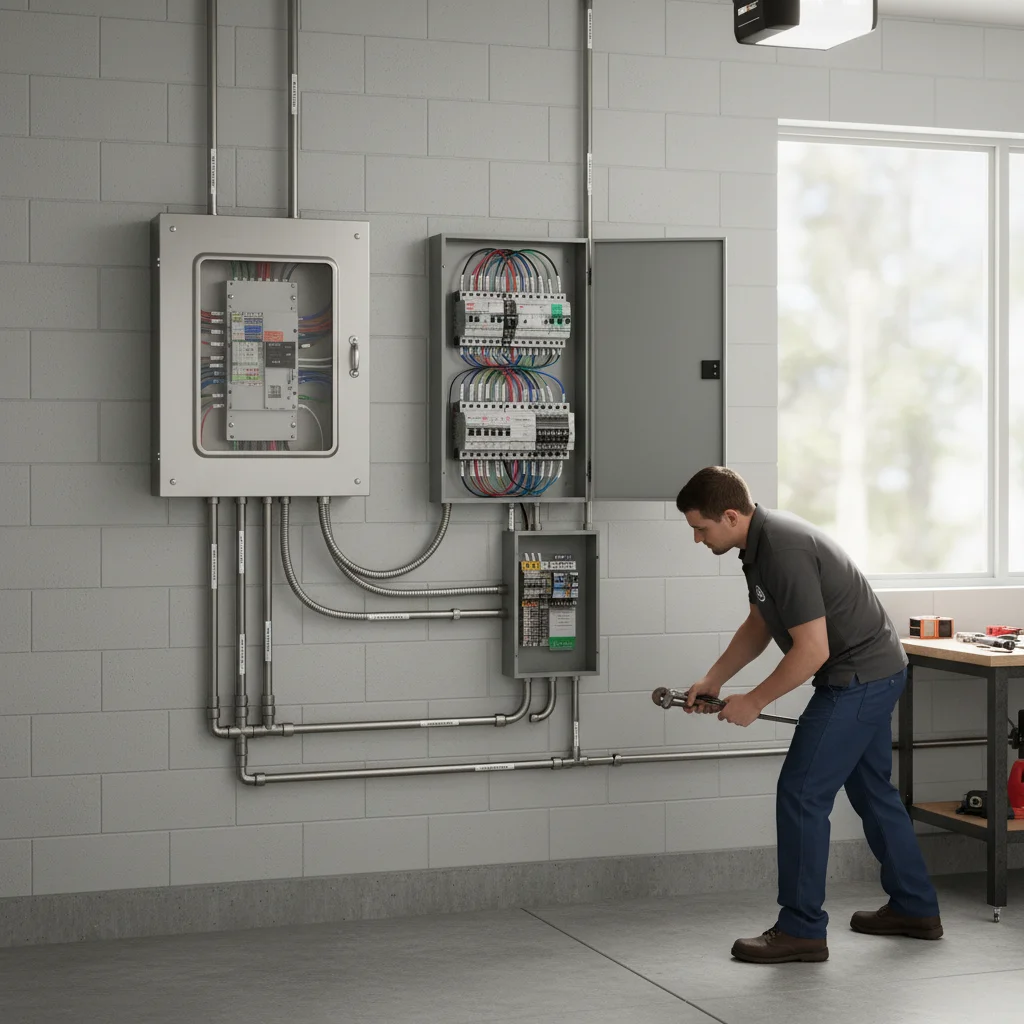
Transfer switch choice also affects this calculation. A manual transfer switch is cheaper but requires you to physically flip it. An automatic transfer switch (ATS) detects the outage and switches over within 10–15 seconds, no action required. For a whole-house standby system, an ATS is a common listed path. Whether it is worth the extra cost is the quote, not this page. If you’re comparing a manual interlock kit against a transfer switch for a portable generator setup, our generator interlock vs. transfer switch guide covers the cost and code differences. Some ATS units also include load management, which lets a smaller generator handle more circuits by shedding non-essential loads during high-demand moments.
Permits, setbacks, and HOA rules in cities like Poway and Carlsbad
Every permanent standby generator needs a building permit from the city or county that reviews that address. Skipping it can complicate a sale and an inspection. Ask your insurer whether unpermitted equipment affects a claim. That is a policy question, not a denial rule.
What the permit covers
The permit process typically involves two inspections: one for the electrical work (transfer switch, panel connections) and one for the gas line extension. In most San Diego County jurisdictions, the electrical permit is pulled by the licensed electrician and the gas work is handled by a licensed plumber or the electrician if they hold both licenses. The electrician you hire pulls the electrical permit. Gas work is a licensed plumber or a contractor who holds the right classifications. Bright Pro does not coordinate permits.
Setback requirements vary by city and by fuel type. Most jurisdictions follow a rule of at least 5 feet from windows and doors, 18 inches from the structure wall, and compliance with NFPA 70 (National Electrical Code) for the electrical connections. Carlsbad and Poway both follow California Building Code amendments that may add local requirements. The permit office in each city has the current standards.
HOA rules are a separate layer and often more restrictive than city code. Some HOAs in communities like 4S Ranch or Rancho Bernardo require architectural review before installation and may dictate where on the lot the generator can sit, what enclosures are required, and whether screening vegetation is mandatory. Check with your HOA board before finalizing pad placement. Moving a poured concrete pad after the fact is expensive.
When you’re verifying any contractor you hire for this work, confirm their CSLB license is current and covers the scope. You can verify a California contractor license directly through the CSLB.
Install timeline and what a typical day looks like
From permit application to first test run, a straightforward whole-house generator installation in San Diego takes two to four weeks. Here’s how that breaks down.
Week one: Site assessment, load calculation, equipment selection, and permit application. The electrician measures pad location, confirms gas routing, and orders equipment. Lead times depend on the distributor, not on a Bright Pro warehouse.
Install day (typically one full day for a standard installation):
The crew arrives early. Concrete is poured for the pad, or a pre-poured pad is used if the site allows. The generator is set and bolted down. Gas line extension is run from the meter. This work happens in parallel with the electrical run from the main panel to the transfer switch location. The ATS is mounted in or adjacent to the main panel, wired in, and labeled. Final connections are made to the generator control board.
By mid-afternoon, the system is ready for commissioning: a startup test under load, transfer switch timing verification, and a walkthrough showing you how to check oil, exercise the unit, and interpret the control panel indicators.
After install: The inspector visits, usually within a week. Most inspections pass first time when the work is done to code. SDG&E is notified of the new load connection. This is standard procedure that doesn’t require action on your part.
Maintenance contracts and what they should include
A standby generator sits dormant most of the year, which is exactly why maintenance matters. Engines that don’t run degrade. Gaskets dry out, fuel systems gum up, and batteries lose charge.
A solid annual maintenance contract should cover:
- Weekly auto-exercise test (most modern generators do this automatically, and the contract should verify it’s functioning)
- Annual service visit: oil and filter change, spark plug inspection, air filter replacement, battery load test, coolant check on liquid-cooled units
- Transfer switch inspection: contact cleaning, timing verification
- Firmware updates for Wi-Fi-enabled models (Generac’s Mobile Link system, for example, lets you monitor the unit remotely and receive alerts)
Expect to pay $150–$300 per year for a residential maintenance contract in San Diego County, depending on generator size and what’s included. Some manufacturers, including Generac and Kohler, have dealer networks that offer branded service agreements. Parts availability is usually faster through that dealer channel. Bright Pro does not sell maintenance contracts.
What a contract should not skip: the transfer switch. That component works hard and is often overlooked. A generator that runs fine but doesn’t transfer properly is useless in an actual outage.
If your generator is fueled by natural gas, there’s no fuel management to worry about. Propane owners should set up automatic delivery with their supplier so the tank never drops below 25%. Most suppliers offer this as a standard account option.
Frequently asked questions
How much does a whole-house generator cost in San Diego?
A 13-20 kW natural gas standby generator with transfer switch typically costs $6,000-$12,000 on this page. Larger 22-26 kW systems for bigger homes can reach $15,000 or more. Those are published ranges, not a Bright Pro all-in package. Pad, permit fees, gas line work, and labor stay separate until the electrician’s quote says otherwise. A propane system on a rural lot with tank installation adds $2,000-$4,000 on top of that as a published add-on range.
Do I need a permit for a standby generator in San Diego?
Yes. Every permanent standby generator needs a permit covering the electrical work and usually the gas line. The reviewing authority is the city or county for that address. Skipping permits can complicate a sale. Ask your insurer about claims. Coverage is not automatically invalidated.
What size generator do I need for a San Diego home?
A proper load calculation adds up the wattage of everything you want to run simultaneously. Central AC is often the biggest listed load. Read the nameplate. Undersized generators trip when that load starts. A 13 kW unit covers essential circuits in a mid-size home on many quotes; a 22 kW unit is a larger-house path. A licensed electrician performs a load calculation before recommending a unit size. Bright Pro does not size generators.
Will my HOA in San Diego allow a whole-house generator?
Possibly, with conditions. HOAs in communities like 4S Ranch, Rancho Bernardo, and Carmel Valley often require architectural review before installation and may specify where on the lot the generator can sit, what type of enclosure is required, and whether screening vegetation is mandatory. Check with your HOA board before finalizing pad placement, moving a poured concrete pad after the fact is expensive. Your electrician can advise on setback and screening requirements, but HOA approval is separate from city permits.
When to call us
Whole-house generator installation is licensed electrician and, for gas, licensed gas work. It is not a handyman job. If the panel cannot support the generator, that shows up in the load calculation. Bright Pro Electric matches you with an independent licensed electrician. We do not handle permits, load calculations, or inspections ourselves.
Use contact for a match. Leave a message any time. See generator installation.