A GFCI that won’t reset almost always means one of three things: no power is reaching it, something on the circuit is causing a real ground fault, or the device has failed after years of service. Rarely is it a stuck button.
TL;DR
- Check for power first. A tripped breaker or an upstream GFCI can leave a downstream outlet dead with no reset possible.
- A real ground fault, often moisture in an outdoor or bathroom box, will hold the GFCI open no matter how many times you press RESET.
- Reversed LINE and LOAD wiring from a past install is a common reason a GFCI never resets properly.
- GFCI devices wear out after 10 to 15 years and can fail in a way that prevents reset entirely.
- A GFCI that won’t reset in a wet or exterior location is a call-tonight situation, not a wait-and-see one.
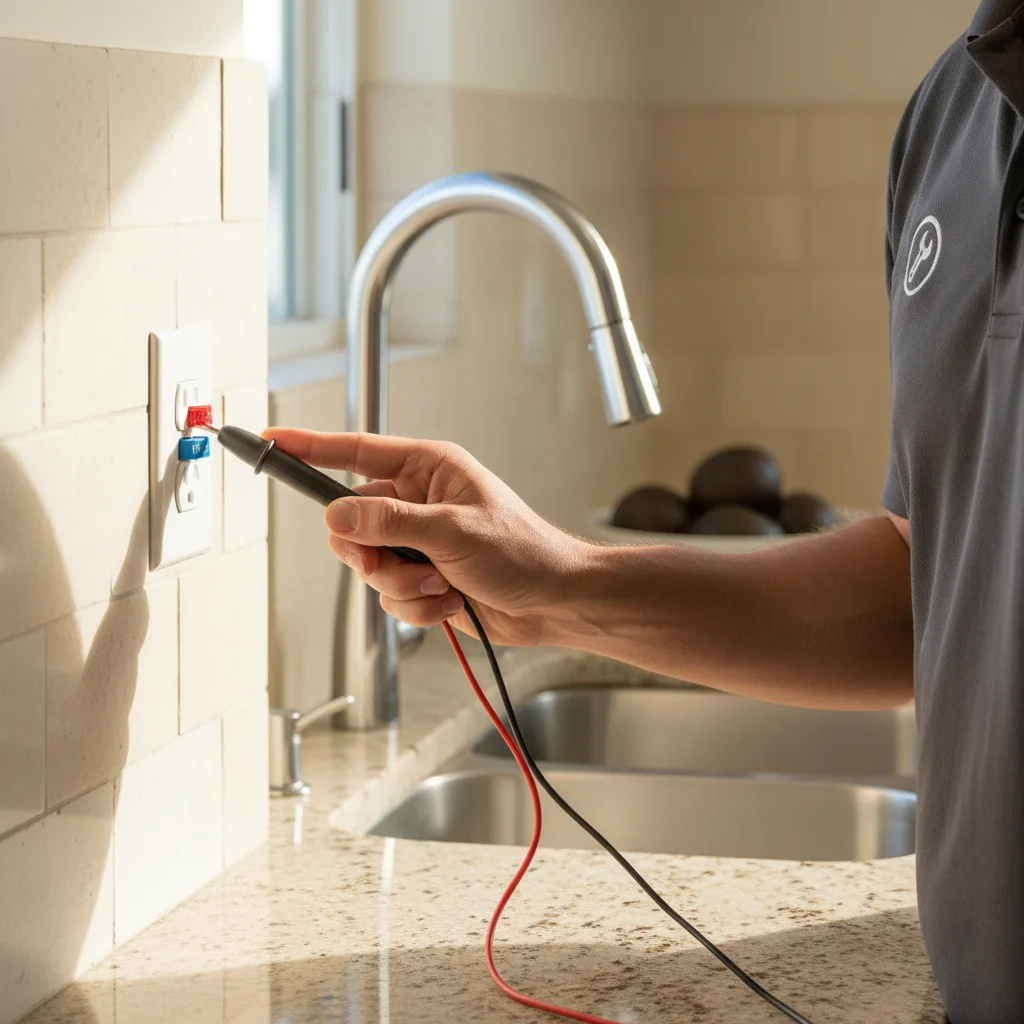
First, confirm the outlet has power at all
Before assuming the GFCI itself is broken, rule out the simplest explanation: it isn’t receiving power. Check your breaker panel for anything tripped or sitting in the middle position, and reset it firmly to OFF and then back to ON.
GFCI outlets are often wired to protect several standard outlets downstream on the same circuit, and some sit downstream of another GFCI. If an upstream GFCI in a kitchen, garage, or exterior location tripped, the one you’re staring at may have zero power reaching it, and the RESET button will do nothing no matter how many times you press it. Walk the house and check every GFCI, not just the one that seems affected.
Rule out a real ground fault
If the outlet has power and still won’t hold a reset, the next most common cause is a genuine ground fault on the circuit. This isn’t the GFCI malfunctioning. It’s refusing to energize a circuit where current is leaking somewhere it shouldn’t.
Moisture is the usual culprit in San Diego, especially in exterior outlets after irrigation runs, on patios near pools, or in bathroom boxes with poor ventilation. A faulty appliance or extension cord downstream can also cause this. Unplug everything on the circuit, dry out any wet covers you can see, and try the reset again. If it holds with everything unplugged, you’ve found a device to blame. If it still won’t hold, the fault is in the wiring itself.
Check whether LINE and LOAD got reversed
A GFCI outlet has two sets of terminals: LINE, where incoming power connects, and LOAD, which feeds downstream outlets. If an electrician or a previous DIY job connected the incoming power to the LOAD terminals by mistake, the outlet will often refuse to reset at all, or it will reset but provide no actual protection.
This is one of the more common reasons a GFCI installed within the last few years never worked right from day one. It’s not something you can safely diagnose by eye. If the outlet is one that’s never reliably reset since it was installed or replaced, wiring reversal is a real possibility and it needs a licensed electrician to open the box and check.
Consider a failed device
GFCI outlets have a service life of roughly 10 to 15 years. San Diego’s coastal humidity and salt air shorten that window for exterior and bathroom units in particular. The internal sensing mechanism is mechanical and electronic, and it can fail in a way that locks the device in a tripped state permanently, especially after age, corrosion, or a power surge.
If you’ve confirmed power is present, ruled out an obvious ground fault, and the outlet still won’t reset, replacement is usually the answer. Our GFCI outlet replacement guide covers the signs of a failing device and what a straightforward swap costs. Our GFCI outlet installation cost and requirements guide covers where protection is required and what a new install involves.
Work through it in this order
- Check the breaker panel for anything tripped and reset it.
- Check every other GFCI in the house, not just the affected outlet, since one upstream trip can kill several downstream.
- Unplug everything on the circuit and try the reset again.
- If it still won’t hold, suspect a real ground fault, most often moisture, and check exterior or bathroom locations first.
- If the outlet has never reset reliably since it was installed, suspect reversed LINE and LOAD wiring.
- If none of that explains it, the device has likely failed and needs replacing.
Bathrooms carry their own set of code requirements around GFCI placement and circuit sizing. Our bathroom GFCI outlet requirements guide covers what San Diego code expects in that specific room.
Safe DIY checks vs. when to stop
Checking the breaker panel, testing other GFCIs in the house, and unplugging devices to isolate the problem are all safe for a homeowner to do. None of that involves opening an outlet or touching live wiring.
What isn’t safe to DIY: opening the GFCI to inspect LINE and LOAD wiring, replacing the device yourself if you’re not confident with electrical work, or forcing repeated resets on an outlet that’s warm, smells like burning plastic, or shows scorching around the face. A GFCI that won’t reset in a wet location, like an exterior outlet after rain or one near a pool, is a same-day call, not something to leave dead overnight. Coastal homes, including an electrician in La Jolla, see this pattern often, since salt air corrodes exterior devices faster than inland neighborhoods.
Frequently asked questions
Why does my GFCI outlet trip immediately after I reset it?
That’s a strong sign of a real ground fault, not a stuck button. Something on the circuit, often moisture in an exterior or bathroom box, is causing current to leak to ground, and the GFCI is correctly refusing to stay on. Unplug everything on the circuit and try again before assuming the device is bad.
Can a GFCI outlet fail in a way that stops it from resetting?
Yes. After 10 to 15 years, the internal sensing mechanism can wear out and lock the device in a tripped state. This is more common in exterior and bathroom outlets exposed to humidity and salt air, and the fix is replacement, not repeated resets.
Is it dangerous to keep pressing reset on a GFCI that won’t hold?
Not dangerous by itself, but it wastes time if there’s an actual ground fault or wiring problem. If two or three clean reset attempts don’t hold, stop and work through the checklist above rather than repeating the same step.
Why would a brand new GFCI never reset properly?
Reversed LINE and LOAD wiring during installation is a common cause. Power connected to the LOAD terminals instead of LINE can prevent the outlet from resetting correctly, or leave it without real protection even when it appears to work. This needs a licensed electrician to correct.
One GFCI trip killed outlets in another room. Is that normal?
Yes. A single GFCI often protects several standard outlets wired downstream on the same circuit, sometimes in a different room entirely. Check every GFCI in the house, including the garage and exterior locations, before assuming the dead outlets have a separate cause.
When to call us
A GFCI that won’t reset after you’ve checked the breaker, unplugged the circuit, and confirmed it isn’t just an upstream trip is a job for a licensed electrician, especially if the outlet is in a wet or exterior location. Our electrical troubleshooting service covers exactly this kind of diagnosis, tracing whether the problem is a ground fault, reversed wiring, or a failed device. If the outlet is hot, sparking, or smells like burning plastic, that’s a job for our emergency electrical service instead of a wait-and-see. Call us at (858) 988-5580 for a same-day estimate.