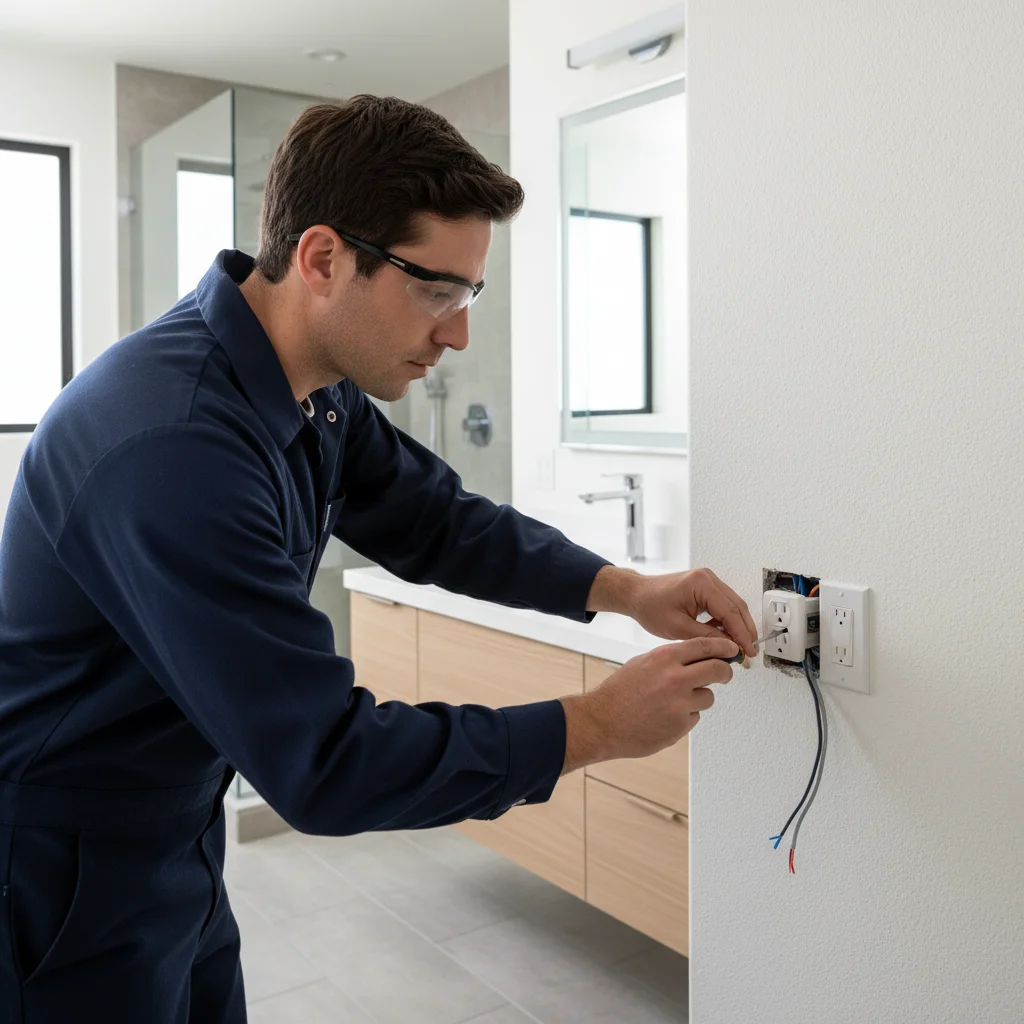
Planning a bathroom remodel in San Diego County means paying close attention to the electrical code, especially when it comes to outlets. The combination of water and electricity makes bathrooms one of the most regulated rooms in the house. Getting the rules for Ground Fault Circuit Interrupter (GFCI) outlets wrong can lead to failed inspections, costly rework, and serious safety hazards.
TL;DR
- Every outlet in a San Diego bathroom must have GFCI protection. No exceptions for new construction or remodels.
- Bathroom outlets also need a dedicated 20-amp circuit. They can’t share a circuit with bedrooms, hallways, or other rooms.
- At least one outlet must be within 3 feet of each sink basin. No outlets are allowed inside a shower or tub footprint.
- A simple GFCI swap in an existing box runs $175 to $300. Adding a new outlet on a new 20-amp circuit runs $450 to over $900.
- All new bathroom outlets must be tamper-resistant (TR). Inspectors flag missing TR receptacles as a separate code violation.
Where bathroom GFCI is required by code
The rule here is simple and absolute: all 125-volt, single-phase, 15- and 20-amp receptacles installed in a bathroom must have GFCI protection. This isn’t a suggestion; it’s a strict requirement of the National Electrical Code (NEC), which is adopted and enforced here in San Diego. This applies to new construction, remodels, and even when you’re just adding a new outlet.
What does a GFCI do? It’s a fast-acting circuit breaker designed to shut off electric power in the event of a ground fault, which happens when electricity takes an unintended path to the ground. In a bathroom, that path could be through a person holding a hairdryer with wet hands. The GFCI monitors the flow of current and if it detects even a tiny imbalance, as small as 4-6 milliamps, it trips the circuit in as little as 1/30th of a second, preventing a potentially lethal shock.
This protection can be provided in two ways:
- GFCI Receptacle: This is the most common method. The outlet itself has the “TEST” and “RESET” buttons. It protects itself and can also be wired to protect other standard outlets “downstream” on the same circuit.
- GFCI Circuit Breaker: The protection is built into the circuit breaker in your main electrical panel. This protects the entire circuit, so every outlet, light, and fan connected to it is GFCI-protected.
For any bathroom project, you must ensure every single standard outlet has this life-saving feature.
20-amp small-appliance branch circuit rule
Beyond just requiring GFCI protection, the electrical code has specific rules for the circuit that powers your bathroom outlets. The code, specifically NEC 210.11(C)(3), requires that at least one 20-amp branch circuit is provided to supply the bathroom receptacle outlet(s). This is to ensure the circuit can handle the load from modern, high-power devices like hair dryers, curling irons, and electric shavers without constantly tripping the breaker.
There are two primary ways to comply with this 20-amp circuit rule:
- A dedicated 20-amp circuit for all bathroom outlets: You can run a single 20-amp circuit that supplies power to the GFCI receptacles in multiple bathrooms. However, this circuit can only power receptacles. It cannot be used for lighting, exhaust fans, or any other electrical equipment in any room.
- A dedicated 20-amp circuit for one bathroom: You can run a single 20-amp circuit that supplies power to all the electrical equipment (receptacles, lighting, and exhaust fan) in a single bathroom. This is a common and practical approach for most remodels, as it contains all of that bathroom’s wiring to one breaker.
What you cannot do is power the bathroom receptacles from a general-purpose 15-amp lighting circuit that also serves a bedroom or hallway. The days of tapping into a nearby circuit for a new bathroom outlet are long gone. Inspectors in San Diego look for this specifically, and it’s a common reason for a failed inspection. Ensuring you have a properly sized and dedicated 20-amp circuit is just as important as the GFCI protection itself.
Outlet placement: distance from sink and tub
The code is also very specific about where you can and cannot place outlets in a bathroom. These rules are designed for both convenience and safety, ensuring power is accessible where you need it without creating a shock hazard.
The primary rule for sinks is found in NEC 210.52(D). It requires at least one receptacle to be installed within 3 feet of the outside edge of each basin. The measurement is taken horizontally, without regard for walls or cabinets. If you have a double vanity with two sinks, you need an outlet for each one, placed within that 3-foot zone. Most designers place an outlet on each side of a double vanity, or one in the middle, to easily meet this requirement.
The rules for tubs and showers are even stricter, focusing entirely on safety. NEC 406.9(C) states that no receptacle can be installed within a shower or bathtub space, including the area directly above the tub. This means you cannot have an outlet inside the shower stall or within the footprint of your bathtub. This prevents a scenario where a plugged-in appliance could fall into the water, creating a severe electrocution risk even with GFCI protection. For any bathroom remodel, planning your outlet and switch installation with these clearances in mind is a critical first step.

Replacing a non-GFCI bathroom outlet safely
If you live in an older San Diego home, you might have bathrooms with old, two-prong outlets or standard three-prong outlets without GFCI protection. Upgrading these is one of the most important safety improvements you can make. While it may seem like a simple swap, electrical work carries inherent risks, and it’s best handled by a licensed professional.
Here’s the process a qualified electrician follows to ensure a safe replacement:
- De-energize the Circuit: The first and most crucial step is to turn off the power at the electrical panel. An electrician will use a voltage tester to confirm with 100% certainty that the power is off at the outlet box before proceeding.
- Remove the Old Outlet: The cover plate is removed, followed by the screws holding the old receptacle in the box. The electrician carefully pulls it out and disconnects the wires.
- Inspect the Wiring: This is a key step. The electrician will check the condition of the wires and the electrical box. In older homes, they might find undersized boxes, deteriorating wire insulation, or no ground wire, which can complicate the installation.
- Install the New GFCI Outlet: The new GFCI receptacle is wired according to the manufacturer’s instructions. GFCI outlets have “LINE” terminals (for incoming power) and “LOAD” terminals (for protecting downstream outlets). It’s critical to connect these correctly for the GFCI to function properly.
- Ensure Proper Grounding: The outlet must be properly grounded. If the old box lacked a ground wire, the electrician will take code-compliant steps to ensure the new GFCI is installed safely.
- Test the Installation: After restoring power, the electrician will use a dedicated GFCI tester to ensure the outlet trips and resets correctly. They’ll also test that it cuts power in response to a simulated ground fault.
All new outlets must also be Tamper-Resistant (TR), which have internal shutters to prevent children from inserting foreign objects.
Cost to add a bathroom outlet in San Diego
The cost to add or replace a bathroom outlet in San Diego depends heavily on the scope of the work. A simple swap of an existing, properly wired outlet for a new GFCI receptacle is on the lower end. However, most projects, especially in remodels or older homes, are more complex.
A straightforward replacement where the wiring is accessible and up to code might cost between $175 and $300.
The cost to add a brand new outlet is more involved. This often requires running a new dedicated 20-amp circuit from your electrical panel to the bathroom. Factors that influence the final price include:
- Distance to the Panel: The farther the bathroom is from your main panel, the more wire and labor are needed.
- Wall Materials: It’s easier and cheaper to run wire through drywall than through plaster, lath, or tile.
- Accessibility: Working in a tight crawlspace or attic adds time and complexity.
- Permits and Inspection: New circuits require a permit from the city or county, which includes an associated cost.
For a project that involves running a new 20-amp circuit for a new GFCI outlet, you can expect the cost to range from $450 to over $900 in the San Diego area. For a more detailed breakdown, see our guide on the cost to add an outlet in San Diego. While it’s an investment, it’s a necessary one for a safe, code-compliant bathroom. You can also review our general guide to GFCI outlet installation costs and requirements or our troubleshooting guide on when a GFCI outlet needs replacing if your existing bathroom outlet is acting up.
Common remodel mistakes inspectors flag
When independent licensed electricians are called in to fix DIY or handyman work, we see the same mistakes over and over. These are the exact things a San Diego building inspector will flag, forcing you to tear open finished walls to correct the wiring.
- No GFCI Protection: The most common error is simply forgetting or not knowing that all bathroom receptacles need GFCI protection. This is an instant failure.
- Wrong Circuit Type: Tapping into a nearby 15-amp lighting circuit is a major code violation. Bathroom receptacles must be on a 20-amp circuit.
- Shared 20-Amp Circuit with Other Rooms: Using the 20-amp bathroom receptacle circuit to also power lights in a hallway or outlets in a bedroom is not allowed. The circuit must be dedicated to bathroom receptacles only (or the entirety of a single bathroom).
- Incorrect Outlet Placement: Placing an outlet too far from the sink (more than 3 feet) or, even worse, inside the footprint of a shower or tub area is a serious safety violation.
- Missing Tamper-Resistant (TR) Receptacles: Since 2008, the NEC has required TR outlets in most areas of the home, including bathrooms. Forgetting this detail will get your project flagged.
- Overfilled Electrical Boxes: Trying to stuff too many wires into a standard-size electrical box is a fire hazard and violates code. An electrician will know when to install a larger box to safely accommodate all connections.
Navigating the NEC (NFPA 70) can be complex. Avoiding these common pitfalls is why hiring a licensed, experienced electrician from the start saves you time, money, and stress.
Frequently asked questions
How do I know if my bathroom outlet is GFCI-protected?
Look for the “TEST” and “RESET” buttons on the outlet face. If they’re there, it’s a GFCI receptacle. If the outlet is a standard outlet without those buttons, check whether there’s a GFCI outlet elsewhere on the same circuit that might be protecting it downstream. You can test any outlet by plugging in a lamp, pressing the TEST button on the GFCI outlet, and confirming the lamp goes off. If you can’t locate a GFCI protecting the outlet, the circuit is not code-compliant.
Can I install a bathroom outlet myself in San Diego?
Adding a new bathroom outlet on a new 20-amp dedicated circuit requires a permit and is work a licensed electrician should do in California. Swapping an existing outlet for a GFCI receptacle is lower-risk but still requires turning off power at the panel and verifying the circuit correctly. Any work that involves opening the wall, running new wire, or working inside the panel is licensed electrician territory.
My bathroom has only one outlet. Does code require more?
Code requires at least one outlet within 3 feet of each sink basin. If you have a double vanity, you need coverage for both sinks. In practice, most San Diego remodels add two outlets to a double vanity, one on each side. If your bathroom has only one outlet and it’s not within the 3-foot zone of your sink, that’s a code deficiency.
Does the exhaust fan need to be on the same circuit as the outlets?
It can be, under one specific scenario. If your bathroom has a single dedicated 20-amp circuit serving only that one bathroom, that circuit can power the outlets, lighting, and exhaust fan together. What isn’t allowed is a bathroom outlet circuit that also serves a different room. The 20-amp circuit serving bathroom outlets must stay in the bathroom.
When to call us
Bathroom electrical work is not a DIY project. The combination of high-amperage circuits and water creates a uniquely hazardous environment. For any work involving new circuits, outlet replacement, or wiring for your San Diego bathroom remodel, trust a licensed professional. Bright Pro Electric matches San Diego County homeowners and property managers with independent licensed electricians. It does not hold a C-10, pull permits, or guarantee dispatch. Hours are Monday through Saturday, 7am to 7pm. After hours, leave a message. Use the contact form.