A ChargePoint Home Flex install runs $500 to $1,500 in San Diego, and the reason it’s the most forgiving charger to quote is that it adjusts to whatever your panel can actually give it, instead of demanding one fixed amperage.
TL;DR
- The Home Flex is adjustable from 16 to 50 amps (up to 12 kW), configurable in the app to match your panel’s real headroom.
- It installs either plug-in (NEMA 14-50 outlet) or hardwired, your choice, and either works with the WiFi app.
- Install runs $500-$1,500 plus the circuit, depending on breaker size chosen and run length.
- It works with non-Tesla EVs natively and with Teslas using the included or a third-party adapter.
- The adjustable amperage makes it a strong fit for older San Diego panels that don’t have a full 60-amp slot open.
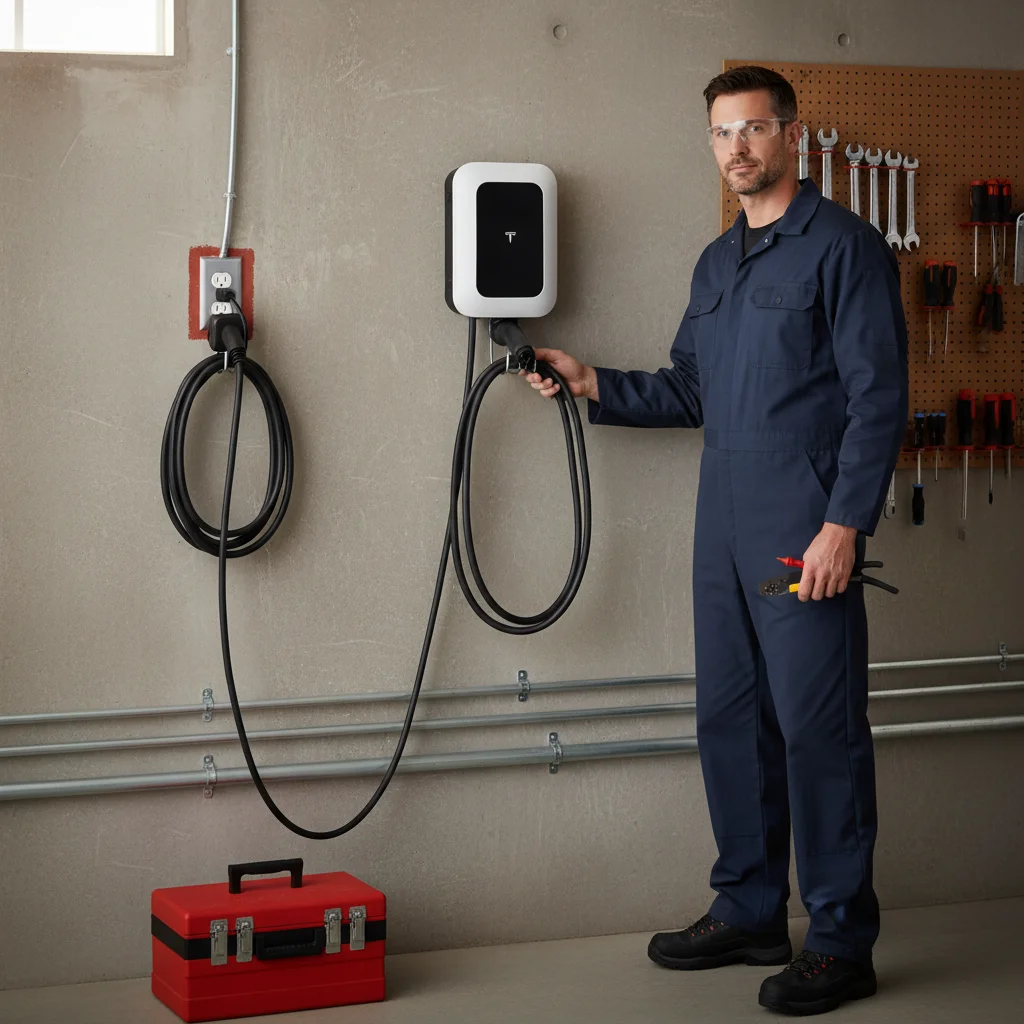
Why the Home Flex fits varied San Diego panels
Most Level 2 chargers are built around one fixed amperage. The ChargePoint Home Flex is different: it’s adjustable from 16 to 50 amps in the app, up to 12 kW, and you set the ceiling based on what the circuit is actually wired for. That flexibility matters a lot in San Diego, where housing stock ranges from newer 200A-service homes in Chula Vista and San Marcos to original 100A panels still common in Clairemont, La Mesa, and older parts of El Cajon.
If your panel has room for a full 50-amp circuit, the Home Flex charges at close to its max. If it only has room for a 30 or 40-amp breaker, the same unit still works, just capped lower in the app. That means the charger purchase decision doesn’t have to wait on a final load calculation the way a fixed 48-amp or 80-amp unit does. It’s the one brand on this list that adapts to the panel instead of the other way around.
For a general comparison of charging speeds and what different amperages mean for real-world range added per hour, see our Level 2 vs. Level 1 EV charger guide.
Plug-in vs. hardwired: which to choose
The Home Flex is one of the few Level 2 chargers that genuinely works both ways.
Plug-in (NEMA 14-50). We install a 240V outlet, and the charger plugs into it. This is the more flexible option if you might move the charger, want to unplug it for any reason, or want the ability to swap in a different NEMA 14-50 device later, like a portable generator inlet or an RV outlet, without rewiring. It also tends to be a slightly faster, simpler install.
Hardwired. The charger wires directly into a dedicated circuit with no plug in between. This is a cleaner, more permanent setup, and some HOAs or inspectors prefer it. It also removes any risk of a loose plug connection on a high-draw circuit over years of daily use.
Neither option changes the charger’s cost. The choice comes down to whether you want flexibility (plug-in) or a fixed, permanent install (hardwired). We’ll walk through both during the site visit.
What it costs in San Diego
Home Flex installs typically run $500 to $1,500 for labor, the circuit, and the permit, with the charger hardware itself around $500-$700 depending on cord length and retailer.
What moves the price inside that range:
- Breaker size chosen. A 30 or 40-amp circuit costs less in wire and breaker than a full 50-amp circuit.
- Plug-in vs. hardwired. Plug-in adds a receptacle; hardwired skips it but takes similar labor overall.
- Run length. A charger close to the panel, under 25 feet, sits at the low end. Detached garages or longer runs add conduit and labor.
- Permit. San Diego’s EV charger permit typically runs $150-$300 through the city, with other North County cities setting their own fee through their building division.
Our EV charger installation cost guide breaks down cost drivers across every brand, useful if you’re comparing the Home Flex against a fixed-amperage option like a Tesla Wall Connector.
Tesla and non-Tesla compatibility
The Home Flex ships with a standard J1772 connector, which means it works natively with every non-Tesla EV on the market. Tesla owners can use it too, either with the adapter ChargePoint includes with some models or a third-party J1772-to-Tesla adapter. If your household has more than one EV brand, or you’re not sure what you’ll drive next, the Home Flex’s connector is the more universal choice compared to a brand-specific charger.
When you still need a panel upgrade
Adjustable amperage helps, but it isn’t a workaround for a panel that’s genuinely out of capacity. If a load calculation shows your 100A panel is already maxed by AC, a range, and a water heater, even a 30-amp circuit might not fit cleanly, and a panel upgrade becomes the right call before any charger goes in. That’s typically $3,500-$6,500 for a 100A-to-200A upgrade in San Diego County. Our EV panel upgrade bottleneck guide covers how to tell whether you’re in that situation.
Frequently asked questions
How much does a ChargePoint Home Flex installation cost in San Diego?
Most installs run $500 to $1,500 for labor, the circuit, and the permit, with the charger hardware separate at roughly $500-$700. The final number depends on the breaker size chosen, run length, and whether you go plug-in or hardwired.
Can the ChargePoint Home Flex charge a Tesla?
Yes. It ships with a J1772 connector, which works with an adapter for Tesla vehicles, either one ChargePoint includes or a compatible third-party adapter. It works natively with every non-Tesla EV without an adapter.
Should I choose plug-in or hardwired for the Home Flex?
Plug-in (NEMA 14-50) gives you more flexibility if you might move the charger or want to reuse the outlet for something else later. Hardwired is a more permanent, cleaner installation some HOAs and inspectors prefer. Both cost about the same to install.
What amperage should I set my Home Flex to?
That depends on what your circuit is wired for, which your electrician sets during install based on the breaker size and a load calculation against your panel. The unit is adjustable up to 50 amps in the app, but the circuit itself determines the real ceiling.
Does the Home Flex need a permit in San Diego?
Yes. Any new dedicated circuit for an EV charger requires a city permit, whether the final setup is plug-in or hardwired. Permit fees generally run $150-$300 in the City of San Diego, with other cities setting their own fee through their building division.
When to call us
The Home Flex’s adjustable amperage makes it one of the more flexible charger choices for San Diego’s mixed housing stock, but the circuit sizing, plug-in-versus-hardwired decision, and permit still need a licensed electrician to get right. Call us at (858) 988-5580 for a same-day estimate.