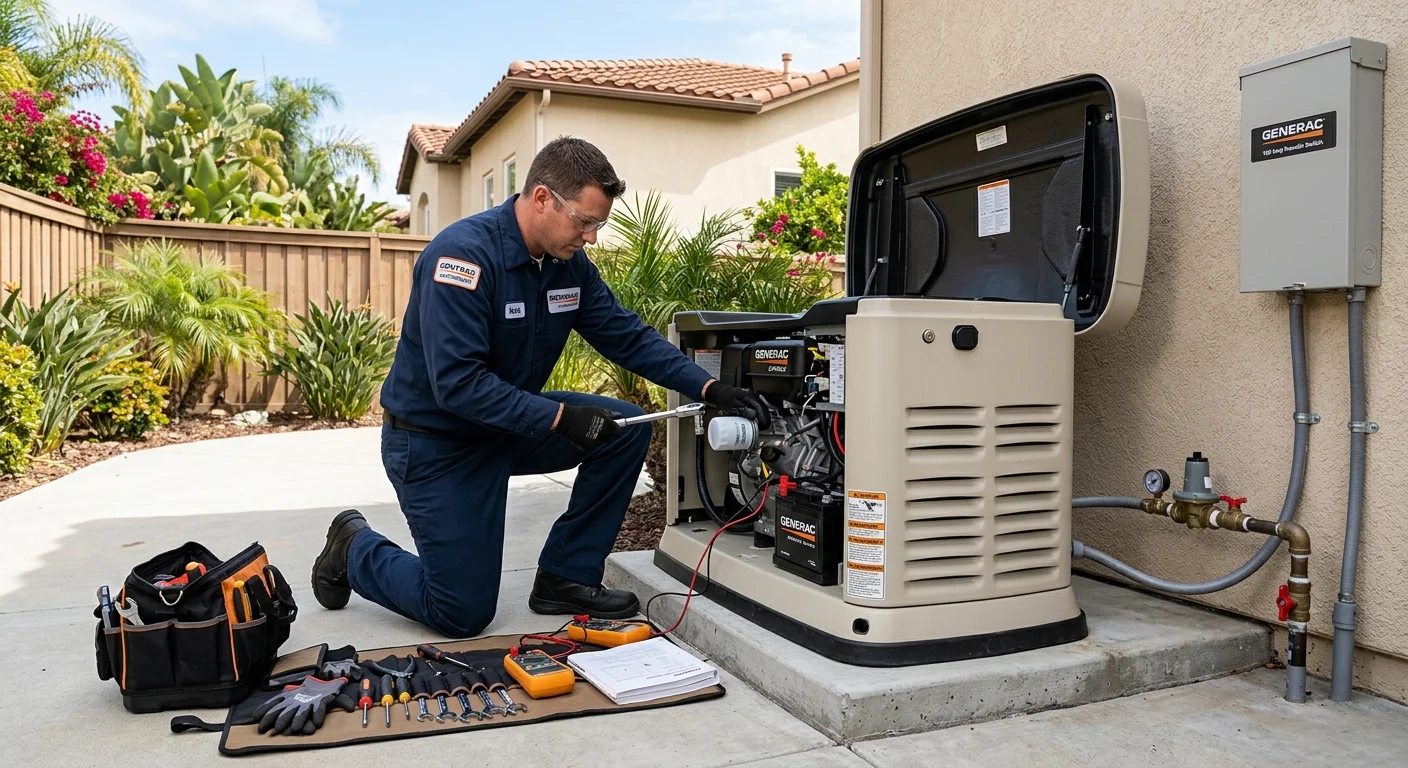
A Generac that won’t start in San Diego is diagnosed from the controller, the starting battery, and the fuel supply, not from a guess about the engine. The 12-volt starting battery is a first check on many idle standby units because a short weekly self-test can still pass when a longer outage crank fails. That is a screening step, not a diagnosis that the battery is the cause. Write down the controller alarm from your unit’s owner manual before you call, because the text and the warranty status decide whether this is dealer work or licensed electrician work.
TL;DR
- Treat the starting battery as the first check on a no-start, not as proof of the failure.
- Controller lights and named alarms are model-specific. Match them to the owner manual or Generac support, not a generic green/yellow/red chart.
- Write down the exact alarm text on the display before calling.
- Warranty engine and controller repairs must go through an Independent Authorized Servicing Dealer. The transfer switch, breaker, feeders, battery, and connections are licensed electrician work outside that warranty path.
- Whether a repair needs a permit depends on the job and the jurisdiction, not the brand. See the San Diego permit guide below.
Why won’t my Generac generator start?
The starting battery is the first check, not a verdict. A Generac home standby uses a 12-volt starting battery that can sit for months between outages. A unit can pass its short weekly self-test and still fail when a real outage asks it to crank longer. If the unit clicks or cranks slowly, have the battery tested before assuming an engine or controller failure. A pass or fail on that test still belongs in the diagnostic, not in a web article.
After the battery, the next categories are fuel, filtration, and controller or sensor faults. Stale fuel or low gas pressure is a common category on propane units when the tank is low. Failed starters, dirty air and fuel filters on units that skipped the service interval in the owner manual, and controller or sensor faults are later categories, not a ranked cause list for your serial number. Our general guide to home generator repair walks the same no-start checklist. Coastal homeowners should have connections inspected for corrosion, because salt air can shorten component life from La Jolla to Oceanside.
What do the lights on a Generac generator mean?
Use the controller that is actually on your unit. Evolution, Nexus, PowerPact, and later LCD controllers do not share one light map. Open the owner manual for that model, or Generac’s support articles for that controller family, and match the LED or screen text there.
On many Evolution-style controllers, a green ready light means the unit is monitoring utility power, a yellow maintenance light means service is due, and a red alarm means a fault shut the unit down until it is cleared. That mapping is not safe to apply to every Generac. Named alarms such as overcrank, low oil pressure, or RPM sense loss are also controller-specific. Write down the exact text before anyone clears it. That note is what the dealer or electrician uses; this page does not decode the fault.
What drives the cost of a Generac repair?
The part that failed drives the price, not the brand and not the size of the unit. Repairs sort into three tiers, and knowing which tier you are in is more useful than a number from a web page.
Consumables and wear items sit at the bottom: the starting battery, oil, filters, and spark plugs. These are the cheaper visits when that is what failed, and they are why the service interval in the owner manual exists.
Fuel and starting system work sits in the middle: a fouled fuel system, a stuck valve, a failed starter. These usually follow a unit that sat through a long idle stretch without service.
Control and switching work sits at the top: the automatic transfer switch and the controller board. These are the expensive parts, and they are also the parts most worth diagnosing carefully before replacing, because a transfer switch fault and a controller fault can look identical from the outside.
Ask for a written quote before work starts. Bright Pro Electric does not credit diagnostics. Whether a contractor applies a diagnostic fee to later work is only in that contractor’s written quote. If a quote for a control or engine failure approaches what a new unit costs, stop and weigh the age of the machine. A standby generator well past a decade with a failed engine or controller is usually replacement territory. Our whole-house generator installation guide covers what a new system involves, and the Generac installation guide breaks down the brand’s current lineup and sizing.
Generac dealer or licensed electrician: who do you call?
It depends on what failed and whether the unit is under warranty. Generac home standby units carry a limited warranty. Generac’s warranty terms require warranty repairs through an Independent Authorized Servicing Dealer, with claims submitted through that dealer. Do not treat a published five-year or 2,000-hour term as your coverage. The term on your unit is the one on your paperwork and model, and PowerPact and EcoGen use different terms. If the unit is still in warranty and the fault is engine or controller work, start with a dealer.
Non-warranty electrical work is licensed electrician scope: the automatic transfer switch, the breaker feeding it, the wiring between the generator and your panel, the battery, and the connections that corrode in coastal air. Out-of-warranty engine work may still go to a dealer or a technician the manufacturer will accept. Bright Pro Electric matches San Diego homeowners with licensed electricians for generator installation and repair. Hours are Monday through Saturday, 7am to 7pm. After hours, leave a message. There is no staffed 24-hour desk and no dispatch guarantee. If you are not sure whether the fault is the generator or the house wiring, electrical troubleshooting is the diagnostic path.
Homeowners in San Marcos and Ramona book the same way as the rest of the county. On East County propane units, check the tank level before booking, because a low tank can look like a generator failure until someone measures fuel.
How do you keep a Generac out of the repair shop?
Annual service and a battery on a schedule prevent most of the failures above. Change the oil, filters, and spark plugs once a year or after any long PSPS run, replace the battery on the interval in your owner manual rather than waiting for it to die, and let the weekly self-test run so problems surface on a calm Tuesday instead of during an outage. The full checklist lives in our generator maintenance guide.
San Diego’s outage pattern rewards this. SDG&E shutoffs cluster into fire season, which means a generator can sit idle for months and then get asked to run for days. A unit that skipped its annual service fails exactly then. Our PSPS generator guide covers how to get ready before the next shutoff window opens.
Frequently asked questions
How often should a Generac generator battery be replaced?
Follow the interval in your unit’s owner manual, and replace it on that schedule rather than waiting for a failure. A weak starting battery is a frequent no-start category on idle standby units, and a battery that still tests okay on a bench can still fail to carry a long crank. Waiting for it to die means finding out during an outage.
Why does my Generac pass its weekly test but fail during an outage?
The weekly self-test is short and puts little demand on the battery and fuel system. A real outage asks for a longer crank and hours of load. A weak battery, low propane, or a dirty fuel system can survive the test and still fail the real thing.
What does the yellow light on a Generac generator mean?
On many Evolution-style controllers, yellow means maintenance is due and the unit may still run. Confirm that mapping in your owner manual. Clearing the alert without doing the service just hides the reminder, not the wear.
Is an old Generac generator worth repairing?
A newer unit with a failed battery, filter, or transfer switch is worth repairing without much debate. An older unit with a failed engine or controller is the harder call, because those are the expensive parts and the rest of the machine has the same years on it. Get the repair quote in writing and weigh it against a replacement quote before deciding.
Does Generac generator repair need a permit in San Diego?
It depends on the job. Straight repair and like-for-like part replacement generally does not trigger a permit, while replacing the whole unit, relocating it, or running new gas or electrical lines generally does. Permit rules are set by your city or the county, not by the manufacturer, so confirm with the jurisdiction that covers your address before work starts. Our guide to San Diego electrical permits covers which jobs cross that line.
Who repairs Generac generators in San Diego?
Authorized Generac dealers handle warranty engine and controller work. Licensed electricians handle the transfer switch, wiring, battery, and everything on out-of-warranty units. Bright Pro Electric matches homeowners with licensed electricians across San Diego County. Hours are Monday through Saturday, 7am to 7pm. After hours, leave a message. Use the contact page to get matched.