The walk-in cooler in a Kearny Mesa warehouse went dark at 9:40 p.m., and a Gaslamp storefront lost its lights after the last table paid. Owners, tenants, and property managers across San Diego County then look for a 24 hour commercial electrician near me. The first move is to tell a utility outage from a building fault, then document what failed before anyone arrives.
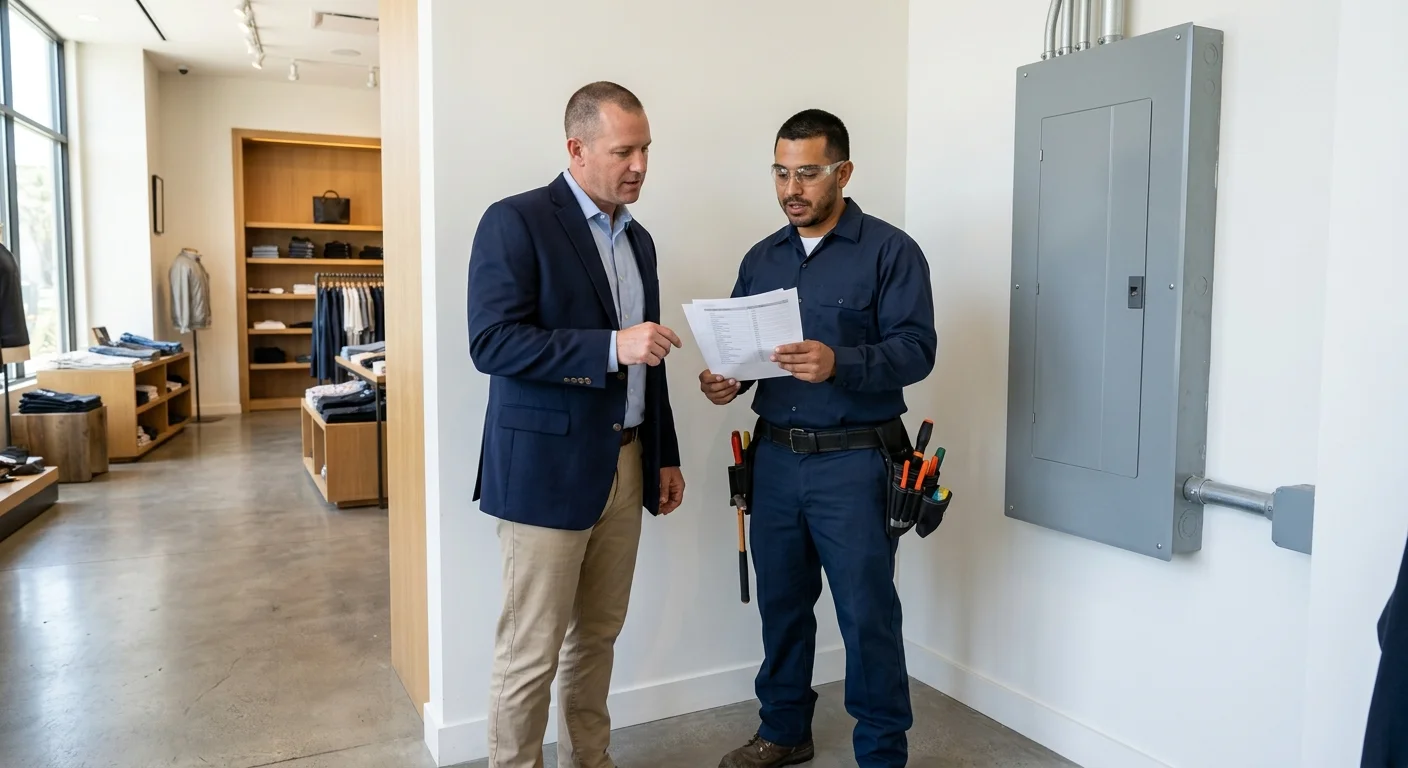
Start with whether the outage is in the building or on the utility
A dark suite is not a diagnosis. SDG&E serves the service drop and the meter. The building owns what sits on your side of that meter. A licensed electrician cannot restore a utility feeder, and a utility crew will not open tenant equipment.
Check SDG&E’s outage map and the SDG&E outage tools from a phone, not from a dark back room. If neighboring suites, the parking lot lights, and the strip center next door are also dark, report the outage to the utility. That still does not prove your panel is safe. A map entry never certifies indoor wiring.
SDG&E also notes that different parts of a neighborhood can sit on different circuits, and those circuits do not always restore together. One lit storefront on El Cajon Boulevard or in Otay Mesa does not prove your fault is indoors. One dark suite among lit neighbors is a reason to treat the building as the likely side, still without opening equipment.
Call 911 for smoke, sparking hazards, electrical shorts, or sounding smoke or carbon monoxide alarms. City of San Diego Fire-Rescue says to leave immediately for fire or smoke and not to go back in. If you are unsure whether it is an emergency, call 911 anyway. Give the address, a short description, and a callback number. Follow the dispatcher. Do not delay leaving to take photos, operate a breaker, or hunt for a contractor.
For downed lines, keep people and pets away. Do not touch fallen wires or pull objects off them. Call 911 for an immediate hazard, and report the line to SDG&E at 800-411-7343. That number is the utility, not Bright Pro Electric.
Warning signs that belong with a licensed electrician, after you are safe, include frequent breaker trips, flickering lights, arcs or sparks, sizzling or buzzing, a hot-insulation odor, hot or discolored receptacle covers, shocks or tingles, and damaged insulation. Do not touch gear to test heat. Do not reset breakers as a test. Do not remove a panel cover or an outlet faceplate. Stop using any appliance that smokes, sparks, or shocks. Stay away from water around electrical equipment.
Homes follow a similar utility-versus-building split. That path is on our 24-hour electrician guide for San Diego homes. A closed commercial space adds lease lines, after-hours access, and tenant equipment the residential page does not cover.
What a closed business should document before anyone arrives
A closed shop is a poor jobsite if nobody can say what failed. From a safe place, write down the time, which rooms or machines went dark, and whether other tenants still have power. Note whether the outage started during a known SDG&E event. Save the outage-map screenshot on your phone.
Photograph what you can already see: the suite number, the meter bank from the public side, labeled disconnects, the alarm keypad if it is reporting, and the faces of equipment that shut down. Do not photograph exposed parts. Do not open a panel to get a better shot.
List the loads that matter tonight. A Kearny Mesa or Miramar shop may care about compressors, dock levelers, and CNC. A Sorrento Valley lab may care about incubators and cold storage. A South Bay or Chula Vista kitchen may care about hoods, make-line refrigeration, and the ice machine. Kitchen breaker behavior in food service is its own pattern, covered in our Chula Vista restaurant breaker guide. Do not treat a tripped kitchen breaker as a small nuisance and keep resetting it.
Write who holds keys, the alarm code path, the property manager’s after-hours contact, and whether a loading dock or roll-up is the only legal entry. Independent electricians cannot guess a gate code. They also cannot work in a space they cannot enter without setting off a monitored alarm.
Pull the lease folder if you can reach it without walking into a hazard. Note the suite number, the landlord entity, and any exhibit that lists electrical as a base-building item or a tenant-improvement item. You do not need to interpret the whole lease at 11 p.m. You need the names of who must be called before a stranger works on a house panel.
If water is near electrical gear, stay out of it. Do not wade to a switch. If you smell burning insulation, leave and use 911. From outside, you can still tell a matched electrician what you already observed: location, onset, and what the utility map showed.
This record is for the people who arrive later. It is not a substitute for emergency electrical review on the building side after 911 and the utility have been handled.
How tenant and landlord electrical scope can differ after hours
Commercial power in San Diego County is often split across more than one responsible party. A downtown high-rise may have a house service, a meter stack, and a suite panel the tenant paid for during a build-out. A Mission Valley or El Cajon strip center may have a landlord-owned house panel and tenant-owned equipment inside the suite. An Otay Mesa warehouse may have dock power on a landlord circuit and production machines on the tenant’s.
The person who pays the SDG&E bill is not always the person who may authorize work. A tenant can usually speak for equipment they own inside the suite. Work on the service, the meter, a shared corridor, or a roof disconnect often needs the landlord or the property manager. After hours, that call is part of the job. Skipping it can stall a licensed electrician in the parking lot.
Ask, in plain words, which of these failed: tenant equipment, the suite panel, a shared house panel, or the utility. A matched C-10 electrician can inspect what they are hired and authorized to open. They cannot rewrite the lease. They also cannot pull a City of San Diego permit in the landlord’s name unless the landlord sets that up.
If the repair turns into an installation, alteration, addition, or replacement, a permit may apply. In the City of San Diego, Development Services issues electrical permits unless a narrow municipal exemption fits the exact work. A Simple No-Plan route is still a permit. Unincorporated areas such as parts of Lakeside, Fallbrook, Ramona, Alpine, and Bonsall go through County Planning & Development Services. Chula Vista, El Cajon, and other incorporated cities run their own building counters. Do not assume a City of San Diego rule applies to a Poway or Vista address.
A general building contractor on a remodel is not a substitute for electrical licensing on electrical-only work. The classification you want on the contract is a California C-10 for the electrical scope, or a Class B who holds C-10 or subcontracts that work to a C-10. Confirm the number on the CSLB license lookup before anyone starts.
Daytime commercial hiring, build-outs, and service planning live on our commercial electrician San Diego guide and the commercial electrical service page. Tonight’s question is narrower: who owns the failed gear, who can let a licensed electrician in, and who will be on the permit if the repair is not a like-for-like swap.
Use 24-hour wording as search language, not a promise
People type 24 hour commercial electrician near me because the cooler, the lights, or the shop floor failed after closing. That phrase describes the moment. It is not a promise that Bright Pro Electric staffs a night desk, owns trucks, or guarantees an arrival window.
Bright Pro Electric is a referral service for San Diego County. We connect you with independent, licensed, vetted electricians. Those pros set their own after-hours coverage. Some take night commercial calls. Some do not. Availability changes with the job, the city, and the electrician’s own schedule. We do not state a response time, a same-night dispatch, or round-the-clock coverage for the brand.
Treat “after hours commercial electrician San Diego” and “emergency commercial electrician San Diego” the same way. They are search language for a closed business with a building-side fault. They are not a warranty of speed. Anyone advertising a one-hour arrival as a rule is making a promise this page will not copy.
Call order stays the same at 2 a.m. in East Village or at 6 a.m. in Oceanside: life-safety first, utility second, licensed electrician third. If the map shows a feeder outage, stay with SDG&E. If 911 is in play, stay out of the building. Only after those two are handled should you ask us to match you with a commercial electrician who can review the suite.
A home outage after dark is a different page, with different access and no landlord exhibit. Use the residential 24-hour article for a house. Use this page for a leased suite, a warehouse, a restaurant, or a managed property. For urgent building-side work once you are safe, start at emergency electrical.
What to compare in commercial electrical proposals
After-hours commercial electrical repair is still a contract. Ask for the same written items you would want at noon, even if the first visit is only to make the space safe.
Get the legal business name and the contractor license number. Check both on the CSLB lookup. Confirm a C-10 classification for the electrical work. A license does not, by itself, prove insurance, complaint history, or skill with your equipment. Ask for a certificate of insurance and verify it with the carrier. CSLB’s public site does not replace that call.
Ask who will be on site, and which licensed business is on the contract. A business license does not mean every worker holds a personal C-10. You want the contracting firm named, plus how the crew relates to that firm.
Ask for a written scope that names the failed equipment, the suite, and whether the house service is included. CSLB’s consumer guidance is to compare at least three written bids on the same plans, specifications, and scope when you have time to bid. A much cheaper number is a reason to ask what was left out. It is not proof of illegal work, and it is not proof of a bargain.
Ask who pulls any permit, with which city or with County PDS, and who meets the inspector if one is required. Ask how after-hours labor, materials, and any follow-up daytime work will appear as separate lines. This site does not publish a commercial hourly rate or an emergency call-out fee. Those figures are set by the independent electrician. A public, countywide commercial price list could not be confirmed.
Ask what “safe for tonight” means in writing: which loads stay off, which can run, and what remains for a permitted repair. Do not accept a verbal “it’s fine” as the end of a burning-odor or sparking call.
Compare access terms too. Night work in a Carlsbad industrial park, a National City food plant, or a downtown garage has different lock, alarm, and loading rules. Put those in the scope so the electrician is not guessing at the curb.
Frequently asked questions
How much does a commercial electrician cost per hour?
A published, countywide commercial hourly rate for San Diego could not be confirmed. Do not use a residential diagnostic range as a stand-in. Ask each independent electrician for a written, itemized quote that separates after-hours labor, materials, and any later permitted work.
How much is an emergency call out for an electrician?
No verified public schedule lists a standard emergency call-out for commercial work in this county. Some electricians price after-hours labor as its own line. Some fold it into a larger repair quote. Get the figure in writing before work proceeds, and do not treat an advertised “no extra emergency fee” from another company as a market rule.
Where can I find an emergency electrician in San Diego?
For fire, smoke, or downed lines, use 911 and SDG&E first. For a building-side fault in a commercial space, you can contact Bright Pro Electric and we will match you with a licensed local electrician. You can also search CSLB by license number. Homes and businesses are not the same job; keep the residential 24-hour page for houses.
How to get an emergency electrician?
Leave if there is fire or smoke. Call 911 if you are unsure. Check the SDG&E outage map and report a feeder outage. Then, from a safe place, collect access notes and ask for a licensed C-10 to review the building-side fault. Bright Pro Electric connects you with independent pros. We do not perform the repair, pull the permit, or promise a clock time.
When to call us
Call after 911 and SDG&E are handled, when a San Diego commercial space still has a building-side fault, a dark suite among lit neighbors, or warning signs such as burning odor, sparks, or repeated trips. Independent matched electricians do the work. Call us at (858) 988-5580 and we’ll connect you with a licensed local electrician.