That dryer or range outlet in a Clairemont or El Cajon garage is not a green light for a home EV charger. The receptacle, the circuit feeding it, and the charger you bought have to match, and a licensed electrician still has to confirm the panel can carry the load. Until that review is done, treat reuse as an open question, not a plan.
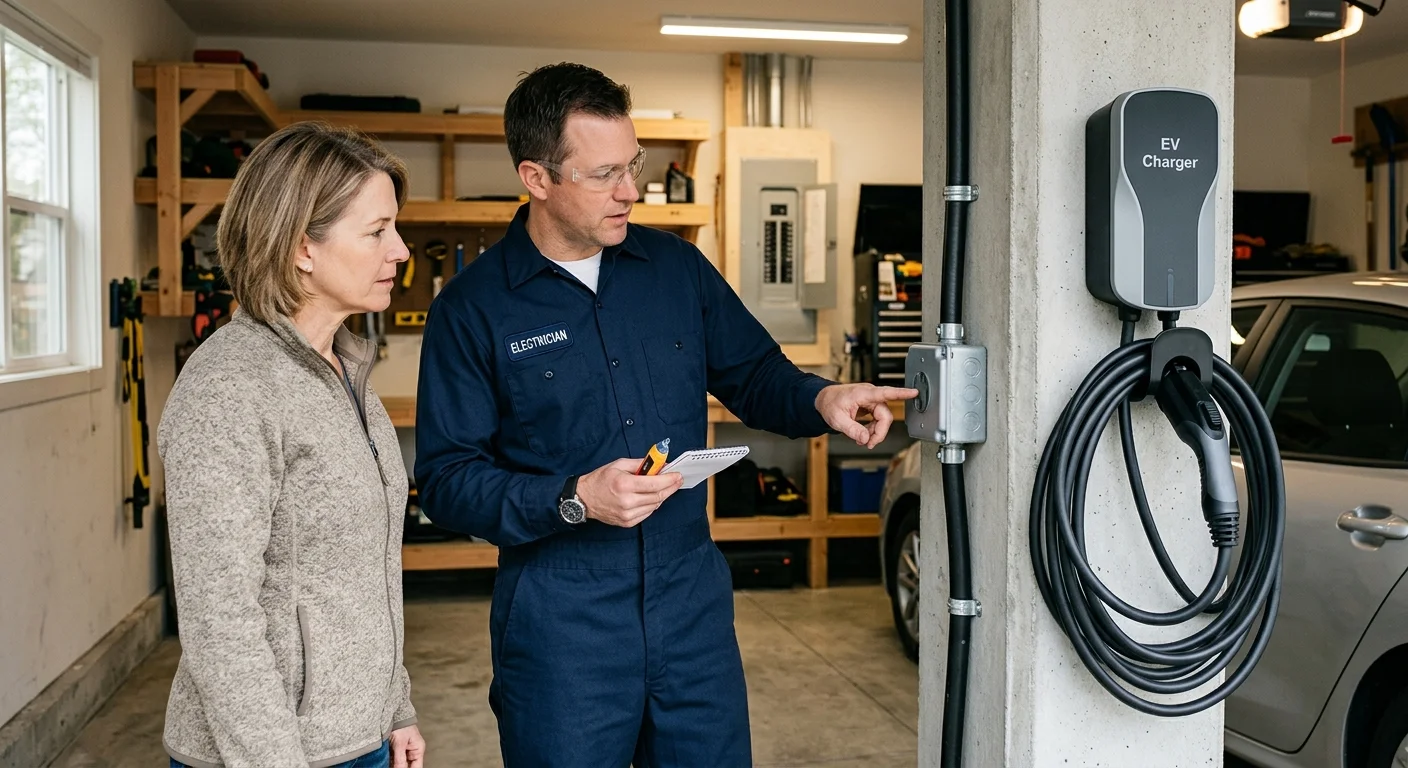
Start with the outlet, circuit, and charger being considered
Bring three facts to the visit, not a photo of the plug. Name the charger model and its listed amp rating. Name the outlet you hope to use, and what already runs on it. Name where the car parks: attached garage, detached garage, carport, or driveway.
San Diego County housing is not one stock. About 69% of Lemon Grove homes and about 63% of El Cajon homes predate 1978. Those houses often have a 240-volt dryer or range receptacle that was never sized for overnight charging. Carlsbad and San Marcos lean newer, with about 28% and 24% of units in that older band, so a garage circuit there may still be a dedicated appliance run, not an EV circuit.
Coastal condos in Pacific Beach or downtown add a different constraint. The parking stall may sit far from the unit panel, and the outlet on the wall may belong to the association, not to you. Inland ramblers in Santee or Lakeside more often have an attached garage and a dryer outlet a few feet from the parking spot. South Bay carports in National City and Chula Vista leave the receptacle outdoors, where weather rating and a locked enclosure matter as much as amp rating.
A home EV charger is a continuous load. It sits on for hours. That is a different job than a dryer that cycles. The electrician we connect you with will treat those as different uses even when the outlet looks the same.
Write down whether the charger is a plug-in unit or a hardwired wall unit before anyone opens a proposal. That choice belongs next to the outlet, not after the equipment is already in the box. Our EV charger installation page is the service path for that assessment.
Why plug shape alone doesn’t settle compatibility
Matching blades do not prove the circuit is ready. Two 240-volt receptacles can look similar and still differ in grounding, slot layout, and the amp rating stamped on the device. A charger cord that physically seats is not a compatibility test.
The circuit behind the cover is the real limit. A receptacle may be on a shared run with a dryer, a shop compressor, or a water heater. It may be on a breaker that does not match the charger nameplate. Labels in older East County panels are often wrong, so the writing on the door is a clue, not a verdict.
Adapters sit outside this page on purpose. Selecting one, stacking one, or using a dryer outlet as a workaround is not a homeowner task and is not a substitute for a listed installation. If the plug and the receptacle disagree, the electrician proposes a listed path: a different charger configuration, a new receptacle on a reviewed circuit, or a hardwired unit.
Vehicle inlets vary too. Some cars use one connector standard, some use another, and some need an automaker-approved interface. Confirm that on the car and the charger paperwork. Do not assume a garage outlet that once ran a welder will speak the same language as a 2026 EV.
Location still matters. An indoor garage in Rancho Peñasquitos and an open carport in Imperial Beach are not the same environment. Outdoor-rated equipment, mounting height, and who controls the stall all sit outside the plastic shell of the plug.
If the honest answer is that you need a new 240-volt receptacle instead of reuse, read our 240V outlet installation cost guide before you compare quotes.
What an electrician reviews before the outlet is reused
The electrician starts at the panel, not at the cord. They identify the breaker, the conductor path they can see, and whether that circuit is dedicated. They compare the charger’s listed rating with that circuit. They do not ask you to reset, probe, or open covers.
Panel capacity is a load-calculation question. A common method for adding a charger to an existing service is the calculation in NEC 220.87. That reference is a practice pointer, not a number you apply at the kitchen table. Older 100-amp services in La Mesa or Lemon Grove hit the ceiling faster than a 200-amp panel in a 2000s San Marcos tract. The electrician has to run the house that is actually in front of them.
They also look at what else already pulls hard: HVAC, a heat-pump water heater, a spa, cooking equipment, or a second vehicle. Coastal homes with heat pumps and inland homes with older electric ranges do not share the same leftover headroom.
Condition counts as much as rating. Discoloration, a warm faceplate, a burning odor, or a receptacle that wobbles in the box are stop signs. Those are warning signs for a licensed electrician, not a DIY cleanup. Leave the cover on. Do not touch equipment to test heat.
Garage layout in San Diego is messy in a local way. Detached garages in Ramona and Alpine may sit on a feeder that was never meant for a second large load. Condos and townhomes may share a meter room. A stall in a Mission Valley garage can be a long run from the unit panel. Each of those changes whether reuse is even on the table.
Ask the electrician to put the finding in writing: reuse as-is, reuse with circuit changes, hardwire on a new circuit, or a panel conversation first. That sentence is the decision. The outlet photo is not.
When hardwiring or circuit changes enter the proposal
Reuse fails for ordinary reasons. The circuit is shared. The breaker or conductors do not match the charger. The receptacle type does not match a listed plug-in unit. The stall is outdoors and the existing device is not. The panel has no spare capacity for a continuous load.
Hardwiring is one listed installation method, not a morale upgrade. Many wall units are sold only as hardwired equipment. Plug-in units still need a reviewed receptacle on a reviewed circuit. The portable vs. hardwired EV charger comparison is the place to sort that product choice. This page is only about whether the outlet you already have can carry the job.
Circuit changes are their own scope. The electrician may propose a dedicated run, a different receptacle, a subpanel, or a service conversation. In City of San Diego, adding circuits and installing an EV charger in a private garage are examples on the Simple (no-plan) permit path. No-plan still means a permit. It does not mean every charger needs a brand-new circuit. That is a field call.
When the main panel is the bottleneck, published project ranges on this site stay tied to the city page they came from. A Rancho Peñasquitos FAQ lists $1,800 to $3,200 for a subpanel-plus-EV scope, or $5,500 to $8,500 for a broader expansion. A Carlsbad La Costa FAQ lists $3,500 to $6,500 for a smart panel added to a coordinated EV and solar project. Those are not countywide averages. Do not blend them.
Load-management equipment can be part of a proposal when the service is tight. It is extra hardware and extra commissioning, not a promise that you will skip a panel upgrade. The electrician has to show why it fits this house.
If two quotes disagree, compare the scope line, not the charger brand. One bid may reuse the outlet. The other may replace the circuit. Those are different jobs.
Which permit, warranty, and product details need confirmation
Permits follow the property, not the mailing city. City of San Diego Development Services issues electrical permits inside the city, including a Simple path for an EV charging system in a private garage. Confirm current rules in Information Bulletin 187 and the electrical permit page. The City can issue that permit to an authorized California-licensed contractor or to a property owner or lessee. That is not a DIY wiring guide, and it is not a claim that only a C-10 can obtain every permit.
Unincorporated communities such as Ramona, Lakeside, Fallbrook, Alpine, and Bonsall pull through San Diego County Planning & Development Services. The county fee schedule effective July 10, 2026 lists $151 for an electric vehicle charging station permit, filed online or in person. Poway runs its own Building Services division and its own fee schedule. Do not use a City of San Diego or county figure there. Chula Vista, El Cajon, and the other incorporated cities each run their own building departments.
HOA and condo stalls add Civil Code 4745. The homeowner pays for installation and electricity, must use a licensed contractor, and must provide a certificate of insurance within 14 days of approval. If the board does not deny the application in writing within 60 days, it is deemed approved. The board can still deny in writing and can still set reasonable conditions. Since January 1, 2026, SB 770 removed the extra requirement to name the association as an additional insured. You still have to keep a liability policy and still have to send the certificate.
Warranties split in two. The charger maker covers the unit per the paperwork in the box. The installing electrician covers workmanship on the circuit they built. Bright Pro Electric does not hold the trade license and does not warrant the equipment. Verify the contractor on the CSLB license lookup before anyone starts.
Product details to confirm in writing: listed amp rating, plug-in versus hardwired, indoor or outdoor rating, connector type for your car, and whether the unit needs networking for the features you care about. Skip anything that asks you to pick an adapter as a fix.
What to compare in EV charging proposals
Line up quotes on the same house, the same stall, and the same charger rating. CSLB still recommends at least three written bids on the same scope. A much cheaper bid often dropped the circuit, the permit, or the disconnect. Ask which licensed business is on the contract, who pulls the permit, and what happens if inspection fails.
Compare the electrical path in plain language. Outlet reuse, new receptacle, hardwired unit, subpanel, or service work are different proposals. If a bid is silent on the existing 240-volt outlet, it has not answered the question you searched.
Compare operating cost with the same math. SDG&E’s EV-TOU-5 plan (bundled residential, rates effective August 1, 2026) prices super off-peak at 13.1¢ per kWh and on-peak at 80.2¢ per kWh. On-peak is about 6 times super off-peak. Super off-peak is weekdays midnight to 6 a.m. and 10 a.m. to 2 p.m., plus weekends midnight to 2 p.m. On-peak is 4 p.m. to 9 p.m. every day. Those figures exclude the monthly Base Services Charge. We do not have a verified dollar amount for that charge on the EV plans page, so confirm it on your SDG&E bill. If you take generation from San Diego Community Power or Clean Energy Alliance, delivery and generation are billed separately.
A 40-amp Level 2 charger at about 7.7 kW, used about 9 hours a week, is about 3,600 kWh a year. At 13.1¢ that energy is about $470 a year. At 80.2¢ it is about $2,880 a year, a difference of about $2,400. Publish those inputs on the quote so you can check them. A charger that cannot be scheduled off the 4 p.m. to 9 p.m. window will not hit the low number.
Do not pick a “best” home EV charger from a national roundup. Pick the unit that matches this circuit, this stall, and this car, installed by a licensed electrician who will pull the right local permit.
Frequently asked questions
How much does it cost to install a home EV charger in San Diego County?
There is no single verified countywide install price. Reuse of an existing 240-volt outlet, a new circuit, a subpanel, and a service upgrade are different jobs. Permit fees also split by jurisdiction. Unincorporated county lists $151 for an EV charging station permit on the current PDS schedule. City of San Diego points EV garage work to Information Bulletin 187 rather than one catch-all number on this page. Ask each electrician for an itemized quote on your address.
What is the best EV charger for home use?
The best unit is the one that matches your car’s connector, the circuit the electrician can support, and plug-in versus hardwired installation. App features and cable length are secondary. A national “best of” list cannot see your El Cajon dryer outlet or your Carlsbad panel.
Can I install a home EV charger myself?
Do not treat this as a homeowner wiring project. In the City of San Diego, permits can be issued to an authorized licensed contractor or to a property owner or lessee, and inspections still apply. Other cities and the county set their own rules. A licensed electrician should still assess the outlet, circuit, and panel before anyone buys a charger around the existing receptacle.
Will I need to upgrade the electrical panel?
Only a load calculation on your service can answer that. NEC 220.87 is one method electricians use when adding a charger. Older East County and South Bay stock is more likely to be tight. Newer north county panels often have more room, and still need the same math.
When to call us
Call when you want a licensed electrician to decide whether that existing 240-volt outlet can support a home EV charger, or whether the job needs a new circuit, a hardwired unit, or a panel conversation. Bright Pro Electric matches San Diego County homeowners with independent, licensed, insured electricians. We do not perform the work. Call us at (858) 988-5580 and we’ll connect you with a licensed local electrician.