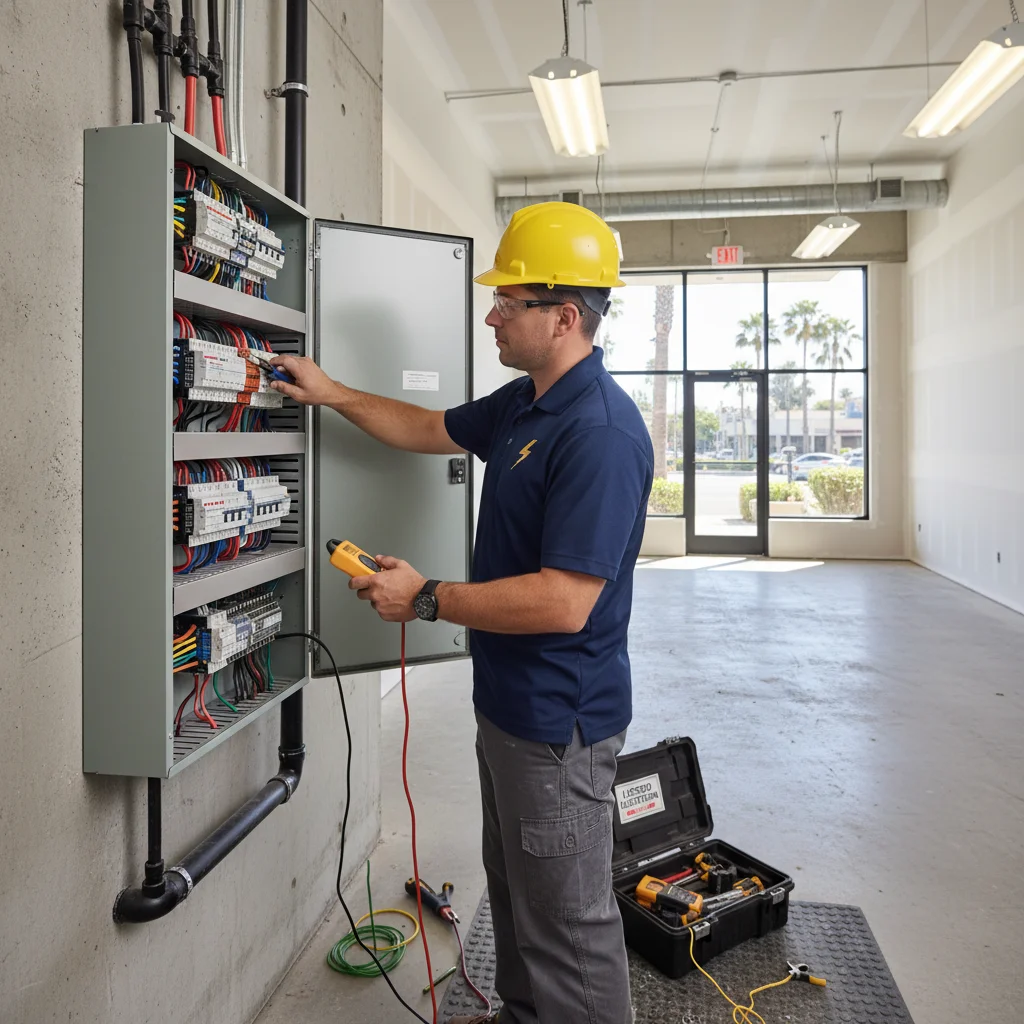
Signing a contract with the wrong electrician on a commercial project can stall your tenant’s opening by weeks, trigger a failed inspection, or leave you personally on the hook for unpermitted work. Commercial electrical work in San Diego County carries a different set of rules, licensing requirements, and consequences than a residential job. Knowing what to ask before you hand over a deposit is the fastest way to protect your property and your schedule.
TL;DR
- Commercial electrical work is licensed contracting. Look up C-10 (electrical) and whether a Class B prime is using a lawful specialty subcontract. Verify at cslb.ca.gov before signing.
- Tenant improvement (TI) lighting often needs Title 24 compliance. The energy consultant or architect typically authors the report. The electrician installs what the approved plans show.
- City of San Diego commercial TI review time is not a guaranteed 2 to 4 weeks. Ask Development Services and the contractor for the current queue.
- A documented load calculation belongs in the file before a service upgrade or a TI with large equipment.
- Ask before signing: license class, recent local permit history, who does the load calc, Title 24 roles, and change-order rules.
Commercial vs. residential: why the license class matters
California’s Contractors State License Board issues different classifications for electrical work. A C-10 license covers general electrical contracting and is valid for both residential and commercial projects. What it doesn’t automatically signal is real commercial experience: high-voltage systems, three-phase distribution, load calculations for HVAC equipment, and code compliance under the California Electrical Code (which adopts NFPA 70 with state amendments).
Before any conversation about scope or price, look up every contractor you’re considering on the CSLB license lookup tool. Confirm the license is active, bonded, and insured. Check whether there are any disciplinary actions on file. This takes about two minutes and it tells you more than a Google review.
The 2025 CEC adoption is the local reason. As of January 1, 2026, California’s current electrical code is the 2025 California Electrical Code (CEC), based on NEC 2023 with California amendments. The City of San Diego and other local AHJs enforce the edition they have adopted. An electrician who primarily does tract homes may not be current on commercial amendments around service entrance, emergency lighting, and tenant-improvement submittals.
Ask every candidate: “What percentage of your annual work is commercial?” A contractor who answers anything below 50% for a project involving a service upgrade or TI buildout is worth scrutinizing harder.
Tenant improvement work and Title 24 compliance
Tenant improvement projects, converting a shell space into a restaurant, office, or retail store, are where commercial electrical gets complicated fast. San Diego’s building department requires a set of permit drawings that include a Title 24 energy compliance report for lighting.
Title 24 is California’s Building Energy Efficiency Standards, administered by the California Energy Commission. For commercial lighting, it mandates controls like occupancy sensors, daylight sensors near windows, and multi-level switching in many occupancies. Your electrician doesn’t write the Title 24 report (that’s an energy consultant or architect), but they do have to install the system exactly as the approved plans specify. If they don’t know what a Title 24 lighting control zone is, they’re going to create a correction on your permit that delays the final inspection.
Ask Development Services for the current commercial TI review queue. This page does not publish a guaranteed 2 to 4 week window. Any change to the approved electrical drawings after permit issuance requires a revision submittal, another round-trip. An experienced commercial electrician catches scope conflicts before the drawings are submitted, not after the rough-in is complete.
Ask: “Have you pulled TI electrical permits in the City of San Diego in the last 12 months?” Local permit history matters. San Diego’s plan check comments have their own patterns, and a contractor who pulls permits regularly in Kearny Mesa or Midway District knows what the city’s reviewers flag.
Three-phase service, transformers, and load planning
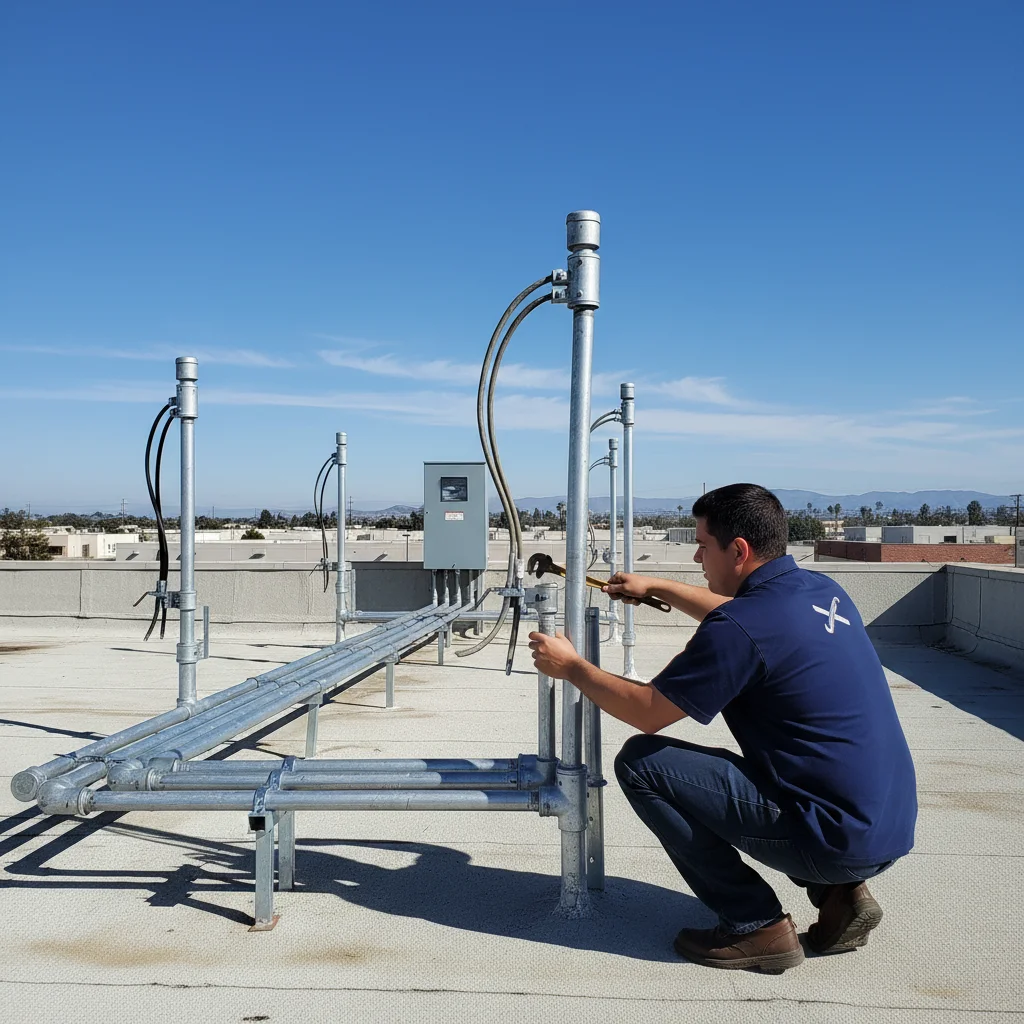
Most commercial buildings in San Diego are served by SDG&E with 120/208V or 277/480V three-phase power. If you’re upgrading a tenant space, adding a commercial kitchen, a manufacturing line, or a bank of EV chargers, your electrician needs to do a real load calculation before you commit to a scope.
A load calculation isn’t a guess. It’s a documented engineering process that adds up the demand of every circuit: HVAC, lighting, receptacle loads, equipment nameplate ratings, and demand factors defined in the California Electrical Code. Getting it wrong means you either oversize the service (overspend on infrastructure) or undersize it (face a costly change order after the panel is already set).
Three-phase systems also involve transformers when stepping voltage down for specific equipment. A 480V to 120/208V step-down transformer for an office build-out inside a larger industrial building is common in San Diego’s older flex spaces. Installation, sizing, and placement of that transformer requires someone with genuine commercial experience.
If your building’s service is already near capacity, a commercial electrical panel upgrade may be part of the project scope from day one. Coordinate this early. SDG&E service upgrades require utility coordination that can add four to eight weeks to the timeline. An electrician who surfaces that issue in week one is worth more than one who discovers it during rough-in.
A licensed electrician should put a documented load calculation in the file before a service upgrade or a heavy TI. Bright Pro does not run that analysis and does not promise a clean inspection.
Permits, inspections, and after-hours work
Every commercial electrical project in San Diego County that involves new circuits, service changes, or panel work requires a permit. This is not optional and it is not negotiable. Any contractor who suggests skipping the permit to “save time” is exposing your property to liability, insurance complications, and re-inspection requirements if you ever sell or refinance.
San Diego’s Development Services schedules commercial electrical inspections through their online portal. Same-day inspection slots exist but aren’t guaranteed, so plan for next-business-day availability. Rough-in inspections, service inspections, and finals are all separate steps. Your contractor needs to be coordinating these proactively, not reactively.
After-hours work is a separate conversation. Many commercial tenants need electrical work done outside of business hours to avoid disrupting operations. This is completely doable, but it costs more. Labor rates go up, and if a permit inspection is required, that has to be scheduled during regular hours regardless. Make sure your contract spells out exactly what “after-hours” means, what the rate premium is, and who coordinates with the building’s property management.
One more thing: if your project is in a fire-sprinkler-protected building, any ceiling work may trigger a sprinkler contractor consultation. Your electrician should know this and flag it during scope review.
Service contracts vs. project bids
Property managers often have a choice: hire a commercial electrician on a project-by-project basis or set up an ongoing service agreement. Both have their place.
A project bid works well when the scope is well-defined: a single TI buildout, a panel replacement, or a specific equipment circuit. The bid should include permit fees, materials, labor, and a clear exclusion list. Watch for bids that exclude permit fees or “unforeseen conditions” without defining what those are.
A service contract makes sense when you manage multiple buildings or have recurring needs: lighting maintenance, annual panel inspections, emergency call response. A contracted electrician who knows your buildings will catch issues earlier and respond faster than one you’re calling cold.
Ask for references from property management companies in San Diego, not just homeowners. A contractor who services multi-tenant retail centers or office parks has a different operational profile than one doing remodels.
For context on what electrical work typically costs in San Diego, our electrical panel upgrade cost guide breaks down what to expect on both residential and light commercial jobs. If you’re evaluating a specific North County city for a commercial space, see our posts on commercial electrical in Carlsbad and commercial electrical in San Marcos.
Five questions every property manager should ask
Before you sign anything, get clear answers to these:
1. Is your C-10 license current and in good standing? Verify it yourself at the CSLB. Don’t rely on a copy of a license certificate. Those can be outdated.
2. Have you pulled commercial permits in San Diego City or County in the last year? Local permit history is a real indicator of working knowledge. Ask them to name a project and a jurisdiction.
3. Who does the load calculation, and will it be documented? You want a written calculation, not a verbal estimate. This protects you if there’s a dispute or a future upgrade.
4. How do you handle Title 24 lighting compliance on TI work? If they look blank, that’s your answer. They should be able to describe coordinating with the energy consultant and installing per the approved plans.
5. What’s your process if a change order is needed mid-project? Change orders are normal. What’s not acceptable is a contractor who surfaces them at the worst possible moment without documentation. Ask for a written change order policy upfront.
A contractor who answers all five clearly and specifically, without hedging, is worth taking seriously. One who stumbles on Title 24 or permits is a risk you don’t need to take.
Frequently asked questions
What is the difference between a C-10 license and a general contractor license in California?
A C-10 is a specialty electrical contractor license issued by the CSLB specifically for electrical work. A general contractor (B license) can oversee and manage a commercial project but must subcontract electrical work to a C-10. For a commercial TI, the general contractor may hold the overall permit, but the electrician doing the panel work and wiring needs a valid C-10. You can verify both at cslb.ca.gov.
What is Title 24 and why does it affect my commercial electrical project?
Title 24 is California’s Building Energy Efficiency Standards, which apply to all commercial lighting installations. It requires controls like occupancy sensors, daylight sensors near windows, and multi-level switching in many occupancies. Your electrician doesn’t write the compliance report (that’s the energy consultant or architect) but must install exactly what the approved plans specify. A contractor unfamiliar with Title 24 controls will create permit corrections that delay your final inspection.
Do I need a permit for every commercial electrical project in San Diego?
Yes. Any commercial project involving new circuits, panel changes, service upgrades, or lighting system alterations requires a permit in San Diego County. There is no legitimate shortcut. Unpermitted commercial electrical work creates insurance liability, complicates tenant lease renewals, and can force costly remediation if discovered during a future inspection. Every legitimate quote from a licensed electrician includes permit fees.
How long does a commercial electrical TI permit take in San Diego?
Ask the City of San Diego Development Services and the contractor for the current queue. This page does not treat 2 to 4 weeks as a guaranteed review time. Larger or more complex submittals take longer. Any change to the approved drawings after permit issuance requires a revision submittal. A contractor who submits complete documentation on the first attempt reduces delays.
When to call us
If you’re planning a tenant improvement, a service upgrade, or need a commercial electrician who will pull the permits the job requires, Bright Pro can try to match you with an independent licensed contractor. Commercial electrical is the service category. The electrician on the contract owns the permit, the inspection, and the work.
Bright Pro Electric matches San Diego County homeowners and property managers with independent licensed electricians. It does not hold a C-10, pull permits, or guarantee dispatch. Hours are Monday through Saturday, 7am to 7pm. After hours, leave a message. Use the contact form.