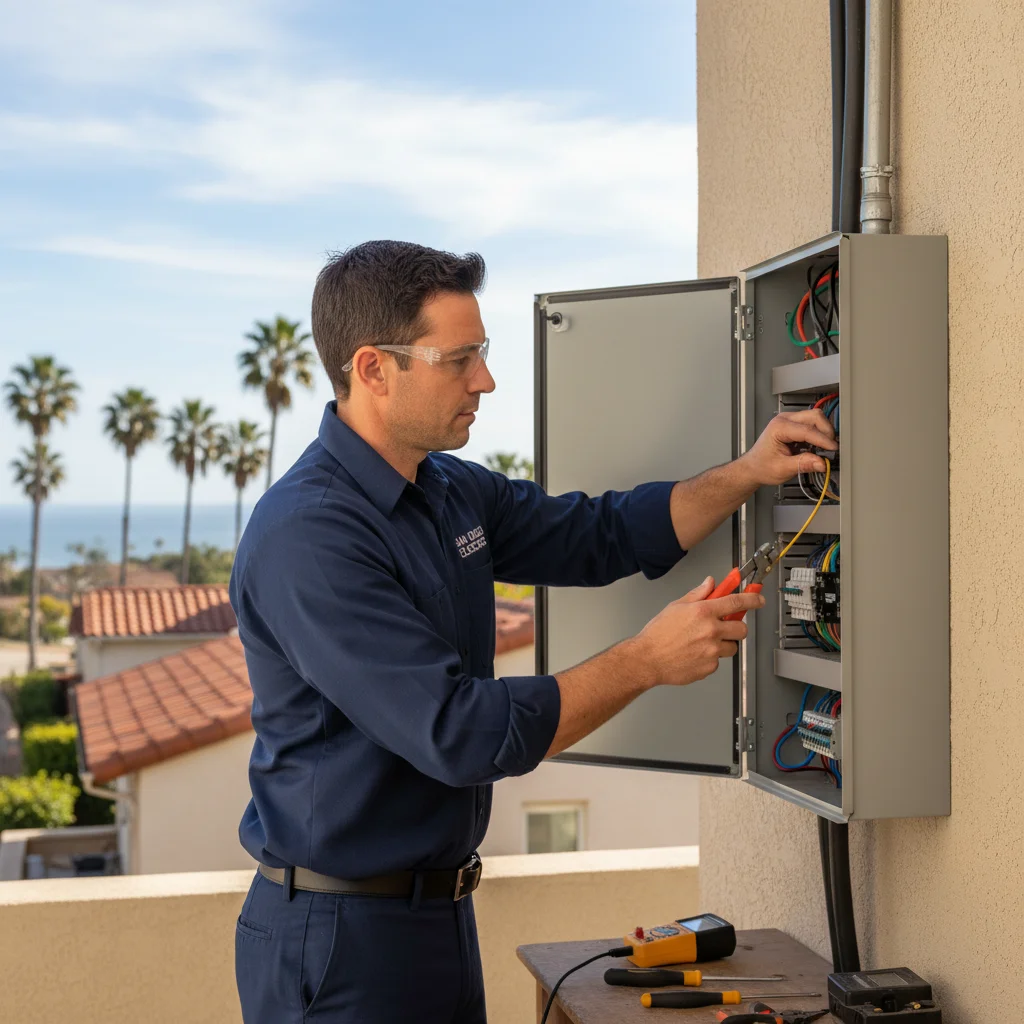
Whole-house surge protector installation in San Diego typically runs $300–$900, with most single-family homes landing in the $400–$650 range. That covers a Type 2 surge protection device (SPD) mounted at the main panel, one to two hours of licensed electrician labor, and the hardware itself. The wide range reflects panel access difficulty, the tier of device you choose, and whether your panel needs any prep work before the SPD can be added. Labor in San Diego runs $90–$140 per hour for a licensed C-10 electrician; the device itself costs $80–$350 depending on joule rating and brand.
TL;DR
- Type 2 whole-house surge protection installed at the panel runs $300–$900 in San Diego. Most jobs are $400–$650.
- The device mounts at the panel and clamps transient voltage before it reaches branch circuits. It does not replace strip-level protection.
- Whether an SPD is required on a new or replacement service depends on the electrical code edition your city or county has adopted. Existing panels are not automatically required to add one.
- Panel space (a spare two-pole slot, or an external-mount device) is a site constraint.
- If the cover label says Federal Pacific or Zinsco, inspect the panel before treating an SPD as the fix. Challenger is a different line.
What a whole-house surge protector actually is
A whole-house surge protector is a device installed inside or immediately adjacent to your main electrical panel that clamps transient overvoltage before it travels down your branch circuits. When utility voltage spikes above the normal 120/240V range, the SPD absorbs and diverts that excess energy to ground (what grounding means in electricity) rather than letting it flow through to your refrigerator, HVAC system, or home theater equipment.
It’s not a power strip with a fancy name. A point-of-use power strip has a joule absorption rating in the 200–1,000 joule range and sits at the end of a circuit. A whole-house SPD is rated in the 20,000–100,000+ joule range and sits at the service entrance, clamping surges before they ever reach your outlets. The two work best together: the whole-house device handles the big event; the strip-level device handles the residual.
Type 1, Type 2, and Type 3: what the difference means
The National Electrical Code defines three SPD types by where they’re installed and what they’re rated to handle.
Type 1 SPDs are installed before the main breaker, between the utility meter and your panel. They’re rated to handle direct lightning strike byproducts and utility-induced surges. Installation is more complex and typically costs more. Type 1 devices are common in new commercial builds and some high-end residential installations, but they’re not the standard for most San Diego homes.
Type 2 SPDs typically mount at the main panel on a dedicated two-pole breaker, or as listed by the manufacturer. This is the usual residential Type 2 layout. Whether a Type 2 is required on a new or replacement service is an adopted-code question for the reviewing authority. Most of the $300–$900 quoted price covers a Type 2 device and labor. Device ratings often discussed for a typical home: 40,000–80,000 joules, with a listed clamping voltage. Confirm the listing for the unit you buy.
Type 3 SPDs are point-of-use devices: the power strips and outlet-level protectors you already have. They’re the last line of defense, not the first. You still want these on computers, TVs, and audio equipment even after you install a Type 2 at the panel.
For most San Diego homeowners, the right answer is a Type 2 SPD at the panel plus Type 3 protection on sensitive equipment.
What drives cost in San Diego
Device tier
Entry-level Type 2 devices from brands like Siemens and Square D (Schneider Electric) run $80–$150. Mid-tier devices with higher joule ratings and dual-mode protection (L-N and L-G clamping) run $150–$250. Premium whole-house devices from Eaton, Leviton, or Intermatic with diagnostic LEDs, thermal disconnect, and 10-year warranties run $200–$350. For most San Diego single-family homes, the mid-tier range is the right call: higher joule capacity without overpaying for features that matter mainly in commercial applications.
Panel access and breaker availability
If your panel has two open slots (one double-pole 15A or 20A breaker space), installation is straightforward: the device mounts to the wall or in the panel enclosure, the breaker snaps in, and you’re done in under two hours. If your panel is full, the electrician needs to consolidate circuits using tandem breakers or move circuits to a subpanel before the SPD can be added. That adds time and cost: a full-panel SPD install on a maxed-out 200-amp panel can run $600–$900 depending on what rearrangement is needed.
Panels in older San Diego homes, particularly those from the 1970s and 1980s in neighborhoods like Clairemont, Allied Gardens, or City Heights, often use outdated breaker configurations that complicate device mounting. That’s worth confirming during a site visit before committing to a price.
Federal Pacific and Zinsco panels
If the cover label says Federal Pacific Stab-Lok or Zinsco, stop at inspection. The label is a cue for a licensed electrician to evaluate the equipment. It is not a replacement diagnosis from this page. Challenger is a different line. An SPD conversation can wait until that inspection is done. See Federal Pacific or Zinsco panel inspection.
Why San Diego homes specifically need whole-house surge protection
San Diego’s surge risk profile is different from most of the country. The primary threat here isn’t lightning, it’s SDG&E’s grid.
Utility switching transients
SDG&E operates a large transmission and distribution network across San Diego County. Normal utility switching operations, the kind that happen thousands of times per year as load management routes power between circuits, create transient voltage events on residential lines. Most are small and invisible. Some are large enough to degrade sensitive electronics over time, and occasionally one is large enough to cause immediate damage. These utility-induced surges are the everyday threat that a whole-house SPD is designed to catch.
PSPS power-restoration events
Public Safety Power Shutoff events have become a regular part of San Diego County life, particularly in East County communities like Alpine, El Cajon, Lakeside, and Ramona. When SDG&E restores power after a PSPS, the reconnection event generates a voltage transient on the line. The longer the outage and the more circuits being re-energized simultaneously, the larger the potential transient. A whole-house SPD clamps that reconnection surge before it reaches your appliances.
This matters especially in homes with solar inverters, battery backup systems, EV chargers, and smart home equipment. These devices are expensive to replace and sensitive to overvoltage. A home battery backup system in San Diego is one place electricians often specify a Type 1 or Type 2 SPD. Confirm that in the battery and inverter listing. This page does not make surge protection mandatory on every battery job.
Lightning: rare but not impossible
San Diego averages a small number of lightning-ground-strike days per year, far fewer than Florida, Texas, or the Midwest. Lightning is not the primary justification for whole-house surge protection here. But when lightning does strike near a distribution line, the induced transient can easily exceed what even a good panel-mounted SPD can absorb. If you’re in a rural area like Valley Center, Ramona, or Poway near open terrain, the argument for a Type 1 SPD or a combined Type 1/2 installation gets stronger.
What the installation process looks like
A standard whole-house SPD installation on a San Diego home with a 200-amp panel and available breaker space runs approximately 90 minutes to two hours.
The process: the electrician kills power at the main breaker, opens the panel cover, confirms available breaker space, mounts the SPD device (typically to the side of the enclosure or on a din rail depending on the device), runs the lead wires to the dedicated breaker and the ground lug, reinstalls the cover, restores power, and tests the device’s indicator lights to confirm it’s online and protecting.
No permit is required in some San Diego jurisdictions for adding a listed device to an existing panel with no other circuit changes. If the job rearranges circuits or replaces the service, a permit is more likely. Confirm with the reviewing authority and the electrician.
When it gets bundled with a panel upgrade
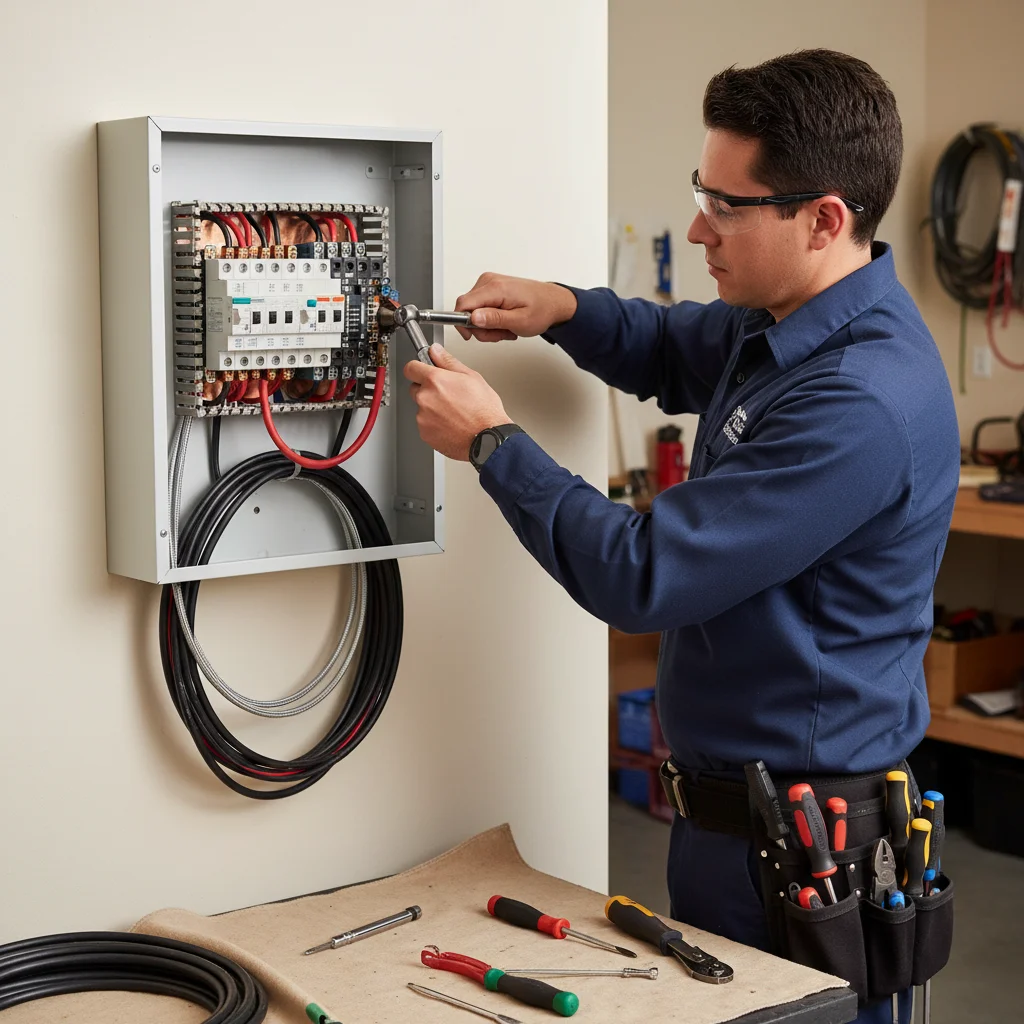
The most cost-effective time to add a whole-house surge protector is during a panel upgrade in San Diego. When your electrician already has the panel open for a 200-amp service upgrade or a breaker replacement, adding an SPD is a small incremental cost, typically $150–$300 on top of the panel job, rather than a standalone $400–$650 service call.
Later NEC editions added SPD requirements for some new and replacement dwelling services. California adopts the NEC on its own cycle, and cities add amendments. If you are replacing a panel, ask the reviewing authority whether an SPD is part of that permit. Existing panels with no service work are not under a universal retrofit mandate. For panel-upgrade pricing, see electrical panel upgrade cost. Adding an SPD during a panel upgrade is often cheaper than a standalone visit because the panel is already open. Typical add-on: $150–$300 versus a standalone $400–$650 call.
This is also the right time to install the SPD if you’re adding an EV charger, solar, or a home battery backup, since those loads justify the panel work anyway and the SPD protects the investment you’re making in the new equipment.
DIY vs. licensed electrician
Surge protection devices mount inside the main electrical panel. The panel is always energized above the main breaker, even when you flip the main breaker off. The only way to de-energize the panel above the main breaker is to have SDG&E pull the meter. That’s not a DIY job.
Beyond the shock hazard, a miswired SPD can create a fault condition that trips the main breaker repeatedly or, in failure mode, introduces a voltage path rather than eliminating one. This is licensed C-10 electrician work.
Work inside a panel is licensed C-10 work. Do not open the inner cover. Owner-builder rules exist, but they still require permits and inspections. The shock hazard is not a DIY savings.
Frequently asked questions
How much does a whole-house surge protector cost installed in San Diego?
Installed by a licensed C-10 electrician in San Diego, a whole-house surge protector runs $300–$900. Most single-family home installations land between $400 and $650. The device itself costs $80–$350 depending on joule rating and brand; labor runs $90–$140 per hour and the job typically takes one to two hours. Bundling with a panel upgrade or other panel work reduces the cost, since the panel is already open.
Is a whole-house surge protector worth it in San Diego?
For most San Diego homes, yes. The primary threat here is SDG&E switching transients and PSPS power-restoration surges, not lightning. Homes with EV chargers, solar inverters, home battery systems, or significant electronics have a higher replacement-cost exposure that makes a $400–$650 SPD installation straightforward to justify. Replacement cost of electronics is household-specific. This page does not publish a $3,000–$8,000 inventory for a basic home.
Does a whole-house surge protector replace power strip surge protectors?
No. A whole-house Type 2 SPD handles the large transient events at the panel before they reach your circuits. A point-of-use surge protector (power strip) handles smaller residual voltage that gets through. Both serve different functions. After installing a whole-house SPD, keep quality surge-suppressing strips on computers, TVs, and audio equipment. Cheap “surge protector” strips with no joule rating printed on the box provide minimal protection regardless.
Does the NEC require a whole-house surge protector?
The NEC 2020 added SPD language for some new and replacement dwelling services. California and local amendments decide what your permit requires. Existing panels with no permit-triggering work are not under a statewide retrofit mandate. Adding one is still a reasonable protection choice.
How long does a whole-house surge protector last?
Most whole-house SPDs have a 5–10 year service life, though many last longer. The device absorbs voltage by diverting energy to ground, and each significant surge event uses some of that absorption capacity. Quality devices have an indicator light or LED status display that shows when the device has reached end of life and is no longer providing protection. Check the indicator every year. When it shows failure, replace the device.
Can I add surge protection if my panel is full?
Yes, but it adds cost. A full panel needs either tandem breakers to free up a slot or circuit consolidation before the SPD can be added. Alternatively, some SPDs are designed to mount external to the panel enclosure and connect directly to available bus lugs, which doesn’t require a dedicated breaker slot. Your electrician can assess the best path for your specific panel during a site visit.
Independent licensed electricians matched through Bright Pro Electric install listed SPDs. Bright Pro does not install devices. Use contact. Leave a message any time. For smoke, sparks, or fire, leave and call 911 first. See emergency electrical.