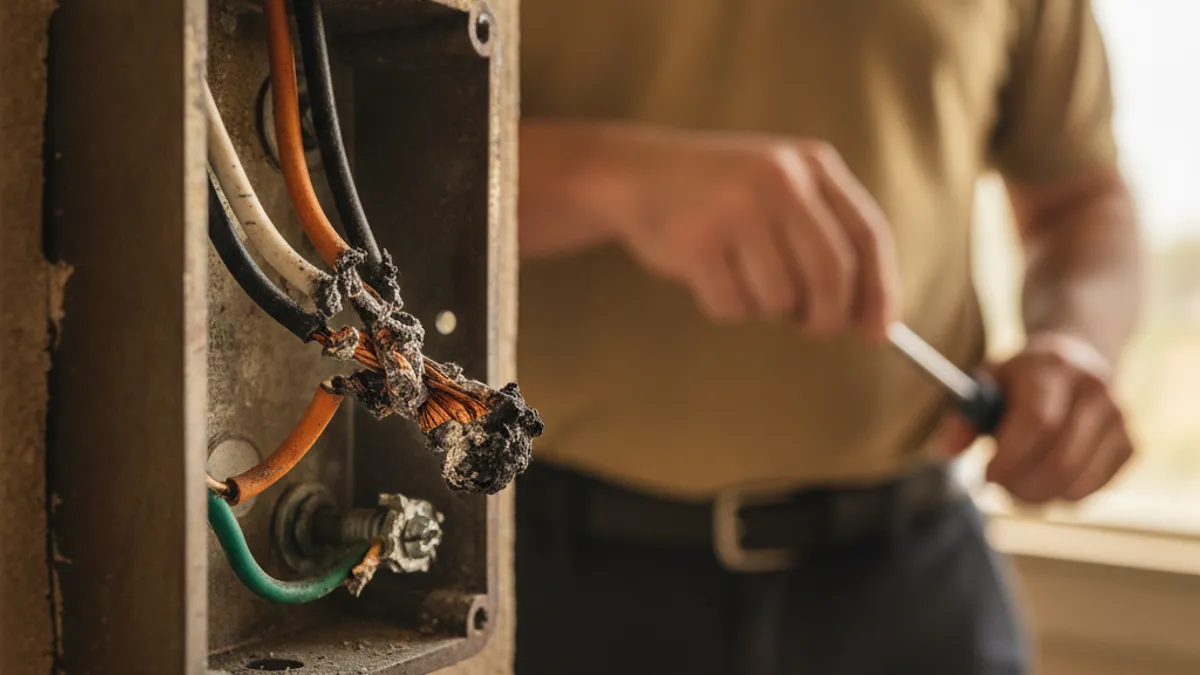
An electrical short happens when current finds a shortcut, a path with far less resistance than the circuit was designed for, and races along it instead of through whatever it’s supposed to power. That surge of current is why a breaker trips instantly instead of gradually, and why a short is treated differently from an ordinary overload.
The mechanics of a short circuit
A normal circuit runs power from the panel, through a hot wire, into whatever it’s feeding, a lamp, a motor, an outlet, then back through the neutral wire. Resistance along that path is what keeps current at a manageable level. A short circuit happens when the hot wire touches the neutral wire, a ground path, or bare metal directly, cutting that resistance down to almost nothing.
With resistance gone, current spikes to levels the wire was never built to carry, sometimes hundreds of amps for a fraction of a second. That spike generates heat fast, which is exactly why breakers are designed to sense it and cut power in a fraction of a second, well before the wire itself gets hot enough to matter. A short that trips a breaker instantly and stays off when you reset it is the system working the way it should.
What actually causes a short in a home
Most shorts trace back to damaged insulation somewhere along the wire. A nail or screw driven through a wall during a picture hang or a shelf install can pierce a cable running behind it. Rodents, particularly common in canyon-adjacent and hillside lots around San Diego County, chew through insulation and expose bare wire. Old, brittle insulation on wiring from the 1950s and 60s can crack and crumble on its own, especially in attic spaces that see wide temperature swings.
Appliance cords are another frequent source. A cord pinched under furniture, kinked at the plug, or worn through at a point where it flexes repeatedly can expose bare conductors that touch each other or a metal casing. A frayed extension cord left outdoors, which takes a beating from sun and moisture even in a mild coastal climate, fails the same way.
Inside an outlet or a switch box, loose connections are a slower-building version of the same problem. A wire that was never tightened fully at installation can work its way loose over years of vibration and thermal cycling, arcing slightly each time, until the insulation nearby degrades enough to short outright.
Warning signs before it becomes an emergency
A breaker that trips the instant you plug something in, rather than after it’s been running a while, points toward a short rather than a simple overload. A burning smell near an outlet, switch plate, or the panel itself is not something to wait out. Discoloration or a slightly warm switch plate, even with no visible damage, is worth checking before it progresses. A visible spark when you plug something in is a reason to leave that outlet alone. Call 911 for flame, heavy smoke, or sparks. Then use contact from outside.
If a breaker will not stay reset at all, or trips again within seconds, stop. Do not keep resetting. Leave that breaker off. Call a licensed electrician to trace the circuit. Do not treat a second trip as confirmation of one cause.
When it’s dangerous versus when it’s just annoying
A short that trips a breaker cleanly and doesn’t recur is doing its job. The danger climbs when a short doesn’t trip cleanly, when a breaker is old or damaged and doesn’t respond quickly enough, or when the short happens somewhere the resulting heat has nowhere safe to dissipate, inside a wall cavity packed with insulation, for instance. That’s the scenario that leads to an electrical fire rather than a simple breaker trip and a phone call.
Homes with older wiring, especially the aluminum branch circuits installed in parts of San Diego through the 1960s and 70s, carry extra risk here, since aluminum connections loosen over time in a way copper doesn’t, creating exactly the kind of degraded connection that can short. If your home falls into that category, it’s worth being more cautious about any warning sign rather than less.
What to do if you suspect a short
- Stop using the outlet, switch, or appliance. Unplug a cord only if the plug and device are cool and there is no smell or smoke.
- If the breaker already tripped, leave it off. Do not keep resetting it to see if it holds.
- If you smell burning, see sparks, or the device is hot, leave that area. Call 911 for flame, heavy smoke, or sparks. Then use contact from outside. Do not operate the main.
- One clean reset is only for a trip with no smell, heat, or scorch, and only if you can do it without opening the inner panel cover. If it trips again, stop.
- Tracing inside walls is licensed electrician work. Why a breaker keeps tripping is the related stop-reset tree. Electrical troubleshooting is the service path for a matched independent electrician.
Frequently asked questions
What does electrical shorting mean?
Electrical shorting means current has found a shortcut, a low-resistance path it was never meant to take, so the amperage spikes almost instantly. That is the whole mechanism behind the term. Shorting happens when a hot conductor touches a neutral, a ground, or another hot conductor, and the breaker is what stands between that spike and a fire.
Can I fix a short circuit myself?
Replacing a clearly damaged appliance cord is reasonable for most people. Tracing a short inside wall wiring involves working inside a live panel and identifying which circuit and which segment failed, which is not a safe first electrical project for most homeowners.
Will my homeowners insurance cover damage from a short?
Coverage depends on your specific policy and the cause of any resulting damage. Check directly with your insurer rather than assuming either way.
Is a short circuit the same as a power surge?
No. A surge is a temporary spike in voltage coming into your home, often from the utility grid or a lightning event. A short is an internal fault where current takes an unintended path inside your own wiring.
How fast should I call an electrician after a suspected short?
If a breaker will not hold after one reset, or you notice a burning smell, discoloration, or a warm plate, call the same day. Leave a message any time via contact. Bright Pro Electric matches you with an independent licensed electrician. We do not come trace it ourselves.