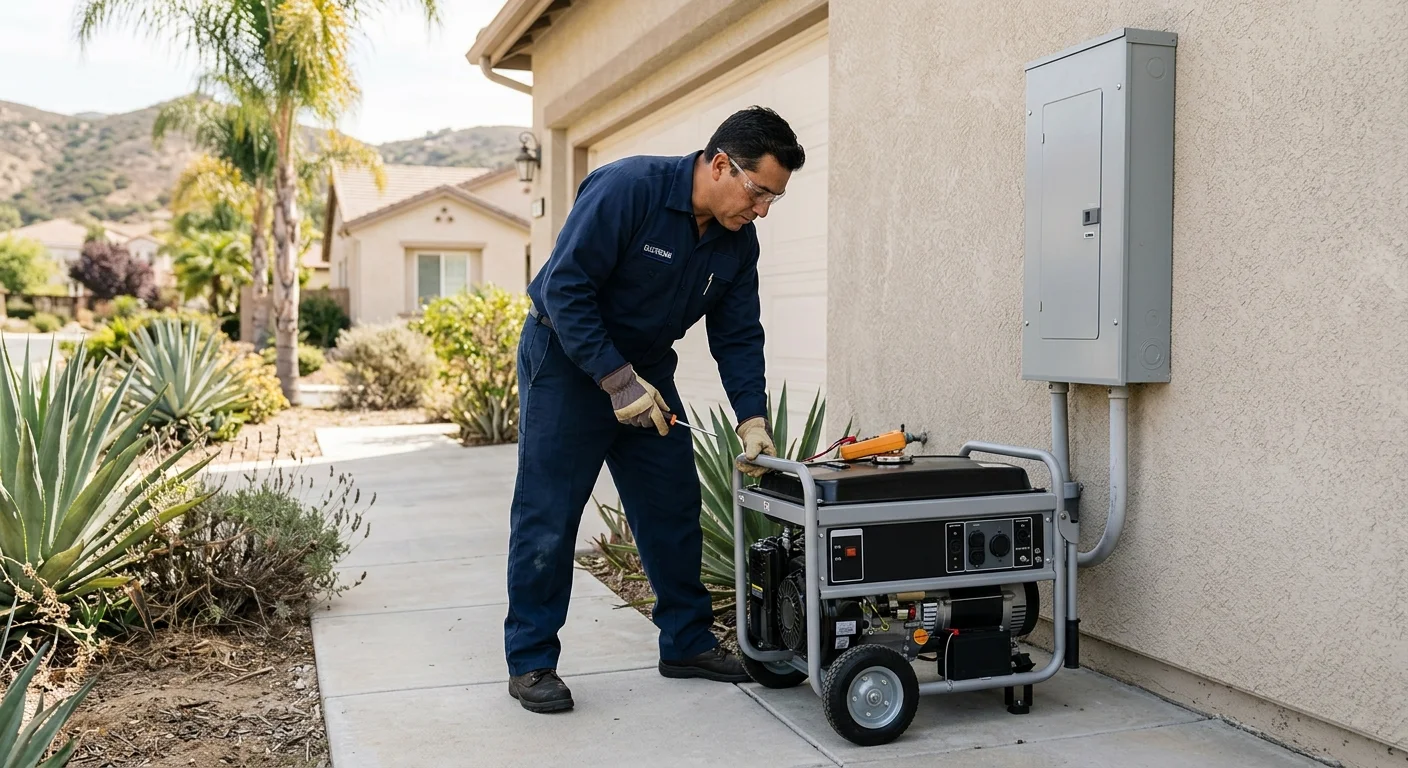
When SDG&E cuts power for a Public Safety Power Shutoff in Ramona or along the brush line near Alpine, a portable generator on the patio does not feed the fridge by itself. A transfer switch for a portable generator is how selected house circuits take power from that unit without cords through a window. Plan the equipment before the next red-flag weekend, and start with the loads you actually need.
Start with the loads you want during an outage
A portable generator only covers what you choose. During a PSPS, that list is the whole backup plan.
Write down what has to stay on. For most San Diego County houses that is the refrigerator, a few lights, the router, and any medical equipment that cannot miss a cycle. Inland and backcountry homes add more. A well pump in Ramona, Valley Center, or Alpine is a hardwired load, not something you plug into a living-room cord. East County summer nights still get hot, so a furnace blower or a window unit may sit on that list too. Coastal houses in Encinitas or Carlsbad often keep the list shorter: fridge, lights, phones.
Hardwired appliances are the reason people search this topic. A furnace, a well pump, and some water heaters do not have a cord you can run to the patio. A portable generator transfer switch is the equipment that lets those selected circuits take generator power through the panel path the electrician builds. Extension cords still leave those loads dark.
Keep the list short on purpose. Portable backup is a subset of the house, not whole-home coverage. If every circuit has to come back without you standing there, you are looking at a standby system, not a portable one. Our PSPS shutoff generator guide walks through how SDG&E shutoffs actually show up at the meter.
Check SDG&E’s outage map when the lights go out, and treat a neighbor’s porch light as a clue, not a diagnosis. SDG&E notes that different parts of the same neighborhood can sit on different circuits, and they may not restore together. A lit house across the street does not prove your wiring is fine, and a dark block does not tell you which indoor loads to keep.
Bring the written list to the electrician we connect you with. Older East County stock makes that visit do more than pick circuits. About 62.5% of El Cajon’s housing units predate 1978. Crowded panels, two-prong circuits, and aging gear show up in that era. The load list and a look at the panel belong in the same conversation.
How a portable generator differs from a standby system
A portable unit is equipment you store, roll out, start, and fuel. You have to be there. A standby generator is a permanent outdoor machine, usually tied to a fuel line, with transfer equipment that can move the house without you standing at the panel. Mixing those two plans is how people buy the wrong gear.
The portable path asks more of you on the day of the outage. You place the unit outdoors, start it, and operate the transfer equipment the electrician installed. Fuel is on you, including how you store it between events. If you are comparing gasoline and propane on the same machine, read our dual-fuel generator backup guide before you shop. This page does not publish runtime, wattage, or fuel-cost figures. Those depend on the machine and the loads, and they were not verified as a countywide number for this article.
Standby is a different generator installation project. The unit stays put. Transfer is often automatic. That fits a Jamul or Harbison Canyon house that may lose power while nobody is home, or a medical load that cannot wait for someone to roll a generator out of the garage. It is a larger electrical job, and it is not what a portable transfer switch is for.
Inland wildland-urban addresses watch PSPS season more closely than a beach bungalow. Ramona, Lakeside, Alpine, Valley Center, and the unincorporated pockets around them sit closer to the high-fire weather that can trigger a shutoff. SDG&E may use PSPS during high-fire-risk conditions. Restoration follows safe conditions, inspection, and any repairs the utility needs. There is no published countywide clock for that, so do not plan around a promised hour. Check SDG&E’s PSPS information for the event that actually hits your address.
If you can be home, you can start the machine, and you only need a short circuit list, portable backup can be the right shape. If the house has to transfer while you are at work in Kearny Mesa, look at standby instead.
What transfer equipment changes the backup plan
Transfer equipment is the isolation between the utility and the generator. That isolation is the safety point. Generator power should not ride the utility lines, and utility power should not fight the generator on the same conductors. A transfer switch for a portable generator is one way to make that isolation part of the house.
It is not the only way. An interlock is a different device on the existing panel. Our interlock versus transfer switch page covers that fork. This page stays on portable-generator transfer equipment: selected circuits, a machine you start yourself, and a switch the electrician installs as permitted work. Do not treat those two articles as the same decision.
For a portable setup, many San Diego homes use a manual transfer switch. You start the generator, then you operate the switch. Automatic transfer is more typical of a standby plant that senses a lost utility and moves on its own. If you are stuck on that fork, use our automatic versus manual transfer switch guide. A portable generator can work with transfer equipment. The electrician matches the equipment to the generator you own and to the circuit list, rather than forcing a catalog kit onto a panel it does not fit.
This is not a connection tutorial. We are not walking through inlets, cords, or how to tie a generator into the house. Backfeeding a dryer outlet or a window is not a plan. The electrician we connect you with locates any outdoor inlet as part of a permitted job. Ask them to explain the operating sequence they will leave you with. Ask them which circuits move, and which stay dark.
Panel condition still sits under this choice. La Mesa and Lemon Grove have a large share of pre-1978 housing, and El Cajon does too. Aging panels can limit what transfer equipment can attach to. That is a site finding, not a countywide rule. The licensed electrician looks at the panel you have, not the one a product page assumes.
Fuel placement and permit details to confirm
Fuel and placement are outdoor problems. Keep the generator outside. Do not run it in a garage, a basement, a laundry room, or an enclosed patio. Carbon monoxide gathers in those spaces. Exact setbacks, pad rules, and fuel-storage limits were not confirmed as a single county figure for this article. Confirm placement with the electrician and with the building or fire department that actually covers the parcel. Inland lots with slope and brush, common around Alpine and the Ramona country, need that conversation more than a flat Mira Mesa driveway.
Permits are local. San Diego County is not one electrical counter.
In the City of San Diego, Development Services issues electrical permits. Electrical installation, alteration, addition, or replacement needs a permit unless a narrow San Diego Municipal Code exemption applies. The published exemption is for minor replacement of switches, breakers, lampholders, luminaires, ballasts, or receptacles of the same size and general type as the originals. A new transfer switch is not that swap. City Simple No-Plan routes are still permits. The City can issue electrical permits to authorized California-licensed contractors or to property owners and lessees. That does not make this a weekend DIY project, and it does not mean every other city follows the same form.
Unincorporated addresses in Ramona, Lakeside, Fallbrook, Alpine, Bonsall, and similar communities go through San Diego County Planning & Development Services. Poway is its own city, with its own Building Services division and its own fee schedule. Do not import a City of San Diego fee into Poway, and do not use a county fee on a Chula Vista or El Cajon job. Escondido, El Cajon, Chula Vista, Vista, and the other incorporated cities we serve run their own building departments. Name the agency on the actual permit, not the city in the mailing address.
Fee amounts for transfer-switch work are not in our verified claims ledger, so this page does not publish one. Ask the local department, and ask the electrician who will pull the permit. Insurers can deny claims tied to unpermitted or unlicensed work. That is a reason to keep the paper trail, not a promise about any one policy.
CSLB’s C-10 classification covers installing and connecting electrical wires, fixtures, appliances, raceways, and related equipment. Verify the business and classification on the CSLB license lookup before you hire. A license number is not a guarantee of insurance, workmanship, or permit approval. Ask for written scope, who does the work, who pulls the permit, an itemized quote, and insurance evidence.
What to compare before you buy or hire an installer
Shop the plan, not a box.
Compare the circuit list to the generator you already own. If you do not own one yet, compare portable against standby using the outage pattern you actually live with. Inland PSPS and a well pump point one way. A Clairemont fridge-and-lights outage points another.
Compare a portable generator transfer switch to an interlock only after an electrician has seen the panel. Compare manual operation to automatic operation only after you know who will be home. Do not order a kit online and then hunt for someone to make it legal. The matched electrician should specify the equipment.
CSLB recommends at least three written bids on the same plans, specifications, and scope. A much cheaper number is a reason to ask what was left out, not proof of a bargain. Ask which licensed business is on the contract. A company license does not mean every person on site holds an individual C-10. Check the license on CSLB, then check insurance with the carrier. For hiring steps, use our license verification guide.
Installed cost for a transfer switch for a portable generator is not a verified market statistic on this site. Product pages quote kit prices. Labor, panel work, and permit fees sit on top of that, and they move with the house and the city. We do not publish a county average here. Get an itemized quote that names the switch, the selected circuits, permit responsibility, and anything the panel needs first.
Bright Pro Electric is a referral service. We match San Diego County homeowners with licensed, independent electricians. We do not install equipment, pull permits, or warrant the work. The electrician you are matched with does.
Frequently asked questions
Can you use a transfer switch with a portable generator?
Yes. That is the equipment this page is about. A portable generator can feed selected house circuits through a transfer switch the electrician installs, so hardwired loads can run without a web of indoor cords. The switch still has to match the generator and the circuit list. Standby plants use different transfer gear.
Can I install a generator transfer switch myself?
Treat this as licensed electrical work. In the City of San Diego, electrical installation and alteration need a permit unless a narrow same-size replacement exemption applies, and a transfer switch does not fit that exemption. The City may issue a permit to a property owner or lessee, or to an authorized licensed contractor. Other cities and the County set their own rules. This article gives no wiring, inlet, or connection steps. Hire a licensed electrician and confirm the permit with the department that covers the parcel.
What kind of transfer switch do I need for a generator?
For a portable generator, many homes use a manual transfer switch you operate after you start the machine. Automatic transfer is more common on standby systems. An interlock is a different device on the existing panel. The electrician we connect you with should pick among those after seeing your panel, your generator, and the loads you circled.
How much does it cost to install a transfer switch for a portable generator?
No verified San Diego County install price for this job is in our claims ledger, so we are not publishing a number. Kit prices on retail sites are not the installed cost. Ask for an itemized quote from a licensed electrician, on the same scope you gave the other bidders, and confirm permit fees with the local building department.
When to call us
Call when you want a portable generator tied to selected house circuits through permitted transfer equipment, or when you are still choosing between portable backup and a standby plant. The independent electrician we connect you with reviews the panel, the circuit list, and the local permit path. Call us at (858) 988-5580 and we’ll connect you with a licensed local electrician.