Santa Ana season in Ramona, Alpine, and Valley Center is when SDG&E may shut power for wildfire risk. A dual fuel generator is a portable machine that can run on gasoline or propane, so you are not tied to one fuel if stations go dark. Start with the loads you actually need, then decide whether a portable unit or a standby system fits the house.
Start with the loads you want during an outage
Square footage is a weak way to size backup power. A 2,000 square foot coastal house in Encinitas on a cool night is not an inland two-story in Escondido with a fridge, a well pump, and air conditioning. The search for a dual fuel generator for home backup starts with a written load list, not a floor plan.
Write down what has to stay on if SDG&E is out. Most inland households put the refrigerator and freezer first. Then a few lights, phone chargers, and any medical device that cannot wait. If you are on a well in Valley Center, Ramona, or Alpine, the pump belongs on that list. Garage doors, sump equipment, and a window of HVAC come after that, only if you truly need them during a shutoff.
Motors draw more when they start than when they run. That surge is why a fridge, a well pump, and an air conditioner cannot be treated as three quiet loads stacked on a label. Do not guess wattage from a blog. Read the nameplates on the appliances you own, then have a licensed electrician walk the panel with you. Older inland stock makes that walk more than a courtesy. About 63% of El Cajon homes and about 43% of Escondido homes predate 1978, so Federal Pacific, Zinsco, aluminum branch wiring, and tight panels show up more often there than in newer San Marcos tracts.
Check the live SDG&E outage map when the lights drop, and use SDG&E’s outage safety page for utility status. A dark street is a reason to report an outage. It is not proof the trouble is only on the pole. One lit house next door does not prove your panel is fine. SDG&E’s PSPS notes say different parts of a neighborhood can sit on different circuits, and those circuits may not return together. Our PSPS shutoff generator guide covers how inland and wildland-urban addresses should plan around that.
Keep the list honest. A dual fuel generator that covers the fridge, a lamp circuit, and phones is a different project from one meant to hold the whole house. If the list keeps growing, you are shopping a standby path, not a portable one.
How a dual-fuel portable unit differs from a standby system
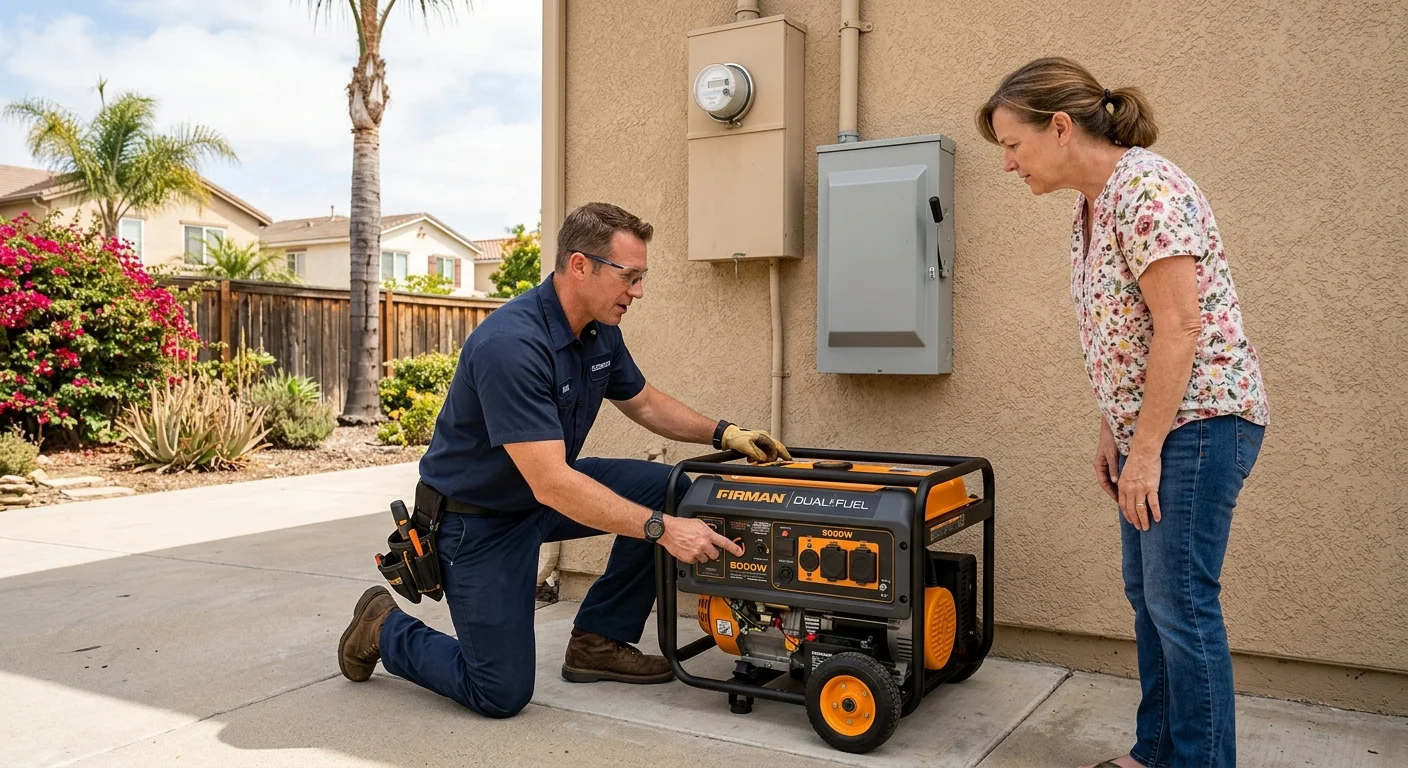
A portable dual fuel generator is equipment you store, roll outside, and start on gasoline or propane. You then power selected cords or, if a licensed electrician has already installed the right transfer equipment, selected house circuits. It does not sit on a pad and take over the service by itself.
A standby generator is a permanent install. It is usually tied to a fuel supply at the house, paired with a transfer switch, and meant to pick up chosen circuits when utility power drops. That is a different product, a different permit path, and a different service call. If you are weighing inverter portables against a hardwired standby unit, read inverter vs standby generators in San Diego. The dual-fuel question is narrower: can this portable machine run on two fuels, and is that enough for the outage you actually get.
Fuel flexibility is the reason people search dual fuel. Gasoline is easy to buy on a normal day in Oceanside or El Cajon. During a long PSPS, pumps need power too. Propane in cylinders can sit on site if your fire rules, HOA, and the unit’s manual allow it. Dual fuel does not mean the machine makes the same power on both fuels, and it does not mean one fuel is always cheaper. Those numbers live on the model’s own sheet and at the pump that week. They are not a countywide figure we can publish here.
Do not treat a portable dual-fuel unit as a whole-home automatic system. It will not start itself at 2 a.m. in Fallbrook while you sleep, unless you have bought and installed a true standby package. It also is not the same decision as propane versus diesel for a pad-mounted unit. Keep those comparisons on their own pages.
Warranty language is easy to mix up. Some standby brands publish limited terms for home standby engines. A portable dual fuel generator follows the paperwork in its own box. Keep that packet. Scheduled upkeep in the owner’s manual matters if you ever need a claim. Electrical work on a transfer switch, breaker, or feeder is licensed electrician scope either way.
Bright Pro Electric does not sell, store, or install generators. We match you with independent licensed electricians who can look at the portable path and the standby path on the same visit.
What transfer equipment changes the backup plan
A generator in the driveway is not a backup plan until you have a legal way to feed the loads you listed. Extension cords to a fridge and a lamp are one limited path. Feeding the house through the panel is another, and that second path is licensed electrical work.
Do not backfeed a dryer outlet or any other receptacle. Do not follow connection steps from a video. This page will not give interlock, cord, or transfer-switch wiring instructions. The safe question is which transfer equipment belongs on this house, and which licensed electrician will install it.
A transfer switch keeps utility power and generator power from meeting. An interlock is a different hardware approach with the same goal: the main and the generator feed cannot be on together. Which device fits depends on the panel, the loads, and the jurisdiction. Compare those options in generator interlock vs transfer switch in San Diego, then have the electrician you hire confirm what your panel can accept. Older East County panels in La Mesa, Lemon Grove, and El Cajon often need that confirmation before anyone shops a kit.
CSLB’s C-10 classification covers installing and connecting electrical equipment that uses electrical energy. A transfer switch, generator inlet, and related breakers sit in that work. A Class B general contractor can be on a larger project only under the rules in Business and Professions Code section 7057: two unrelated trades besides framing, or the right specialty license, or a subcontract to an appropriately licensed specialty contractor. For electrical-only connection work, you want a licensed electrical contractor on the contract. Verify the business on the CSLB license lookup before you sign.
San Diego County is not one permit office. In the City of San Diego, Development Services issues electrical permits for installation, alteration, addition, or replacement unless a narrow Municipal Code exemption applies. Unincorporated places such as Ramona, Lakeside, Fallbrook, Alpine, and Bonsall go through County Planning & Development Services. Poway runs its own Building Services division. Chula Vista, El Cajon, Escondido, and the other incorporated cities each run their own building department. Ask the electrician which office will see the transfer equipment, and who pulls that permit. Simple No-Plan in the City of San Diego is still a permit. It is not a pass to skip the counter.
Fuel storage, placement, and permit details to confirm
The dual-fuel pitch is useless if you cannot store fuel, place the machine, or get the electrical work approved. Confirm those three things locally. Do not copy a national retail listing.
Placement starts outdoors. Exhaust belongs away from people and occupied rooms. The exact setback, pad, and orientation are not a figure this site can invent. Read the unit’s outdoor-use instructions, then ask the electrician and the building department that covers your address. Inland canyons in Scripps Ranch, Alpine, and the back side of Poway also sit in wildfire country. A generator against a fence under eaves is a placement question for the local fire and building staff, not a catalog photo.
SDG&E’s outage guidance is to use a flashlight rather than candles. Stay away from water when you use electrical equipment. Never touch fallen lines. For downed wires call 911 if it is an immediate hazard, and SDG&E at 800-411-7343 from a safe place. Do not walk out to measure a clearance.
Fuel storage is a local and HOA question as much as a hardware question. Gasoline volume, propane cylinder count, and where tanks may sit are not published as one county rule in our claims ledger, so we will not print a number. Ask the fire authority and, if you have one, the association. During a PSPS, plan how you would refill. A station in Vista or Escondido may be dark. A propane exchange you can reach on a half tank of car fuel is part of the plan.
Permit details for the generator itself and for the electrical connection are set by the same split of offices named above. City of San Diego electrical work needs a permit unless San Diego Municipal Code section 129.0303 exempts that exact swap of like-for-like devices. A new inlet and transfer switch is not a light-switch swap. County unincorporated fees live on the PDS fee schedule and change by fiscal year. Poway’s Master Fee Schedule is separate. We are not publishing a generator permit price here because a verified generator-specific fee was not confirmed for every city we serve. Call the office on your permit, or have the electrician do it.
If you already know you want a hardwired standby path instead of a portable dual-fuel unit, start at generator installation and have a licensed electrician scope the pad, fuel, and transfer work together.
What to compare before you buy or hire an installer
There is no single best dual fuel generator to buy for San Diego County. Retail roundups rank models by watts and noise. Your decision is whether portable dual-fuel backup matches the outage you get, and who will make the house connection legal.
Compare the machine on fuel you can store, outlets that match the cords you will actually use, and whether the maker documents a safe fuel-select method. Compare inverter versus conventional output if you care about electronics; that comparison is in the inverter-versus-standby guide, not in a wattage table on this page. Compare weight and whether one person can move the unit after a long, hot inland day. Those are owner facts. They are not a substitute for the electrical plan.
Compare the house next. Panel type, spare spaces, grounding, and whether a transfer device will even fit belong in the electrician’s notes. A whole-house electrical safety inspection on this site typically runs $150 to $300 when you want that walkthrough before you buy iron. It is this site’s published range, not a market average from a third party.
Compare the contractor the same way CSLB tells consumers to. Get written bids on the same scope. Ask who holds the license, who will be on site, who pulls the permit, and what warranty covers the electrical work. A license is not a guarantee of insurance, so ask for the certificate and verify it with the carrier. Cheap bids that skip transfer equipment are not a bargain. They leave you with a generator that cannot legally feed the panel.
If the load list is the fridge and a few lights, a portable dual fuel generator plus a careful cord plan may be enough. If you want the well, the HVAC, and the panel to come back without dragging a machine into the wind, you are in standby territory. Buy the machine after that fork, not before it.
Frequently asked questions
Is a dual fuel generator a good idea?
It can be, when you need fuel choice during a long inland outage and you only plan to cover a short list of loads. It is a weaker idea when you want automatic whole-house coverage, or when you have no legal transfer path and no place to run the unit outdoors. The good-idea test is the load list, the placement, and the electrician’s transfer plan.
Is it cheaper to run a dual fuel generator on gas or propane?
A cheaper-fuel answer for San Diego County could not be confirmed. Pump gasoline and cylinder propane change week to week, and dual-fuel units do not always make the same power on both fuels. Compare the current price at a station and a propane counter you can reach during a shutoff, and read the model’s own fuel notes. Do not trust a national blog’s cost-per-hour math.
How big of a generator to run a 2000 sq ft house?
House size does not set generator size. Two homes with the same floor area can have different pumps, HVAC, panels, and medical loads. List the circuits you want, read appliance nameplates, and have a licensed electrician check starting load against the panel. No wattage target for a 2,000 square foot San Diego house is verified in our claims ledger, so we will not invent one.
What is the best dual fuel generator to buy?
The best buy is the one that matches stored fuel, outdoor placement, and a transfer path a licensed electrician can install in your jurisdiction. Skip model crowns from retailers. Ask for the manual, the electrical scope in writing, and a CSLB check on the business that will touch the panel.
When to call us
Call when you want a dual fuel generator tied into the house through a transfer switch or other listed transfer equipment, or when an older inland panel needs a look before you buy the machine. The electricians we connect you with handle that licensed work and pull the permit in the right city or county office. Call us at (858) 988-5580 and we’ll connect you with a licensed local electrician.