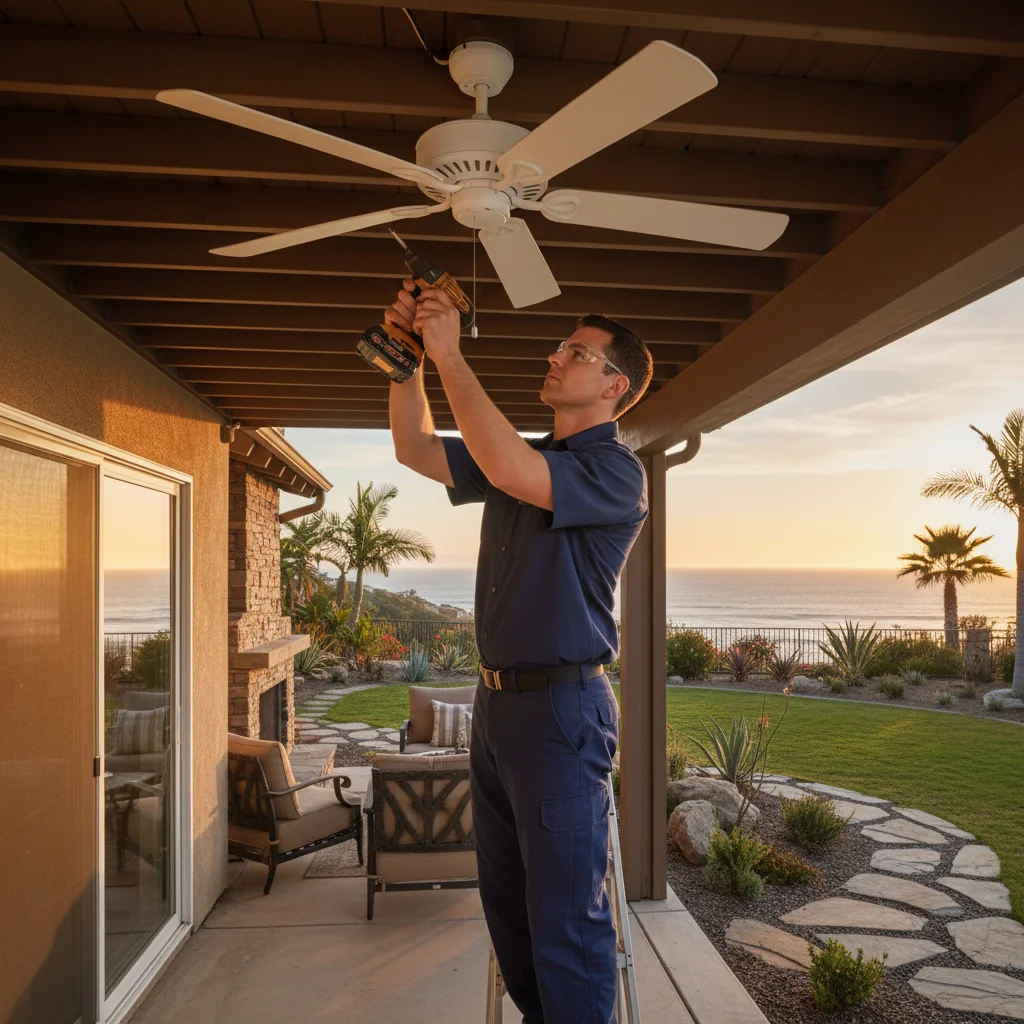
Enjoying your patio on a warm San Diego evening is one of life’s simple pleasures, but a still, hot night can make it less comfortable. An outdoor ceiling fan seems like the perfect solution, creating a gentle breeze to keep you cool. But choosing and installing one here is more complicated than just picking a style you like, especially with our coastal climate.
TL;DR
- Use the fan’s listing (damp vs wet), the manufacturer’s instructions, actual rain and salt exposure, a fan-rated box listed for the weight, and the circuit that will feed it.
- Coastal salt is a screening clue. Replacement cycles in “2 to 3 years” are not a fact for every lot. Match housing and hardware to the listing.
- A fan-rated box on structure is a listing and code check. Do not hang from finish material.
- Replacing an existing fan or light fixture runs $250 to $450 in labor; a new installation with new wiring runs $600 to $1,200 or more. Keep those figures parked.
- Fan blades should sit 7 to 9 feet off the floor for effective air circulation; use a downrod to achieve that height on taller patio covers.
Damp-rated vs. wet-rated: which your patio actually needs
The first and most important decision is choosing a fan with the correct UL rating for your space. Using an indoor fan outside is a non-starter; its motor isn’t sealed against moisture and its blades are often made of materials that will warp and sag. For outdoor use, you have two choices: damp-rated or wet-rated.
Damp-rated ceiling fans are designed for covered outdoor spaces. Think of a typical covered patio, porch, or California room. These areas are protected from direct rain and sprinklers but are still exposed to humidity, moisture, and condensation. The fan’s motor is sealed to prevent moisture from getting in, and the blades are made of weather-resistant materials like ABS plastic. If your patio in an inland area like Poway or Escondido is fully covered, a damp-rated fan is usually sufficient.
Wet-rated ceiling fans are built for direct exposure to the elements. They can handle rain, snow, and even being hosed down for cleaning. Every component, from the motor housing to the mounting hardware and blades, is completely waterproof. You need a wet-rated fan for any location that isn’t fully protected from above, such as a pergola, gazebo, or an uncovered deck. Even in a covered patio in a coastal area like La Jolla or Encinitas, where fog and driving rain are more common, a wet-rated fan offers an extra layer of durability and peace of mind.
Choosing the wrong rating can lead to a shorted motor, rusted components, and a voided warranty. When in doubt, it’s always safer to choose a wet-rated fan.
Coastal corrosion: why listing and hardware matter near salt air
Living in San Diego County means outdoor metal sees salt air. The marine layer carries salt particles that settle on finishes. That is a screening clue, not a replacement-cycle clock. Match housing and hardware to the listing and the actual exposure.
A standard “outdoor” fan from a big-box store can pit, wobble, or seize sooner on a coastal lot than inland. That is not a 2-to-3-year rule for every address. Look at motor housing, fasteners, and the wet/damp listing.
When you’re shopping, look for fans specifically marketed as “coastal,” “marine-grade,” or “weather-resistant,” then confirm the listing:
- Housing: Powder-coated aluminum or high-grade polymer housings.
- Hardware: Screws, brackets, and fasteners listed as marine-grade (316) stainless steel when the site is coastal.
- Blades: All-weather ABS composite blades that the maker rates for outdoor use.
A fan built for coastal conditions costs more upfront. It is still not a measured replacement interval.
Beam mounting, downrods, and ceiling height
Proper installation is just as critical as choosing the right fan. An outdoor fan needs a secure mounting point that can handle the weight and dynamic forces of the spinning motor. This is not a place to cut corners.
The electrical box the fan attaches to must be specifically “fan-rated.” That means it is listed to support the extra weight and vibration. On most San Diego patio covers, the electrician mounts these boxes directly to a solid wood beam or joist. If the patio ceiling is finished with stucco or drywall, they need to locate a structural member. Attaching to finish material is unsafe and against code.
Ceiling height is another key factor. For optimal air circulation, the fan blades should be between 7 and 9 feet from the floor.
- Low Ceilings (8 feet): A “hugger” or low-profile fan that mounts flush to the ceiling is the best choice to maintain safe head clearance.
- Standard Ceilings (9-10 feet): The small downrod included with most fans (typically 3-6 inches) usually works perfectly.
- High or Vaulted Ceilings: For taller patio covers, you’ll need a longer downrod to lower the fan into the effective zone. Downrods come in various lengths, typically from 12 to 72 inches.
Using the correct downrod ensures the fan can move air efficiently instead of just spinning uselessly high above your head. It also helps stabilize the fan and prevent wobbling on angled ceilings. Once it’s up, make sure you’re running it counter-clockwise in summer. Our guide on ceiling fan direction for summer and winter covers the setup and how to find the reverse switch.
Wiring a covered patio without an existing box
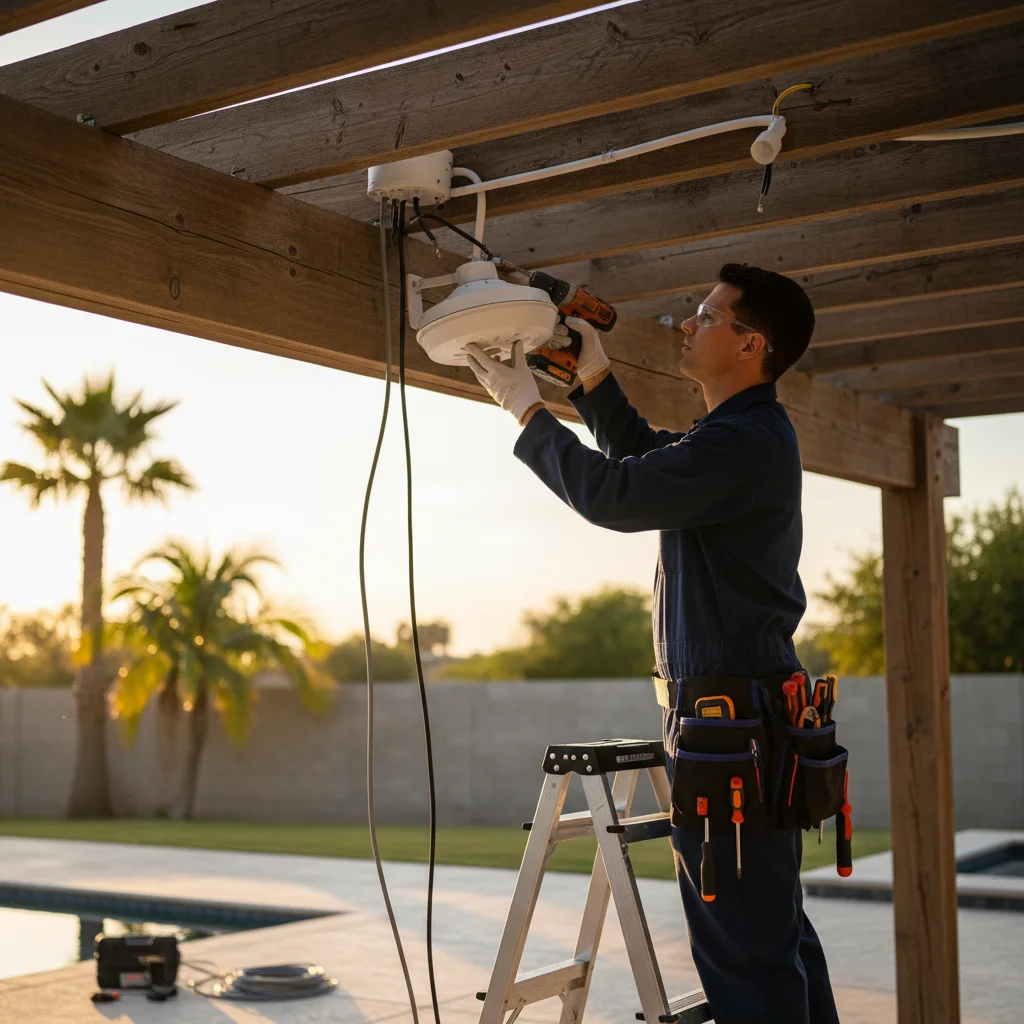
What if your perfect spot for a patio fan doesn’t have any existing wiring or a light fixture? This is a very common situation and one that absolutely requires a licensed electrician. Creating a new circuit for an outdoor fan involves more than just connecting a few wires.
The process typically involves:
- Identifying a power source: The safest listed path, which could be an existing outdoor outlet, an interior circuit, or a run from the main panel.
- Running conduit: Outdoor wiring needs protection. The electrician runs listed conduit from the power source to the fan location. That protects conductors from physical damage, UV, and moisture. On a patio cover, it is often run along the top of beams.
- Installing a switch: A wall switch near the door to the patio is common. Outdoor locations typically need GFCI protection. Confirm against the adopted code and the listing.
- Mounting the fan-rated box: A new, fan-rated box on a structural beam, listed for the fan weight.
This is similar to new outdoor landscape lighting systems and needs the adopted electrical code so the run is listed, weatherproof, and inspectable.
Cost to install in a San Diego outdoor space
The cost of an outdoor ceiling fan installation can vary significantly based on the fan you choose and the complexity of the job.
First, there’s the cost of the fan itself. A basic, damp-rated fan might cost $150-$300. A high-quality, wet-rated, coastal-grade outdoor ceiling fan with light can range from $400 to over $1,500 for premium models from brands like Big Ass Fans.
For the professional installation, here’s a general breakdown for San Diego homeowners:
- Replacing an existing fan or light fixture: If you have a properly wired, fan-rated box already in place, this is a straightforward swap. You can expect labor costs to be in the $250 to $450 range. This covers removing the old fixture, assembling and installing the new fan, and testing everything.
- New installation with new wiring: If there’s no existing box, the job is more involved. Cost depends on how far wire has to run, the type of construction (wood vs. stucco), and whether a new circuit is needed. For a new installation, expect $600 and $1,200 or more.
For more details on the factors that influence pricing, you can read our general guide to ceiling fan installation costs in San Diego. Always get a firm quote from a licensed electrician. You can check any electrician’s license status on the California CSLB website.
Brands that hold up in salt air
When you’re investing in an outdoor fan for a San Diego home, brand and listing matter more than a Bright Pro install list. Manufacturers that publish coastal or wet-rated lines include:
- Hunter: A classic for a reason. Hunter’s “WeatherMax” line is specifically engineered to be corrosion and salt-air resistant. They are UL wet-rated and feature powerful, quiet motors. They offer a great balance of performance, durability, and traditional style without a premium price tag.
- Modern Forms: If you’re looking for a sleek, contemporary design with smart features, Modern Forms is a top choice. Many of their fans are built with marine-grade stainless steel and reliable finishes. They integrate with smart home systems like Alexa and Google Assistant, allowing you to control fan speed, light, and direction from your phone.
- Big Ass Fans: The name says it all. These are premium, high-performance fans built with industrial-grade materials. They are engineered for maximum air movement and efficiency, and their durability is unmatched. While they are a significant investment, they come with long warranties and are designed to last for decades, even in the harshest coastal conditions.
While you might pay more for these brands, you are buying a listed wet-location fan. How many seasons a cheap fan lasts is a field finding, not a cycle this page can publish.
Frequently asked questions
Do I need a wet-rated fan or is damp-rated enough for my San Diego patio?
If your patio is fully covered and you’re in an inland area like Poway, Escondido, or El Cajon, a damp-rated fan is sufficient for normal humidity and condensation. If your patio faces the ocean, sits in a coastal neighborhood like Encinitas or La Jolla where fog and driving rain are common, or is only partially covered, a wet-rated fan is the right choice. When in doubt, wet-rated is always the safer option and usually only costs $50 to $150 more per unit.
Why do outdoor fans fail so quickly near the San Diego coast?
Salt-laden marine air settles on outdoor surfaces and can accelerate corrosion compared with inland lots. That is a screening clue, not a measured replacement cycle. Standard “outdoor” fans from big-box stores often use steel motor housings and ordinary fasteners. Look specifically for fans marketed as coastal or marine-grade, with powder-coated aluminum or polymer housings and 316 stainless steel fasteners, then confirm the listing.
Can I install an outdoor ceiling fan myself if there’s already a light fixture there?
If there’s an existing fan-rated electrical box properly secured to a structural member, swapping in a new fan is something many homeowners do successfully. The critical check is confirming the box is fan-rated (it will be labeled) and anchored to framing, not just the finish ceiling. If you’re unsure, or if the existing box is just a standard light fixture box, a licensed electrician should inspect it before installation. A ceiling fan creates constant vibration that standard light boxes aren’t rated to handle.
How much does it cost to add a new wired outdoor fan on a patio with no existing outlet or wiring?
Expect $600 to $1,200 or more for a new installation that includes running conduit, pulling wire from a power source, installing a fan-rated box on a structural beam, and adding a control switch. Homes with limited attic access, stucco exteriors, or long conduit runs trend toward the higher end. The fan fixture itself is separate and can range from $150 for a basic damp-rated unit to $1,500+ for a premium coastal-grade model.
When to call us
Installing an outdoor ceiling fan, especially with new wiring, is licensed electrical work: outdoor listings, a fan-rated box on structure, and the adopted code. Bright Pro Electric matches you with that electrician. It does not run conduit or pull permits.
Ceiling fan installation is the matching page for indoor and outdoor fan work across San Diego County, including patio covers, pergolas, and California rooms.
Use the contact page. Hours are Monday through Saturday, 7am to 7pm. After hours, leave a message.