Spring in San Diego is when homeowners finally walk their yards at dusk and realize the landscaping looks great, and completely invisible after 7 p.m. If you’re weighing a lighting project this season, the decisions stack up fast: low-voltage or line-voltage, which fixtures survive the salt air, and what’s a fair price to pay.
TL;DR
- Design from the listed system instructions, a calculated voltage drop, the wiring method, the jurisdiction, and actual exposure. 12V vs 120V is a listing and use choice, not a San Diego default.
- A starter landscape system (6 to 10 lights, one transformer) runs $800 to $1,500 installed; a full property system runs $5,000 to $12,000+ in Del Mar, La Jolla, and Rancho Santa Fe. Park those dollars.
- Coastal lots should match fixture material to the listing and the site. Do not treat a one-mile ocean rule or a “few seasons” failure as measured fact.
- Adding any new outdoor outlet or line-voltage circuit typically requires a permit in San Diego County; confirm for that address. Low-voltage wiring plugging into an existing outlet often does not.
- Size your transformer at 50% of rated capacity maximum to extend its life; 18-gauge DIY kit wire causes voltage drop on runs longer than 50 feet.
Low-voltage vs. line-voltage: which fits your yard
Most residential landscape lighting runs on one of two systems. Low-voltage (12V DC) is the default for path lights, uplights, and accent fixtures. Line-voltage (120V AC) is what you’d use for post lights, high-output floodlights, and any fixture that needs to throw serious light across a large driveway or backyard.
Low-voltage is the right call for the majority of San Diego yards. Here’s why:
- Cable runs shallow, typically 6 inches deep, though local inspectors sometimes want more in high-traffic zones
- DIY-friendly wiring up to the transformer, but the transformer itself needs a proper outdoor outlet
- LED fixtures draw so little power that a single 150-watt transformer can handle 20-plus lights
- Safer to work around after installation
Line-voltage earns its place when you need brightness that 12V can’t deliver. Think a large parking pad in Rancho Santa Fe, or a pool deck where you want true security lighting. For dedicated security applications, including motion-activated floodlights and dusk-to-dawn perimeter fixtures, see our security lighting installation guide for San Diego. Any 120V outdoor circuit needs GFCI protection and, in San Diego County, a permit if you’re adding a new circuit.
The honest answer for most homeowners: go low-voltage for the decorative work, add a line-voltage circuit if you need one or two high-output fixtures. A licensed electrician can install the outdoor outlet the transformer plugs into. Outdoor and landscape lighting is the matching page. Bright Pro Electric does not install that outlet.
Path, uplight, downlight, and wash: a quick design primer
Good landscape lighting does three things: it guides people safely, it creates depth in the landscape, and it makes your house look intentional from the street. Four fixture types cover almost every residential application.
Where each fixture goes is a design call as much as an electrical one. If you want the layout planned around mature plantings and hardscape, a landscape lighting team like Bloom Pro SD handles the design. A licensed electrician wires the listed low-voltage or line-voltage work. Bright Pro Electric does not.
Path lights
Stake-mounted, typically 18–24 inches tall. Space them 8–10 feet apart. Closer than that and you get a runway effect. Aim for a warm white (2700K–3000K). San Diego’s drought-tolerant landscaping looks better with warmer tones than the cool whites that wash out native plants.
Uplights
Buried or surface-mounted at the base of a tree, wall, or architectural feature. They punch light upward to create drama. A 35-degree beam angle works for most palm trees; go narrower (15–20 degrees) for a tight column or sculpture. Keep the fixture itself hidden. The light should be visible, not the source.
Downlights
Mounted in trees or on eaves, pointing down. Moonlighting, placing a cool-white fixture high in a mature oak or jacaranda, mimics natural light and is one of the most striking effects you can achieve. Requires running wire up the tree or to the eave, which adds labor.
Wash lights
Low-angle fixtures that graze a wall or fence to reveal texture. Especially effective on stucco, which is everywhere in San Diego. Keep the fixture 12–18 inches from the wall for the best texture shadow.
You don’t need all four types in every yard. A simple front yard can look polished with just path lights and two uplights on the anchor tree or front facade.
Transformers, timers, and smart controls
Every low-voltage system starts at the transformer. It’s a box, usually mounted near your outdoor outlet, that steps 120V down to 12V and controls when the lights run.
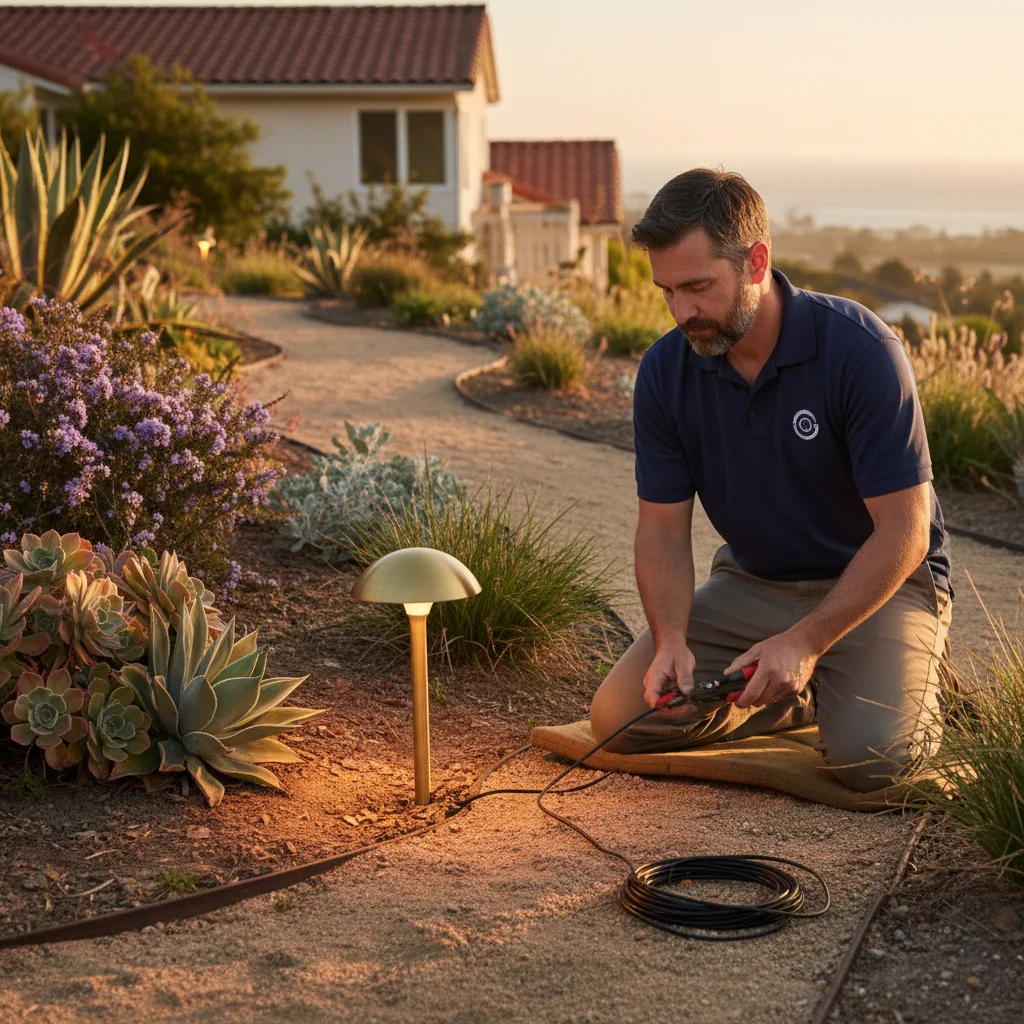
A basic transformer with a mechanical timer costs $50–$120. It works fine. But San Diego’s sunrise and sunset shift by nearly two hours between December and June, so a mechanical timer needs seasonal adjustments or your lights run through the afternoon in summer.
Astronomical timers solve this automatically. They calculate local sunrise and sunset based on your zip code and adjust every day. Most quality transformers in the $150–$300 range include this feature.
Smart transformers go further. Brands like Kichler and FX Luminaire make Wi-Fi-enabled transformers you can control from a phone, set zones, dim individual circuits, and integrate with platforms like smart home wiring systems. If you’re already running a home automation setup, it’s worth specifying a smart transformer from the start. Retrofitting later means replacing the whole unit.
One practical note: size your transformer at 50% of its rated capacity maximum. If you’re installing 100 watts of fixtures, use a 200-watt transformer. Sustained loads at or near the transformer’s ceiling shorten its life significantly. It’s a cheap mistake to avoid upfront.
What it costs in San Diego and where homeowners overspend
Landscape lighting projects in San Diego County typically fall into three tiers:
Starter system (6–10 path/accent lights, one transformer): $800–$1,500 installed. This covers a modest front yard or single garden bed, with a professional-grade transformer, proper wire gauge, and waterproof connectors.
Mid-range system (12–20 fixtures, multiple zones): $2,000–$4,500 installed. Includes uplighting on trees, path lighting front and back, a smart or astronomical transformer, and potentially one new outdoor GFCI outlet if one isn’t already in the right location.
Full property system (20+ fixtures, line-voltage integration): $5,000–$12,000+. Common in Del Mar, La Jolla, and Rancho Santa Fe, where properties are larger and clients want consistent coverage across multiple zones, including pool, driveway, and garden areas.
Where homeowners overspend: Cheap box-store plastic path lights often degrade in UV and salt air. This page does not publish a two-year replacement cycle. Compare listing, wire gauge, and replacement cost in the written quote. Undersizing wire on a long run causes voltage drop, and fixtures at the far end look dimmer. Proper runs often need 12- or 14-gauge wire, not the 18-gauge included in many DIY kits.
For a broader look at how electrician pricing works in the county, our electrician cost guide for San Diego breaks down labor rates by project type.
Coastal corrosion: why fixtures fail in Coronado and Encinitas
If the lot sees salt air (Coronado, Ocean Beach, Pacific Beach, Encinitas, Carlsbad), fixture material matters more than inland. Salt-laden marine air attacks zinc, aluminum, and steel. Distance-to-ocean rules and “eighteen months vs eight years” clocks are not measured facts on this page. Match the fixture listing to the actual exposure.
The right materials for coastal installs:
Brass and solid copper are common coastal specifications. They develop a natural patina rather than rusting through like painted steel. A brass path light costs $60–$120 per fixture versus $15–$30 for aluminum on this page. That is a material-cost comparison, not a replacement-cycle guarantee. Brands like Unique Lighting, FX Luminaire, and Kichler’s Landscape Pro line offer solid brass options.
Marine-grade stainless steel (316 grade) is the right choice for fasteners, junction box hardware, and mounting brackets. Standard 304 stainless will rust near the coast.
Avoid: Die-cast zinc alloy (common in mid-price fixtures), painted aluminum without a marine coating, and any fixture with exposed steel hardware.
Seal all wire connections with waterproof wire nuts or direct-burial silicone connectors rated for wet locations. A loose connection that is fine inland can fail sooner on a coastal lot. That is a listing and sealing issue, not a measured season count. Skipping professional lighting installation is a homeowner choice; a proper install includes connection sealing and listed conduit entry on the transformer. Bright Pro Electric does not perform that install.
Permits, GFCI, and safe burial depths
Landscape lighting lives in a gray zone for permits in San Diego County. Here’s the practical breakdown:
Low-voltage systems (12V) plugging into an existing outlet: Generally no permit required for the low-voltage wiring itself. You’re not modifying the electrical system, you’re using it.
Adding a new outdoor outlet: Typically requires a permit. Confirm for that address. Any new circuit or outlet addition falls under the California Electrical Code (which adopts NEC/NFPA 70 with California amendments). A licensed electrician pulls this permit when it is in their scope. Bright Pro Electric does not.
Line-voltage outdoor lighting circuits: Always permitted. A new 120V circuit to a post light or flood fixture requires a permit, inspection, and GFCI protection at the outlet or breaker. For context on GFCI requirements specifically, our GFCI outlet installation guide covers where they’re required and what they cost.
Burial depths under California code:
- Low-voltage (under 30V): 6 inches minimum
- Line-voltage in conduit: 6 inches minimum
- Line-voltage direct burial cable (UF-B): 12 inches minimum
- Line-voltage under a concrete slab: 4 inches in conduit
Shallow burial is one of the most common DIY mistakes. A cable at 2 inches gets nicked by a trowel during routine gardening and creates a shock or fire hazard. Depth is cheap protection.
Before any digging, call 811 (Dig Safe) to locate utilities. In San Diego, response time is typically 2–3 business days.
Frequently asked questions
Do I need a permit for landscape lighting in San Diego?
It depends on what you’re doing. A low-voltage (12V) system that plugs into an existing outdoor outlet generally doesn’t require a permit; you’re using the electrical system, not modifying it. Adding a new outdoor outlet to power the transformer typically requires a permit. Installing any new 120V line-voltage circuit (for a post light, floodlight, or high-output fixture) typically does too. Confirm for that address. A licensed electrician pulls these when they are in their scope. Bright Pro Electric does not.
Why do my landscape lights look dimmer at the far end of the run?
Voltage drop. As current travels down a long wire run, resistance causes a drop in voltage. Fixtures at the far end receive less than 12V and appear noticeably dimmer. The most common cause is undersized wire. Many DIY landscape kits include 18-gauge wire, which is only adequate for short runs. Runs longer than 50 feet typically need 14-gauge wire, and runs over 100 feet often need 12-gauge. Daisy-chaining too many fixtures on one run also causes drop; use a hub-and-spoke layout instead.
What landscape lighting fixtures actually last near the San Diego coast?
Match fixture material to the listing and the actual salt exposure. Solid brass and solid copper develop a patina rather than rusting through like painted steel. Brass path lights cost $60 to $120 per fixture versus $15 to $30 for aluminum on this page. For mounting hardware and junction box fasteners, 316-grade stainless steel is a common coastal spec. Avoid die-cast zinc alloy and painted aluminum without a marine-specific coating unless the listing covers that exposure. This page does not assign a one-mile ocean rule.
How do I make my landscape lights turn on at the right time year-round?
A mechanical timer needs manual seasonal adjustment because San Diego’s sunset shifts by nearly two hours between December and June. An astronomical timer solves this automatically by calculating local sunrise and sunset based on your zip code and adjusting every day. Most quality transformers in the $150 to $300 range include this feature. Smart Wi-Fi transformers go further and let you control zones and dimming from a phone.
When to call us
If the project adds an outdoor outlet, runs a line-voltage circuit, or sits within a few feet of a pool or water feature, you need a licensed electrician. Permits and code compliance are the electrician’s scope when they take the job. Coastal installs also need a listed fixture and sealed connections. Bright Pro Electric matches you with that electrician. It does not handle the project as a crew. One exception: a pool light is a submerged pool fixture, not house wiring, so if you’ve got a pool light that’s not working, that’s pool-side work for a pool specialist.
Outdoor and landscape lighting is the matching page for transformer outlets through multi-zone systems.
Use the contact page. Hours are Monday through Saturday, 7am to 7pm. After hours, leave a message.