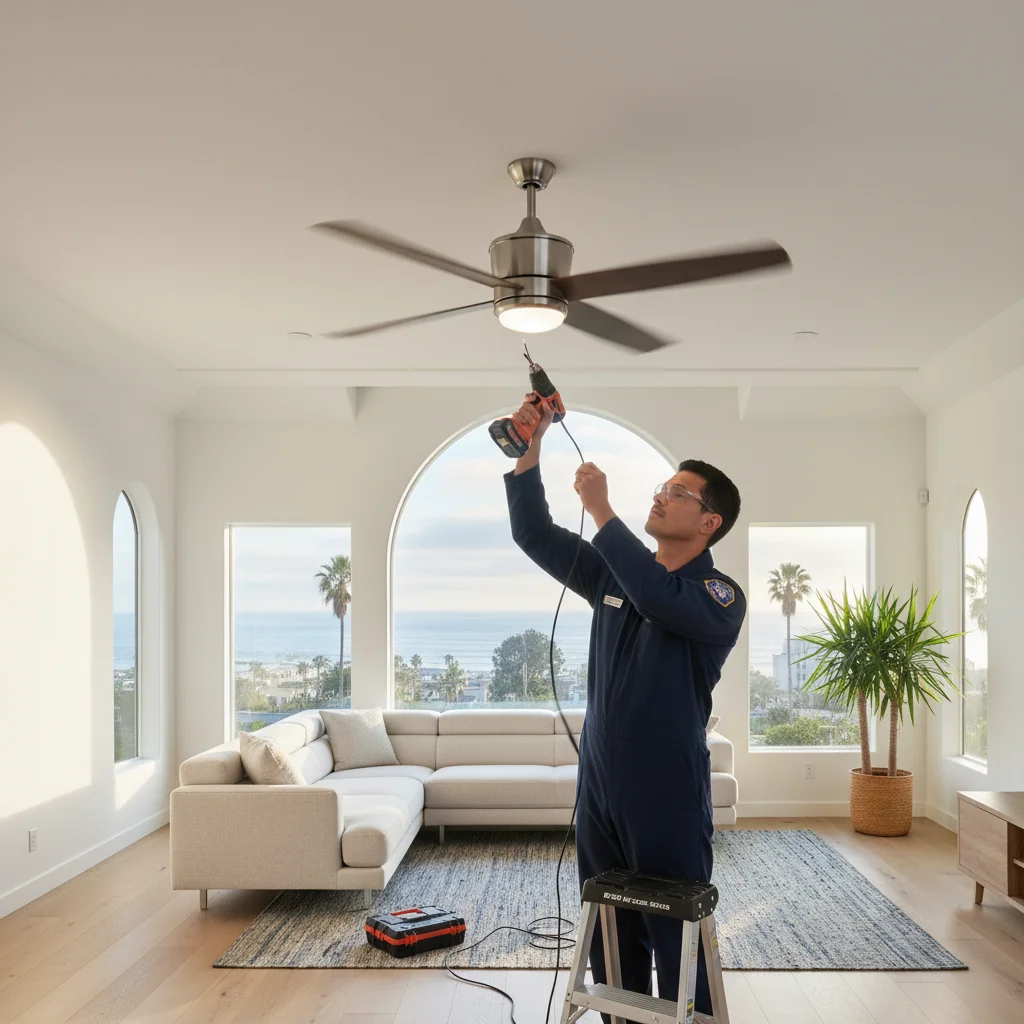
Your ceiling fan is a comfort tool, not a heater or an air conditioner. Direction matters, but the label “clockwise = winter” is a convention that assumes a standard blade pitch. Some fans and some aftermarket blades reverse that. Start with the manual, then test the air on your skin.
TL;DR
- Cooling mode is the direction that pushes a noticeable breeze down onto people. For many fans that is counter-clockwise from below. Confirm it.
- The other direction, usually on low, is meant to move stratified ceiling air without a strong downdraft. Test, do not assume.
- Stop the fan before using a reverse toggle on the motor. Remotes have their own reverse control.
- DOE consumer guidance talks about raising a cooling setpoint when fans are on. That is not a guaranteed SDG&E savings percent.
- San Diego winters are mild. High ceilings still stratify. This page does not claim nine months of summer mode.
Summer: counter-clockwise to push air down
During San Diego’s hot, sunny summers, your goal is to create a cooling breeze. To do this, your ceiling fan blades should spin in a counter-clockwise direction.
When you look up at the fan, the blades should be moving from right to left. This orientation angles the blades to push air directly downward. This creates a downdraft, which you feel on your skin as a cool breeze.
This phenomenon is known as the “wind chill effect.” The moving air helps evaporate moisture from your skin, making you feel several degrees cooler, even though the actual room temperature hasn’t changed. According to the U.S. Department of Energy’s consumer ceiling-fan guidance, fans can let you raise a cooling setpoint about 4°F with similar comfort for people in the room. That is not a room-temperature drop and not a verified SDG&E bill cut. For the full energy math (DC vs. AC motors, SDG&E TOU rates, and CFM sizing by room) see our guide on ceiling fan energy savings for San Diego homes. Remember, ceiling fans cool people, not rooms. Be sure to turn them off when you leave a room to save energy.
Winter: clockwise to pull cool air up and recirculate warm air
Even in San Diego’s mild winters, a little extra warmth is always welcome, especially during cool evenings. You can use your ceiling fan to help your heating system work more efficiently. For the winter months, your fan should spin in a clockwise direction on its lowest speed.
When looking up, the blades should appear to move from left to right. This reverse motion pulls the cooler air from the center of the room up toward the ceiling. This gentle updraft displaces the warm air that has naturally risen and collected near the ceiling.
As the cool air is pulled up, the warm air is pushed out toward the walls and then back down into the living space. This process slowly and evenly recirculates the heated air throughout the room without creating a noticeable draft. You won’t feel a breeze directly under the fan. Instead, the entire room will feel more uniformly warm and comfortable.
By preventing heat from stacking at the ceiling, you may help a heat pump or furnace cycle less in a tall room. This page does not publish a heating-bill percent.
How to tell which direction your fan is spinning
Not sure which way your fan is currently rotating? It’s easy to check. Turn the fan on a low speed and stand directly underneath it.
First, just watch the blades. Do they look like they’re moving to the left (counter-clockwise) or to the right (clockwise)?
If you’re still not sure, pay attention to the air movement. If you feel a distinct breeze, the fan is in its summer, counter-clockwise setting. If you feel little to no air movement directly below, but the air in the room seems to be gently circulating, it’s likely in its winter, clockwise setting.
The easiest way to change the direction is to find the reverse switch. On most traditional ceiling fans, this is a small toggle switch located on the motor housing, just below the blades. Turn the fan completely off and wait for the blades to stop spinning before you flip this switch. Then turn the fan back on to confirm it’s spinning in the desired direction. For more modern fans with a remote control or wall panel, the reverse function is usually a button marked with a circular arrow or a similar symbol.

What to do if your fan has no reverse switch
If you’ve looked all over the motor housing and remote and can’t find a reverse switch or button, you may have an older or a very basic fan model. Some budget-friendly fans are designed to spin in only one direction, almost always counter-clockwise for summer cooling.
In this case, your fan is essentially a summer-only appliance. You can still use it to cool down, but you won’t be able to use it for winter heat circulation. While you can manually reverse the blade pitch on some very old models by un-screwing and flipping each blade, this is not recommended. It can easily unbalance the fan, leading to wobbling and noise.
If having year-round functionality is important to you, your best option is to upgrade to a new model. Modern ceiling fans are more energy-efficient, quieter, and almost always come with a reverse function as a standard feature. A professional ceiling fan installation ensures the new unit is safely mounted, properly balanced, and wired correctly from the start.
Why bedroom and great-room fans need different speeds
The size of the room and its primary use should dictate your fan’s speed setting. It’s not just about spinning in the right direction; it’s also about spinning at the right speed.
In a bedroom, the goal is gentle, quiet air circulation to promote restful sleep. A high-speed fan can be noisy and create an uncomfortably strong draft. For most bedrooms, a low or medium setting is perfect for creating a subtle breeze in the summer or for circulating heat in the winter without being disruptive.
In a larger space like a great room, family room, or a room with vaulted ceilings, you need to move a much larger volume of air. In these cases, a higher speed setting is necessary to create a noticeable cooling effect in the summer. A low speed in a large room might not be powerful enough to circulate air effectively. Similarly, in winter, a medium speed might be needed to properly destratify the heat in a tall space. The fan’s size also matters. A larger-diameter fan can move more air at a lower, quieter speed, which is often a better choice for big rooms.
When a fan is wired backwards and how to fix it
If your fan isn’t behaving as expected, maybe the pull chains seem to control the wrong functions or the fan won’t reverse, it could be a sign of improper wiring. This is a common issue with DIY installations or work done by an unlicensed handyman.
Inside the fan’s housing, there are separate wires for the motor (which spins the blades) and the light kit. If these wires are crossed during installation, it can cause a range of problems. The fan might only work on one speed, the lights may not dim properly, or the remote receiver may not function at all. Reversing the fan’s direction involves changing the polarity of the motor, and faulty wiring can interfere with this function.
Fixing a fan that’s wired backwards is not a simple DIY project. It involves turning off the power at the circuit breaker, taking the fan partially apart, identifying the correct wires, and reconnecting them according to the manufacturer’s diagram. Working with electrical wiring can be dangerous if you’re not experienced. For a more detailed look at the steps involved, you can read our guide to ceiling fan installation in San Diego. If you suspect a wiring issue, the safest and most reliable solution is to call a licensed electrician.
Frequently asked questions
How do I know which way my ceiling fan is spinning in San Diego?
Turn the fan on a low speed and look up at it. If the blades appear to move from right to left (counter-clockwise), you’re in summer mode and should feel a breeze below. If they move from left to right (clockwise), you’re in winter mode and the air circulates more gently. You can also hold your hand a foot below the fan: a distinct downward draft means summer mode, little to no direct draft means winter mode.
Where is the direction switch on a ceiling fan?
Most fans have a small toggle switch on the motor housing, which is the part just above the blades that attaches to the mounting bracket. Turn the fan completely off and wait for it to stop before flipping this switch, otherwise the motor can be damaged. Newer fans with remotes or wall controllers usually have a dedicated reverse button, often marked with a circular arrow.
Does ceiling fan direction matter in San Diego winters?
Less than in colder climates, but it still helps in rooms with high or vaulted ceilings. When warm air collects near a 10 or 12 foot ceiling in a Rancho Santa Fe or Scripps Ranch home, a ceiling fan in clockwise mode on low speed pushes it back down along the walls without creating a draft. For standard 8-foot ceilings, the benefit is modest.
My fan has no reverse switch. Can I still use it in winter?
A fan without a reverse switch is essentially a summer-only appliance. You can still use it for cooling. Manually flipping the blade pitch on very old fans isn’t recommended because it usually causes wobble and noise. If year-round functionality matters, replacing the fan with a modern model that includes a reverse function is the practical solution.
When to call us
Direction and a reverse switch are homeowner controls. New wiring, a fan-rated box, wobble that is not a blade-balance weight, or a fan that was wired wrong is licensed work. Bright Pro Electric matches you with an independent licensed electrician. It does not install fans. Hours are Monday through Saturday, 7am to 7pm. Use the contact form.