A landscape lighting system that used to work and now does not is a repair job, not a new install. In San Diego County that usually means a transformer, a buried cable, a failed fixture, or a photocell or timer that no longer matches sunset. Bright Pro Electric matches you with an independent licensed electrician. We do not install or repair the lights ourselves.
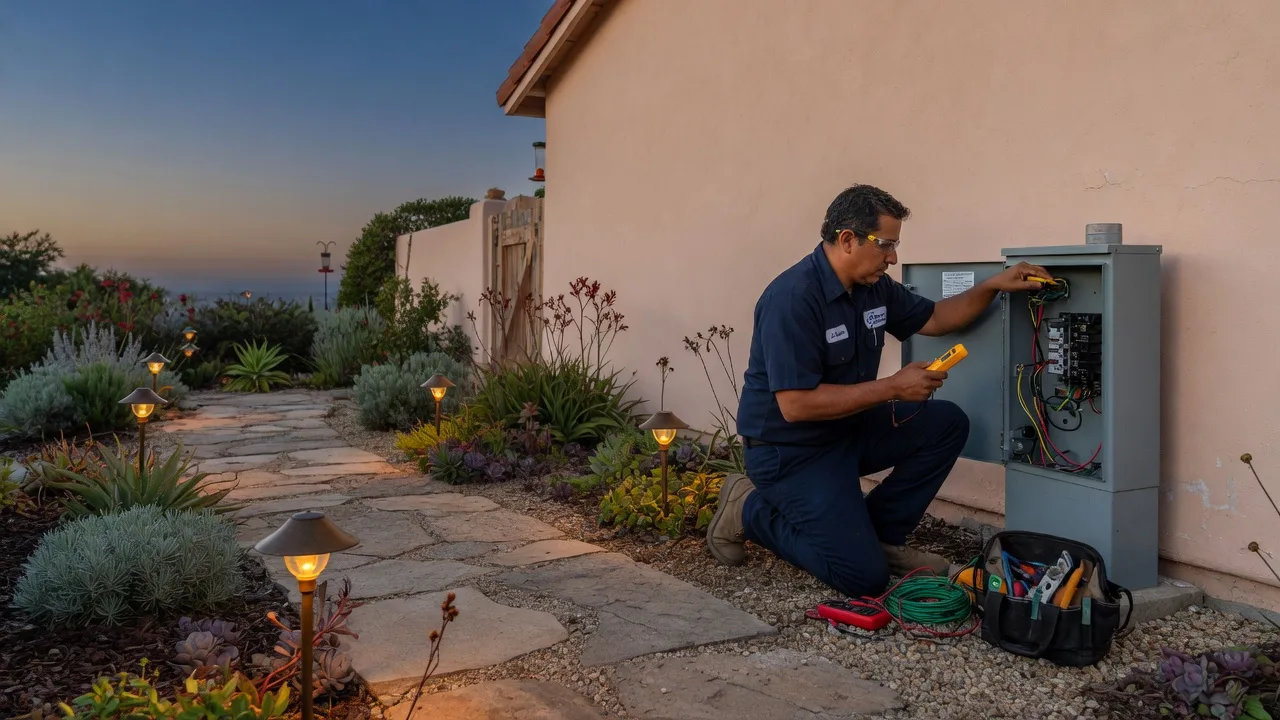
This page is for systems that already exist. For a first-time layout, see outdoor and landscape lighting in San Diego. The matching service page is outdoor and landscape lighting.
What actually failed: transformer, cable, or one fixture
Start with the pattern, not a parts cart.
If every path light is dark, the first check is power to the transformer. A GFCI that feeds an outdoor receptacle can open after rain and take the whole low-voltage run with it. If the transformer has power and the output terminals are dead, the unit itself is the suspect, not the first fixture in the bed.
If one zone is dark and the other still lights, the split is at a zone tap, a second transformer, or a cable splice. Encinitas and Carlsbad front yards often run two zones so the path and the tree uplights do not share one overloaded run. A single dead zone is not proof the transformer is finished.
If one fixture is dark and its neighbors are on, that is a lamp, a socket, a fixture body, or the two-wire tap at that stake. Swapping every lamp in the yard before anyone meters the transformer is how people buy a box of LEDs and still have a dark walk.
Coastal salt air in Imperial Beach, Coronado, and Ocean Beach eats cheap housings and open splices faster than inland Escondido or El Cajon. Inland heat cooks a transformer that sits in full sun on a south wall. The repair is the same category. The exposure is not.
After-rain failures and photocells that lie
Rain is the most common trigger people describe. Water in a low-voltage splice does not always trip a breaker. It can dim a run, flicker a line of path lights, or kill a zone until the soil dries. Then the same splice fails the next storm. That is a buried joint, not a “wet season” fixture.
A photocell that sticks on or off looks like a lighting failure. An astronomical timer that was never set for the ZIP looks like one too. San Diego sunset shifts by nearly two hours between December and June. A mechanical timer that was right in March is late in June. Confirm the control before anyone opens the first fixture.
Do not dig for the cable as a homeowner project. Low-voltage landscape cable is still a buried conductor. The electrician locates it, tests it, and replaces the failed section. Bright Pro Electric does not.
Line-voltage outdoor lights are a different repair
Not every “landscape light” is 12-volt. Wall packs, some tree floods, and older line-voltage path lights sit on a 120-volt circuit. Those repairs are lighting fixture repair territory: a listed box, a GFCI where the adopted code requires it, and a permit when the run is extended.
If the dead lights sit near a pool or spa, stop. Tingling at a rail or wet deck is an emergency. Leave the water. Call 911 if anyone is hurt. Then call. A submerged pool light that is not working is not a landscape transformer job.
A commercial lot with dead poles is not this page. That is parking lot lighting.
Permits, listings, and who does the work
Like-for-like replacement of a listed low-voltage fixture at the same location is often a different permit question than a new outdoor circuit. Confirm with the office that issues electrical permits for the address. City of San Diego Development Services handles City addresses. Unincorporated Ramona, Lakeside, Alpine, Fallbrook, and Bonsall use County Planning & Development Services. Poway runs its own building division. Chula Vista, El Cajon, Escondido, Carlsbad, Oceanside, Vista, San Marcos, Encinitas, La Mesa, Santee, Lemon Grove, Imperial Beach, and Coronado each run their own.
This page does not publish a landscape-lighting repair price. No verified San Diego installed figure sits in the claims file for that job. If the electrician adds a new 15- to 45-amp circuit inside the City of San Diego, the published Simple permit fee for the first five of those circuits is $176.57. That is a permit fee, not the repair. Unincorporated County electrical-only permits are $392 on the PDS-613 schedule effective 07/10/2026. Do not import either number into Poway or another city.
California’s current electrical code is the 2025 California Electrical Code, in effect as of January 1, 2026. Local departments can add rules. The electrician on the job applies the edition your city is enforcing.
CSLB classifies C-10 electrical contractors for installing and connecting fixtures, apparatus, and raceways. Check the business and license number on the CSLB license lookup before anyone opens the transformer.
Frequently asked questions
Why do only half my landscape lights work?
A half-dark run is usually a zone, a splice, or a second transformer, not a random lamp failure. Have it metered. Do not replace every fixture first.
Can I replace a landscape transformer myself?
A plug-in listed replacement at the same receptacle is a product swap. Moving the unit, changing the output, or adding a new outdoor receptacle is licensed electrical work. Confirm the listing and the permit with the electrician.
Do landscape lighting repairs need a permit in San Diego?
Sometimes. A like-for-like fixture at the same spot can be exempt under a local code. A new circuit, a relocated transformer on a new receptacle, or a line-voltage extension often needs a permit. Ask the office for your address.
When to call us
Call when the system used to work and now does not, when lights fail after rain, or when a zone is dark and the other is not. Call (858) 988-5580. Hours are Monday through Saturday, 7am to 7pm. After hours, leave a message on the contact page. Bright Pro Electric matches you with an independent licensed electrician. Same-night dispatch is not guaranteed.