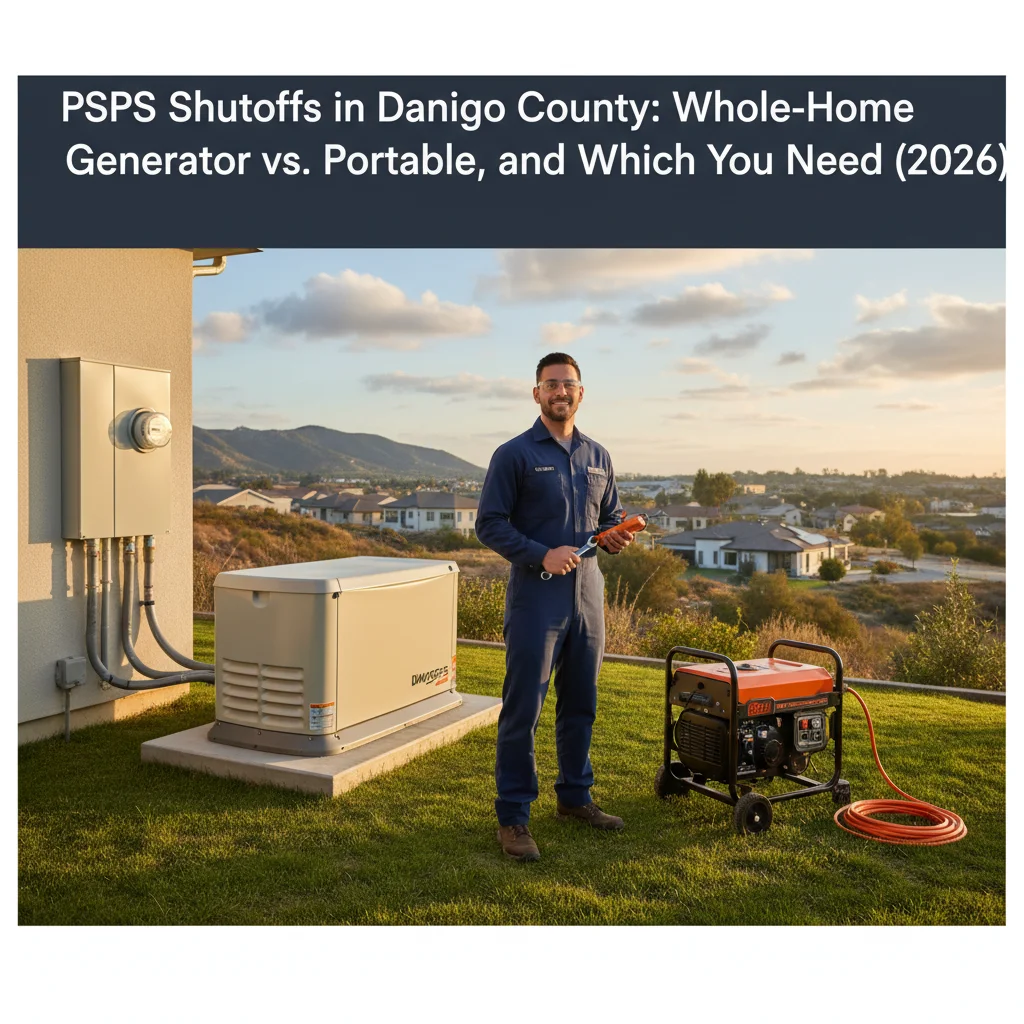
A portable inverter generator costs $500–$2,500 for the unit. Output, runtime, and transfer behavior are model-specific: read the nameplate and the owner manual. An installed standby generator runs $9,000–$22,000 total with permits on this page. Kilowatt bands (2–7 kW portable, 10–26 kW standby) are examples. Decide from protected loads, fuel, whether you need automatic transfer, and whether a medical device is listed to run on that generator.
TL;DR
- Portable inverter generator: $500–$2,500 for the unit. Confirm wattage, THD, and runtime on that model. Manual start. Not a medical-device guarantee.
- Installed standby generator: $9,000–$22,000 total. Automatic transfer only when the listed ATS is installed. Runtime follows fuel availability, not “unlimited.”
- The middle path: a portable inverter plus a listed interlock kit ($900–$1,500 installed) is a panel-hookup path when the kit matches the panel.
- California only sells CARB-compliant generators. That’s not optional.
What an inverter generator actually is
Most people picture a conventional portable generator: loud, heavy, with an engine that runs at a fixed 3,600 RPM regardless of load. An inverter generator works differently.
An inverter generator uses electronics to convert the engine’s AC output to DC, then invert it back to AC at a stable 60 Hz with less than 3 percent total harmonic distortion (THD). What that means practically: the power is clean enough to run laptops, phones, medical equipment, and anything with a sensitive processor. Conventional portable generators produce dirtier power that can damage electronics over time.
The other practical benefit is noise. Because an inverter generator’s engine throttles up and down based on actual load, it runs quietly at partial load. A quality 2,000-watt inverter generator runs at roughly 51–58 dB at 23 feet, quieter than a normal conversation. Conventional portables run at 70–85 dB continuously. That difference matters at 2 a.m. in a residential neighborhood, and it matters with San Diego’s noise ordinances.
Popular models (Honda EU2200i, Yamaha EF2200iS, Westinghouse iGen4500) are available in California only in CARB-compliant versions. More on that below.
Spec comparison: inverter generator vs. standby generator
| Feature | Portable inverter generator | Installed standby generator |
|---|---|---|
| Unit cost | $500–$2,500 | Equipment only: $3,500–$10,000+ |
| Total installed cost | $500–$2,500 unit + $900–$1,500 interlock | $9,000–$22,000 (permits, pad, ATS, labor) |
| Output | 2–7 kW | 10–26 kW |
| Noise at 23 ft | 51–65 dB | 60–70 dB |
| Fuel | Gasoline (some dual-fuel propane) | Natural gas or propane |
| Runtime | Model-specific; often listed as hours per tank | Follows fuel availability. Natural gas is not “unlimited.” |
| Startup | Manual; you must be home | Automatic only when the listed ATS is installed |
| Runs central AC? | Rarely; most top out at 5–7 kW | Only if the generator is sized for that load |
| Runs medical equipment? | Only if that device’s listing allows that generator. Clean output is not a medical guarantee. | Only if the ATS and generator listing cover that load. Not a medical-device guarantee. |
| Permit required in SD? | No (unit only); yes if wired to panel | Yes; electrical + gas permits |
| Annual maintenance | Minimal (oil change, fresh fuel) | $250–$400/year service contract |
| Portable? | Yes; bring it anywhere | No; permanent install |
What a portable inverter generator can typically run in a San Diego home: refrigerator, freezer, a few LED lights, phone chargers, a CPAP machine, a laptop or two, and a window AC unit (if the generator is rated 4 kW+). What it usually cannot run: central AC, electric range, electric water heater, or well pump, at least not simultaneously.
A standby generator sized at 18–22 kW covers all of those simultaneously, including a 3–4-ton central AC system. That’s the core trade-off.
The middle path: inverter generator plus interlock kit
If a $9,000–$22,000 standby installation isn’t in the budget but you want your portable generator connected safely to your home’s circuits, not just running extension cords across the floor, an interlock kit is the answer.
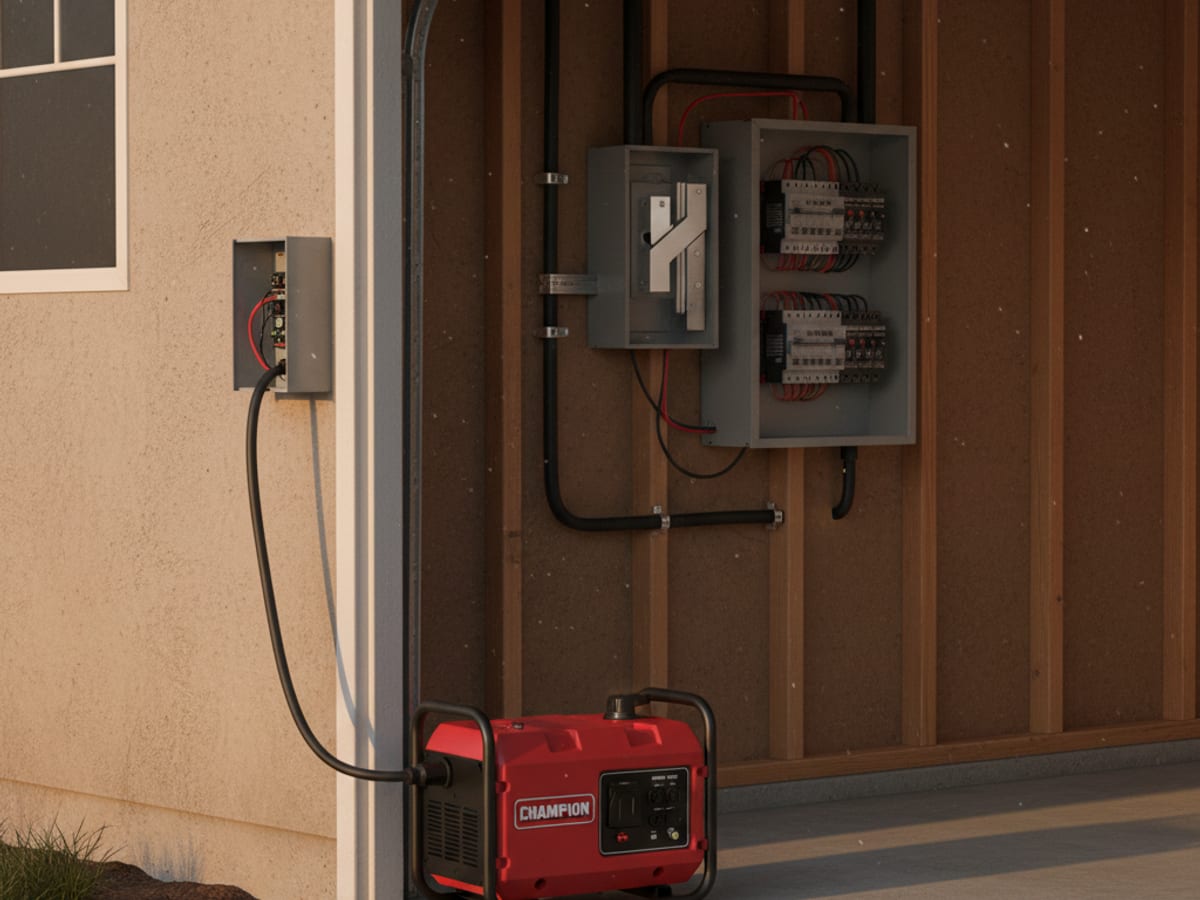
An interlock kit installs on your main panel for $900–$1,500 (labor, permit, and a new 30- or 50-amp inlet box included). It physically prevents the main utility breaker and the generator breaker from being open at the same time, which is what stops dangerous backfeed to the grid.
Once it’s installed, you connect your portable inverter generator to the inlet box on your exterior wall, flip the interlock, and power individual breakers inside the panel. You control which circuits get power based on your generator’s capacity. For PSPS events where you need the fridge running, lights on, and devices charged, it works well.
This is the budget play for PSPS preparedness. Our generator interlock vs. transfer switch guide covers the code requirements, wiring options, and cost breakdown in detail.
When a standby generator is the right answer
For some San Diego households, a portable inverter generator with an interlock isn’t enough. A standby generator is the clear choice when:
You’re in a PSPS zone. Homes in Ramona, Alpine, Julian, Valley Center, and Fallbrook can face multi-day shutoffs during high fire-risk wind events. Duration is event-specific; this page does not assign a day count. A portable generator requires gasoline storage and refueling on that model’s tank interval for the duration. A natural gas standby generator still follows fuel availability. It is not unlimited. Our PSPS shutoffs and generator guide covers how San Diego PSPS events are announced and what to check on the utility map.
You have medical equipment. Confirm the device listing against that generator before treating backup power as medical coverage. An automatic standby removes the need to start a portable unit by hand. It is not a medical-device guarantee.
You have a well pump. Properties in rural East County and North County with private water systems lose water when the power goes out. Central AC, a well pump, and a refrigerator running simultaneously will overload any portable generator. A standby sized at 18 kW+ handles all of it.
You travel or aren’t always home. A standby generator protects your home whether you’re there or not. A portable generator does nothing if no one is around to start it.
For a full breakdown of standby generator costs and Generac model sizing in San Diego, see our Generac generator installation guide.
When a battery beats both
For homes with solar, a battery backup system like a Tesla Powerwall or Enphase IQ Battery offers a different trade-off: silent operation, indoor installation, no fuel to manage, and daily energy cost savings from solar arbitrage. The limitation is runtime: a typical battery system provides 8–24 hours of whole-home backup per charge cycle, which isn’t enough for a multi-day PSPS event unless the solar array can recharge it daily.
Battery backup makes the most sense when outages are short (under 8 hours), you already have solar, and noise is a priority. It’s a parallel category, not a substitute for a generator if you’re in extended-outage PSPS country. Our home battery backup installation guide covers the costs and trade-offs.
California and CARB: what you need to know
California has its own emissions standards for small off-road engines, enforced by the California Air Resources Board (CARB). Every generator sold in California must meet CARB Phase 3 standards. This isn’t optional: a generator that doesn’t carry CARB certification cannot legally be sold or used in the state.
In practice, this affects which models you can buy at Home Depot, Costco, or any California retailer. Honda, Yamaha, Champion, and most major brands sell CARB-compliant versions of their popular inverter generators in California. Some national websites ship non-CARB units to California addresses, which is illegal. Buy from a California dealer or confirm CARB compliance before purchasing online.
Most major brands also offer parallel kits that let you connect two identical inverter generators for doubled output. Running two Honda EU2200i units in parallel gives you 4,400 watts, enough to add a window AC unit or a larger appliance to your load.
Noise ordinances vary by San Diego city and unincorporated county area. Most jurisdictions restrict generator operation during overnight hours (typically 10 p.m. to 7 a.m. or similar). A good inverter generator at 51–58 dB is significantly less likely to draw a noise complaint than a conventional portable running at 80 dB. Standby generators are typically allowed under PSPS hardship provisions but confirm your municipality’s rules if you’re in an HOA.
Safety: the things that can go wrong
Two risks come up repeatedly in generator-related electrical work in San Diego.
Carbon monoxide. Portable generators produce carbon monoxide and must never run inside a garage, enclosed patio, or structure. Minimum clearance is typically 20 feet from any door, window, or vent. CO deaths from portable generators happen every year, almost always from units running too close to occupied space. Buy a generator with CARB-compliant CO shutoff if one is available, and install a CO detector near your sleeping areas.
Backfeed. Never connect a portable generator directly to your home’s circuits through a dryer outlet, a “suicide cord,” or any DIY hookup. Backfeed sends power back through the utility transformer onto distribution lines, potentially killing utility workers who think the lines are de-energized. This is illegal, and it can fry your generator when utility power returns. The only code-compliant way to connect a portable generator to your panel is through a permitted interlock kit or transfer switch, both installed by a licensed electrician. See the generator interlock vs. transfer switch guide for the code details.
An installed standby generator is wired through an automatic transfer switch that physically isolates your home from the grid before energizing, so backfeed is not possible.
Frequently asked questions
What is an inverter generator?
An inverter generator converts engine output to DC power, then inverts it back to clean AC at a stable 60 Hz with very low harmonic distortion (under 3 percent THD). The result is power that’s safe for sensitive electronics, runs at lower decibel levels than conventional portables, and throttles the engine based on actual load demand rather than running at full speed continuously.
Can an inverter generator power a whole house?
Not a typical San Diego home, no. Most portable inverter generators produce 2–7 kW. Whole-home power for a 2,000–3,500 sq ft home with central AC requires 14–22 kW. An inverter generator can power a meaningful subset of your home’s circuits (refrigerator, lights, medical equipment, devices, and sometimes a window AC unit) when connected through an interlock kit. For true whole-home coverage including central AC, a standby generator is the correct tool.
How much does an inverter generator cost vs. a standby generator?
A portable inverter generator runs $500–$2,500 for the unit depending on output and brand. Adding a permitted interlock kit in San Diego brings the total to roughly $1,400–$4,000. An installed standby generator (unit, automatic transfer switch, concrete pad, gas line work, electrical and gas permits, and labor) runs $9,000–$22,000 in San Diego County depending on size and site conditions.
Do I need a permit for an inverter generator in San Diego?
The generator unit itself doesn’t require a permit to purchase or operate as a standalone device. However, connecting it to your home’s electrical panel through an interlock kit or transfer switch does require an electrical permit in San Diego County. No exceptions, and the work must be done by a licensed electrician. Running extension cords directly from the generator to appliances requires no permit but also offers no panel-level protection.
Are inverter generators legal in California?
Only CARB-compliant inverter generators are legal to sell or use in California. Every major brand’s California-sold units meet CARB Phase 3 standards. Verify CARB compliance before purchasing online, especially from out-of-state retailers. Non-CARB units cannot be legally registered or used in California.
What can I run on a 3,500-watt inverter generator during a San Diego outage?
At 3,500 watts (3.5 kW), you can typically run a full-size refrigerator (150–200W running, 600W startup), a chest freezer (100–150W), several LED lights (10–15W each), phone and laptop chargers (100–300W combined), a CPAP with humidifier (30–60W), and a modem/router (10–20W) simultaneously. That’s about 1,200–1,500 watts of continuous draw, well within the generator’s capacity. Adding a window AC unit (500–1,200W) is feasible if you’re not running everything else at the same time.
When to call us
Whether you need a portable inverter hooked through an interlock kit or a standby generator with a listed ATS, the panel work is licensed electrical work and typically needs a permit in San Diego County. Bright Pro Electric matches homeowners with licensed electricians for generator installation. It does not pull permits or install the equipment.
Use the contact page. Hours are Monday through Saturday, 7am to 7pm. After hours, leave a message. There is no staffed 24-hour desk.