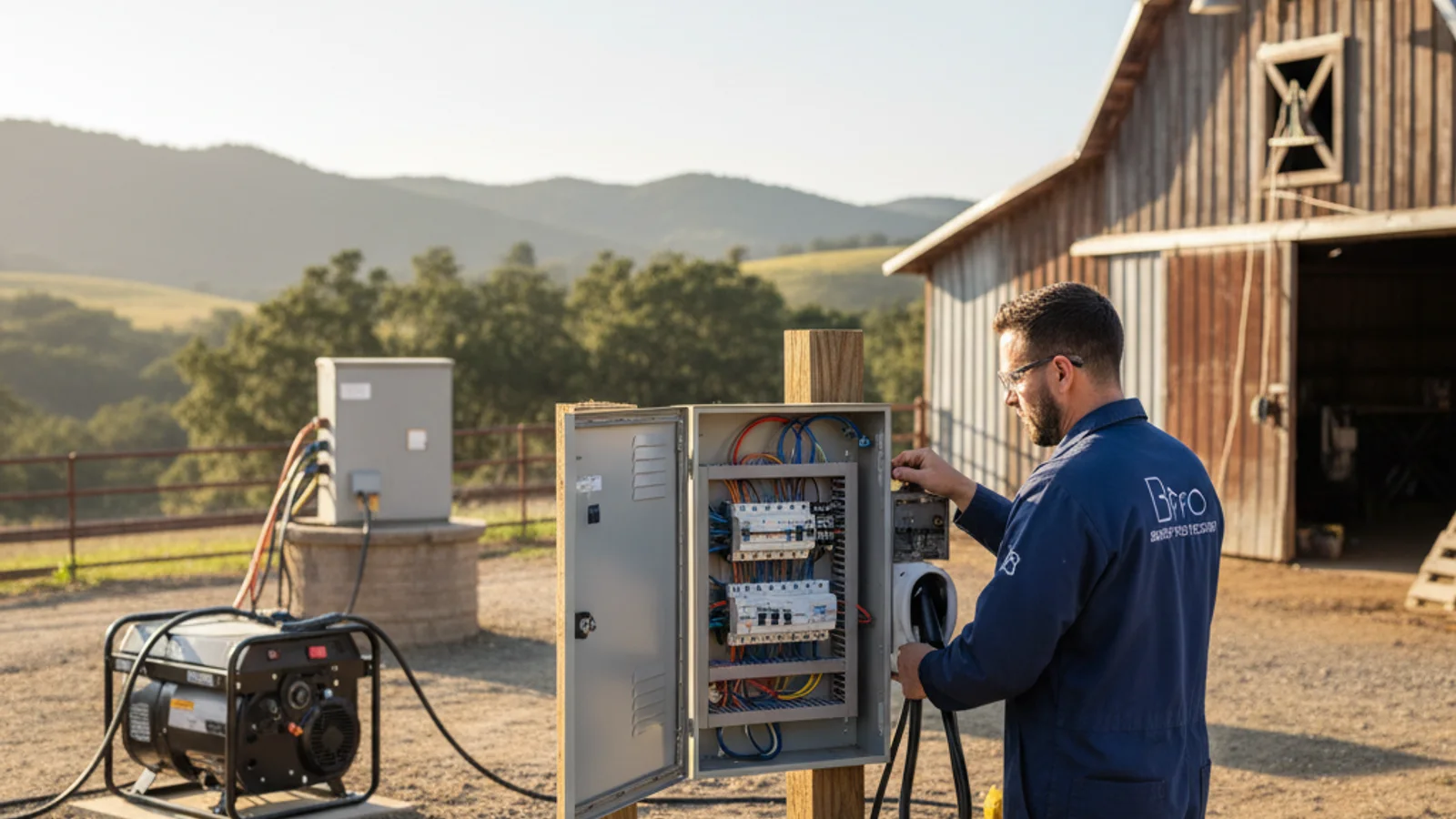
Electrical work in Valley Center is a different category from anything you’ll find in a suburban San Diego neighborhood. Most parcels run several acres. The main house shares the property with a barn, a stable, equipment buildings, and a well-pump that everything depends on. When the power goes out during a PSPS fire-weather event, that well-pump stops working, and a working ranch becomes very difficult very fast. If you’re searching for an electrician in Valley Center, this guide covers what the real scope looks like here, what things cost in 2026, and how permits work under County of San Diego jurisdiction.
Rural full-property scope: what a Valley Center project actually involves
In most San Diego communities, an electrical project means one building. In Valley Center, a thorough project almost always involves multiple structures on the same parcel. A typical scope looks like this:
- Main residence service, often a 200-amp upgrade if the original panel is reaching capacity under today’s combined load
- Secondary structure sub-panels, barns, stables, equipment buildings, and workshops need their own sub-panels fed from the main service with proper wire sizing and breakers
- Well-pump dedicated circuit, 240V circuit with a correctly sized breaker matched to the pump’s horsepower, run in conduit with weather-tight fittings at the wellhead
- Standby generator with automatic transfer switch, sized to keep critical loads running through extended PSPS events
- Grounding and bonding throughout, NEC 250 requires proper grounding at each structure and equipotential bonding where applicable
Independent licensed electricians do the NEC 220.87 load calculation on every Valley Center quote. It gives a documented snapshot of current demand across all structures so the upgrade is sized for real load, not guesswork. Because Valley Center sits well out from the I-15 corridor, larger projects are scoped as a single coordinated mobilization where possible to avoid multiple trips out the Cole Grade Road and Lilac Road corridors.
Standby generators and PSPS: why Valley Center runs differently than the coast
Valley Center sees PSPS shutoffs. During fire-weather conditions, SDG&E can shut off distribution circuits that cross high-risk terrain, and those shutoffs can last days rather than hours. For a ranch on city water, that’s an inconvenience. For a ranch on well water, it’s a functional crisis. The well-pump stops, livestock water stops, irrigation stops, and anything refrigerated starts a clock.
A standby generator with automatic transfer switch solves this completely. The transfer switch monitors grid power, senses the outage, and starts the generator and reconnects the selected circuits automatically, typically within 10-20 seconds, without anyone touching anything.
Sizing for Valley Center rural properties:
Most Valley Center properties land in the 14-22kW range for generator sizing. A licensed electrician does a critical-load analysis to identify which circuits must stay live: well-pump (often the highest single draw), refrigeration, HVAC for at least one zone, critical lighting, and medical equipment if applicable. A 14kW unit handles most single-family residences with a well-pump. Properties with a larger pump, HVAC, and multiple outbuildings often need 20-22kW. Equestrian properties with water heaters for animal washdown or arena lighting requirements can push 22-30kW.
Typical install cost ranges for Valley Center in 2026:
Typical published range on this page for a complete standby generator install (Generac, Kohler, or Briggs & Stratton) including propane, automatic transfer switch, pad, permits, and inspection is $10,500-$19,500 for a 14-22kW unit on a standard residential property. Larger units and equestrian-scope properties with more critical-load circuits run $15,000-$26,000 on this page. Those are not Bright Pro quotes. Propane is the usual fuel here because natural gas does not extend to most of Valley Center’s rural parcels.
For more on how standby generators work and what the installation involves, see our whole-house generator installation guide. For background on how PSPS events affect San Diego and what backup power options look like, the PSPS shutoffs and generator guide covers the landscape well.
Well-pump electrical: sizing, circuit requirements, and common failures
The well-pump circuit is often the single most important circuit on a Valley Center property, and it’s frequently one of the least well-maintained. Common issues independent licensed electricians find on older installs:
Undersized breaker. Pump motor HP ratings convert to amperage at roughly 1 HP = 6-8 amps at 240V. A 2 HP submersible pump needs a 20-25 amp dedicated circuit. Many older installs ran 15-amp circuits that cause nuisance trips under start-up surge, which is hard on both the breaker and the pump motor.
Deteriorated wiring at the wellhead. Conduit transitions from underground to above-ground at the wellhead take weather exposure. UV breakdown on conduit fittings and water intrusion at poorly sealed connections are common on installs more than 15-20 years old.
No GFCI protection. Current NEC requires GFCI protection on pump circuits. Older installs don’t have it. During a panel upgrade or service assessment, independent licensed electricians bring the pump circuit to current standard as part of the work.
No surge protection. Lightning-driven transient surges from proximity to open terrain can blow pump motor windings. A whole-home surge protector at the main panel adds significant protection for a relatively small cost.
Typical published range on this page for a dedicated well-pump circuit replacement, with weather-tight conduit, GFCI, and surge protection at the panel, is $650-$1,100 depending on distance from the panel to the wellhead and the condition of existing conduit. That is not a Bright Pro quote.
Barn, stable, and equestrian electrical
Valley Center’s equestrian properties have their own electrical requirements that go well beyond what a house needs. Standard equestrian scope includes:
Stable lighting. Stall lighting on a dedicated circuit with a proper sub-panel feed. Fixture selection matters here: damp-rated or wet-rated fixtures appropriate for the environment, placed to minimize shadow for nighttime animal assessment without causing eye strain.
GFCI-protected exterior receptacles. Any receptacle in or around a stable or barn requires GFCI protection per NEC 210.8. Older installs often skip it. Code compliance matters for a later insurance file. Ask your carrier.
Water heater circuits for animal washdown. A 240V dedicated circuit sized to the water heater’s wattage. On equestrian properties with multiple washdown stations, this can mean multiple circuits or a single larger-capacity heater on a properly sized circuit.
Equipotential bonding in stall areas. NEC 547 covers agricultural buildings and includes specific bonding requirements for structures where animals are present. This is often skipped on older installs and it matters for animal safety.
Arena lighting. Where outdoor arena lighting is part of the scope, the electrician lays out even coverage, sizes the load for the fixture count, and runs underground conduit to pole bases with weatherproof fittings. Bright Pro does not design that layout.
Licensed electricians often bid barn and house as one project so sub-panel sizing accounts for stall lighting, water heaters, arena lighting, GFCI receptacles, and other outbuilding loads on the same feed. Piecemeal visits over years usually cost more. Bright Pro does not run that coordinated crew.
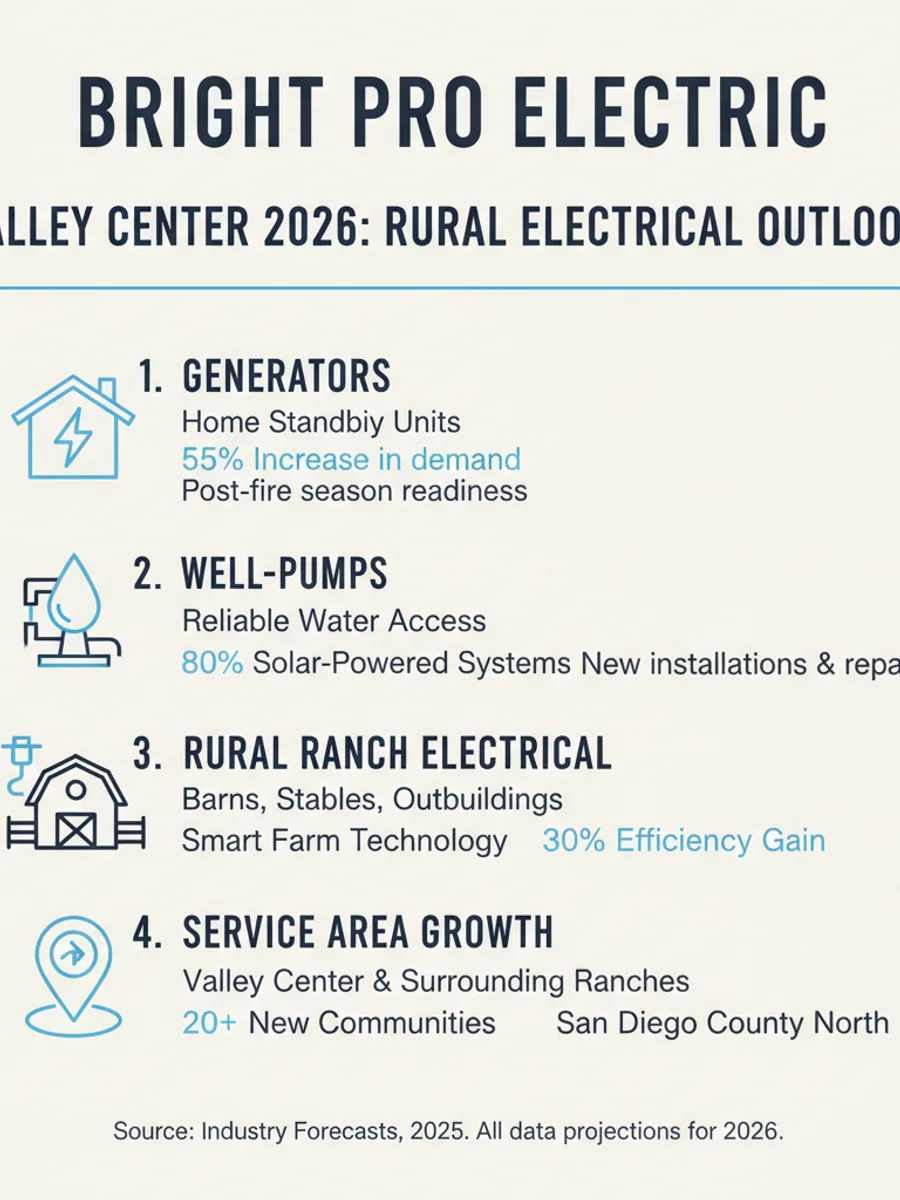
Panel upgrades on aging Valley Center stock
Valley Center’s housing inventory runs mostly 1970s through early 2000s construction. That stock carries a predictable set of electrical issues.
Maxed 200-amp service. A 200-amp panel that was adequate for a single-family home in 1985 often isn’t adequate today when the same service feeds the house, two or three outbuildings via sub-panels, a well-pump, HVAC, and a charging station. The panel isn’t the wrong size in terms of physical breaker slots, it’s the wrong size in terms of available capacity once you add up the connected load.
Federal Pacific and Zinsco panels. These two brands show up in Valley Center’s older stock. Both have documented failure modes where the breaker doesn’t trip under overload. This page does not diagnose a panel from the brand name. A licensed electrician inspects and may quote replacement. See the Federal Pacific and Zinsco panel replacement guide.
Outdoor service equipment degradation. Valley Center’s high UV exposure, dust accumulation from the rural environment, and temperature swings accelerate wear on outdoor meter sockets, weatherheads, and main disconnect enclosures. An aging main panel is often accompanied by a meter socket that needs replacement at the same time.
Typical published range on this page for a panel upgrade to 200-amp service with a new main panel, AFCI and GFCI coverage, and SDG&E meter reconnect is $4,500-$7,500 for a standard Valley Center single-family residence. Properties where the service equipment has deteriorated more, or where the upgrade is coordinated with generator and sub-panel work, run $7,000-$14,000 on this page. Those are not Bright Pro quotes.
For broader context on what drives panel upgrade costs, the electrical panel upgrade cost guide covers the main variables.
Permits in unincorporated San Diego County
Valley Center is unincorporated San Diego County, which means permits go through the County of San Diego Planning and Development Services, not a city building department. The permit process is similar in structure but different in jurisdiction from what applies to Escondido, Vista, or other incorporated cities nearby.
What requires a permit in unincorporated San Diego County:
- Panel upgrades and service changes
- New circuits and dedicated circuit additions
- Standby generator installation with transfer switch
- Sub-panel installation in outbuildings
- New wiring runs of any significant scope
- Well-pump circuit replacement or upgrade
Minor repairs, like replacing a breaker, outlet, or switch in kind, generally don’t require a permit. But anything that changes the service configuration or adds new circuits does.
Independent licensed electricians handle permit applications and inspection scheduling as part of every permitted project. County Planning and Development Services timing is the county’s. Bright Pro does not factor a Bright Pro schedule into it.
Response and dispatch times from Valley Center
Most Valley Center properties are accessed via Cole Grade Road, Lilac Road, or Old Castle Road from the I-15 corridor. Drive time out to most Valley Center addresses is longer than the coastal cities, and the electrician who takes the job gives you an honest arrival window rather than overpromising.
For flame, heavy smoke, or sparks, leave and call 911 first. Then use contact. Bright Pro does not flag jobs urgent and does not give an arrival window. For larger quotes, the electrician sets the date.
Ask whether a trip charge applies beyond the diagnostic fee and whether it credits toward any repair work on the same visit.
The Bright Pro Electric service area hub for Valley Center has more detail on what’s available in the community.
Frequently asked questions
What standby generator size do I need at my Valley Center ranch?
Most Valley Center rural properties (residence plus well-pump plus secondary structures) land at 14-22kW. A licensed electrician does a critical-load analysis to identify which circuits need to stay live during a PSPS event, including the well-pump, refrigeration, HVAC, lighting, and any medical equipment. Properties with larger pumps, multiple outbuildings, or equestrian infrastructure with water heaters and arena lighting often need 22-30kW. Typical published range on this page for a 14-22kW install with propane, automatic transfer switch, and pad is $10,500-$19,500. That is not a Bright Pro quote.
Can licensed electricians wire the barn and stable in the same project as the main house?
Doing the main residence service upgrade, secondary structure sub-panels, well-pump circuit, and barn electrical as one coordinated project is usually cheaper than piecemeal visits over years. It also lets sub-panel sizing account for all connected loads from the start. Bright Pro does not run that crew.
Do licensed electricians replace Federal Pacific or Zinsco panels in Valley Center?
FPE and Zinsco labels show up in Valley Center given the age of the housing stock. This page does not diagnose a panel from the brand name. A licensed electrician inspects and may quote a swap, SDG&E meter reconnect, and a County Planning and Development Services permit. Bright Pro does not.
How does a PSPS outage affect my well-pump, and what’s the fix?
During a PSPS shutoff, grid power stops and the well-pump goes offline immediately. A standby generator with automatic transfer switch reconnects the well-pump circuit (and other critical loads you choose) within seconds of grid failure, automatically, without any action on your part. It’s the most complete solution for Valley Center properties where well water is the only water source.
What’s the difference between a manual transfer switch and an automatic one?
A manual interlock or manual transfer switch requires you to physically switch over to generator power after starting the generator by hand. An automatic transfer switch monitors grid voltage constantly, starts the generator automatically when power drops, transfers the selected circuits, and returns to grid power automatically when utility power restores. For PSPS events that happen overnight or when you’re away from the property, automatic is the right choice. For more on the comparison, see generator interlock vs. transfer switch.
Valley Center electrical work is often full-property scope. If you are dealing with an aging panel, a well-pump circuit that needs sizing and GFCI, or a standby generator for the next PSPS event, the electrician can bid it as one project. Use contact. Bright Pro does not run that coordinated crew.