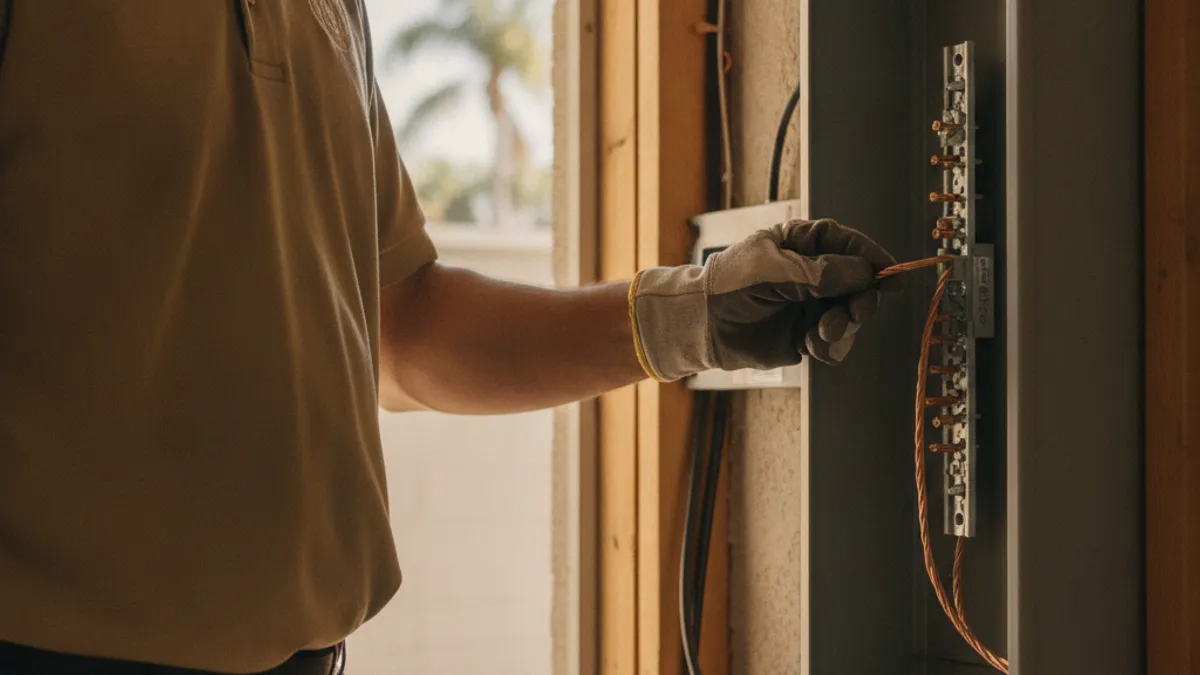
A grounded electrical system gives stray current somewhere safe to go. Without it, a short or a fault can travel through whatever happens to be nearby, including a person. Grounding is one of those things that sits quietly behind the walls of every home, doing nothing at all until the one moment it matters.
What grounding actually does
Every circuit in your home has a hot wire carrying power and a neutral wire carrying it back. The ground wire is the third piece: a dedicated path that connects your panel, your outlets, and your metal fixtures to the earth itself, usually by way of a ground rod or the metal water line entering the house.
Under normal operation, the ground wire carries nothing. It only activates when something goes wrong, a hot wire touching a metal appliance case, a nicked cord inside a wall, a failed component in an outlet. When that happens, the ground wire gives that stray current a low-resistance path back to the panel instead of through the metal frame of your dishwasher, your washing machine, or you. That surge of current is also what trips the breaker fast enough to cut power before things get worse.
Take the ground away and that same fault has nowhere obvious to go. It can sit live in a metal appliance case until someone touches it and completes the circuit themselves. That’s the entire reason grounding exists: it turns an invisible hazard into a breaker trip.
How to tell if your home is grounded
The three-prong outlet is the visual shorthand most people use, but it isn’t proof by itself. Some older San Diego homes were retrofitted with three-prong outlets wired to a two-wire circuit that was never actually grounded, sometimes called a bootleg ground. The outlet looks modern. The wiring behind it isn’t.
A simple outlet tester from a hardware store can flag an open ground in seconds, and it’s worth doing on a few outlets in any home you didn’t wire yourself. If the tester shows an open ground, that doesn’t necessarily mean anything is actively dangerous right now, but it does mean that specific circuit doesn’t have the safety path it’s supposed to have. An electrician can trace the circuit back and confirm what’s actually happening behind the wall, rather than guessing from the outlet cover alone.
Why older San Diego neighborhoods run into this more often
Grounding requirements have been part of residential wiring standards for decades, but plenty of San Diego housing predates that. Craftsman bungalows in North Park and South Park, older Point Loma cottages, and the original tract homes scattered through Kensington and City Heights were often built with two-wire, ungrounded circuits that have never been fully updated, even after a kitchen or bathroom remodel touched part of the house.
Partial updates are common and they create a patchwork: a remodeled kitchen with grounded outlets feeding into a living room that’s still running the original 1940s wiring. Salt air along the coastal neighborhoods adds another wrinkle, since it accelerates corrosion on ground rods and clamps that were installed decades ago, which can quietly degrade a ground path that used to work fine. None of this is unusual for a house this age. It’s just worth knowing, especially before you plug in anything with a metal case.
Grounding vs. bonding, and why the difference matters
Grounding and bonding get used interchangeably in casual conversation, but they solve different problems. Grounding connects your system to the earth. Bonding connects all the metal parts of your electrical system, panel enclosures, conduit, metal boxes, together so they’re all at the same electrical potential. A house can have a functioning ground and still have a bonding gap somewhere, which is one of the things an electrician checks during a full panel or rewiring inspection rather than something you can verify with a plug-in tester.
GFCI protection when a circuit has no ground
A ground-fault circuit interrupter outlet works differently from a ground wire. It monitors the current going out on the hot wire against the current coming back on the neutral, and it trips fast if the two don’t match, which usually means current is leaking somewhere it shouldn’t. That’s useful protection even on a circuit with no ground path, which is why GFCI outlets are common on ungrounded circuits in older homes as an added layer of protection.
A GFCI outlet doesn’t replace a true ground, though. It protects a person from shock on that specific outlet, but it doesn’t give sensitive electronics, surge protectors, or grounded appliances the reference path they’re designed to use. For a full remodel or an electrical panel upgrade, most homeowners end up asking an electrician to extend real grounding rather than relying on GFCI outlets as a permanent stand-in.
What to do if you’re not sure
Requirements around grounding, bonding, and where GFCI protection has to go depend on the age of the circuit, the scope of any work being done, and how your city’s building department applies the current code cycle to your specific project. That’s not a question a blog post can answer for your house. A licensed electrician can test your panel and circuits directly, and your city’s permit office can confirm what applies if you’re planning work that goes beyond a simple repair.
If you’re dealing with aluminum wiring on top of a grounding question, or you’re not sure what your panel is actually connected to, that’s worth a professional look before you assume either way.
Frequently asked questions
What does grounded mean in electricity?
Grounded means a metal path connects your electrical system to the earth, so fault current has somewhere safe to go instead of through a person. In practical terms, grounding in electricity means every metal part that could accidentally become energized is tied back to the panel and then to a ground rod or water pipe. When something fails, the current races down that path, the breaker sees the surge, and it trips.
Can I add grounding to an outlet myself?
Running a new ground wire back to the panel usually means opening up a wall or accessing the circuit from an attic or crawl space, which is a job for someone who can trace the existing wiring safely. Swapping a two-prong outlet for a three-prong one without an actual ground behind it doesn’t add protection, it just hides the problem.
Does homeowners insurance care about ungrounded wiring?
Some insurers ask about the age and condition of a home’s electrical system, and older ungrounded wiring can come up during an inspection or a claim. Ask your carrier directly what they require, since policies vary.
Is a bootleg ground dangerous?
It can create a false sense of safety, since the outlet reads as grounded on a simple tester in some configurations but doesn’t actually carry fault current anywhere useful. It’s worth having checked rather than assumed.
Will a home inspector catch ungrounded circuits when I sell?
Most general home inspectors will flag two-prong outlets and obvious bootleg grounds, but a full circuit-by-circuit trace usually isn’t part of a standard inspection. If grounding comes up as a concern, an electrician can give you a clearer picture before you list.
Grounding work is licensed electrical work. Hire a licensed electrician. Bright Pro Electric matches San Diego County homeowners and property managers with independent licensed electricians. It does not hold a C-10, pull permits, or guarantee dispatch. Hours are Monday through Saturday, 7am to 7pm. After hours, leave a message. Use the contact form.