A standard circuit breaker replacement costs $150 to $350 in San Diego, most of that labor for a diagnostic visit and a same-day swap. The part itself is cheap, usually $5 to $20 for a standard breaker. What pushes the price up is the breaker type: AFCI and GFCI breakers cost more, and breakers for an obsolete panel brand can cost the most of all, if you can find one that fits.
TL;DR
- Standard breaker replacement: $150-$350, mostly labor.
- AFCI or GFCI breaker replacement: $250-$450, because the breaker itself runs $40-$90.
- Obsolete-panel breaker (Federal Pacific, Zinsco, older Bulldog): $300-$600, or a sign you need to talk about the whole panel.
- A single like-kind breaker swap doesn’t need a permit in California. A panel or service change does.
- If breakers keep tripping or won’t reset at all, that’s a different problem than a normal repair, and it’s worth ruling out first.
When you actually need a breaker replaced
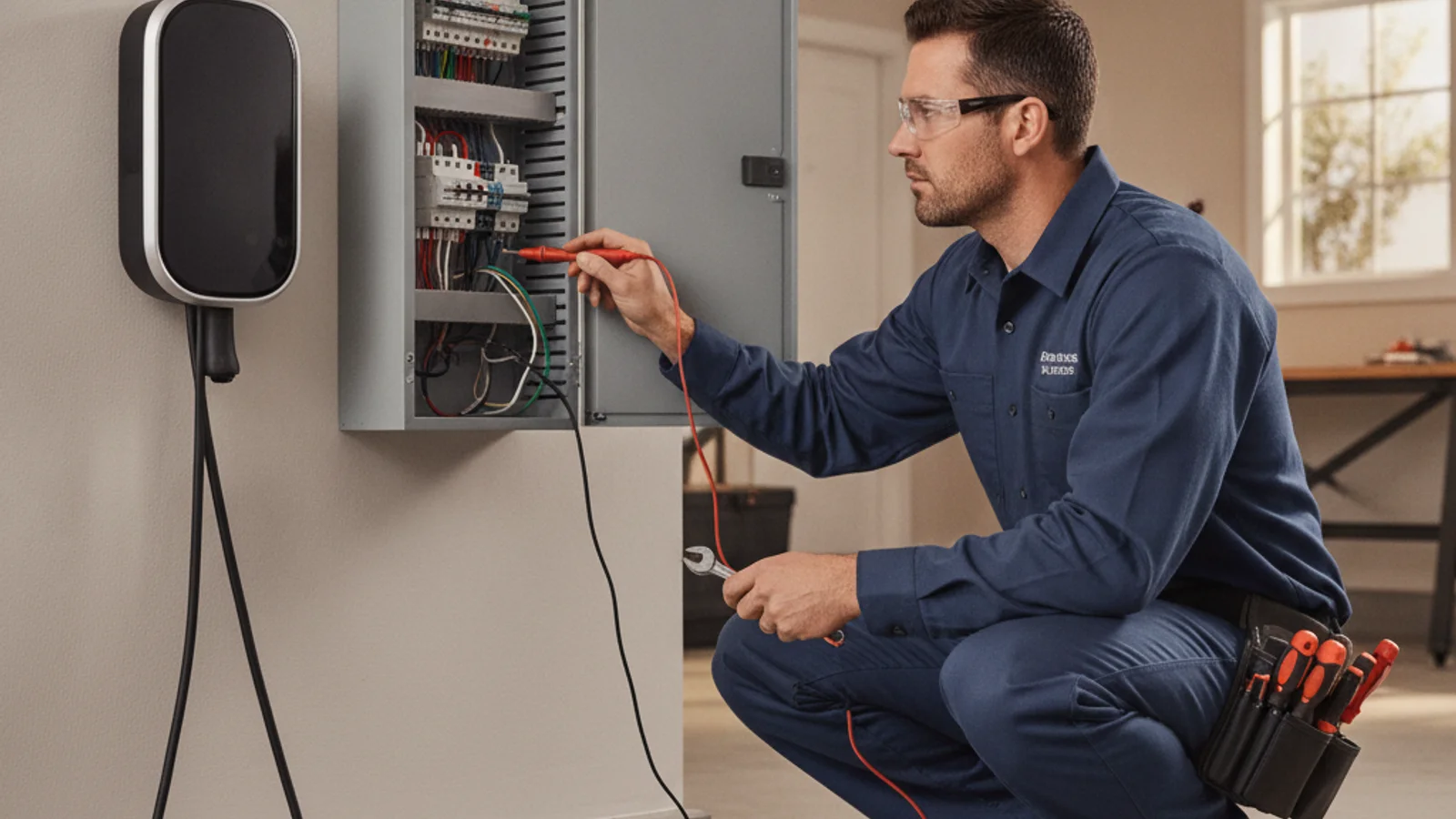
Most breaker calls fall into one of three categories. The breaker won’t reset at all, it stays in the middle position or snaps back to OFF the instant you flip it. The breaker feels warm or the panel smells faintly like burning plastic when it’s under load. Or the breaker is old enough that the mechanism inside has worn out, so it trips at loads it used to handle fine.
A breaker that trips occasionally under a real overload is usually doing its job correctly. That’s a wiring or load problem, not a bad breaker, and our breaker-tripping diagnostic guide walks through how to tell the difference in about 15 minutes. A breaker replacement makes sense once you’ve ruled that out and the breaker itself is the failure point.
What breaker replacement costs in San Diego
The type of breaker moves the price more than anything else. Here’s how the common jobs break down.
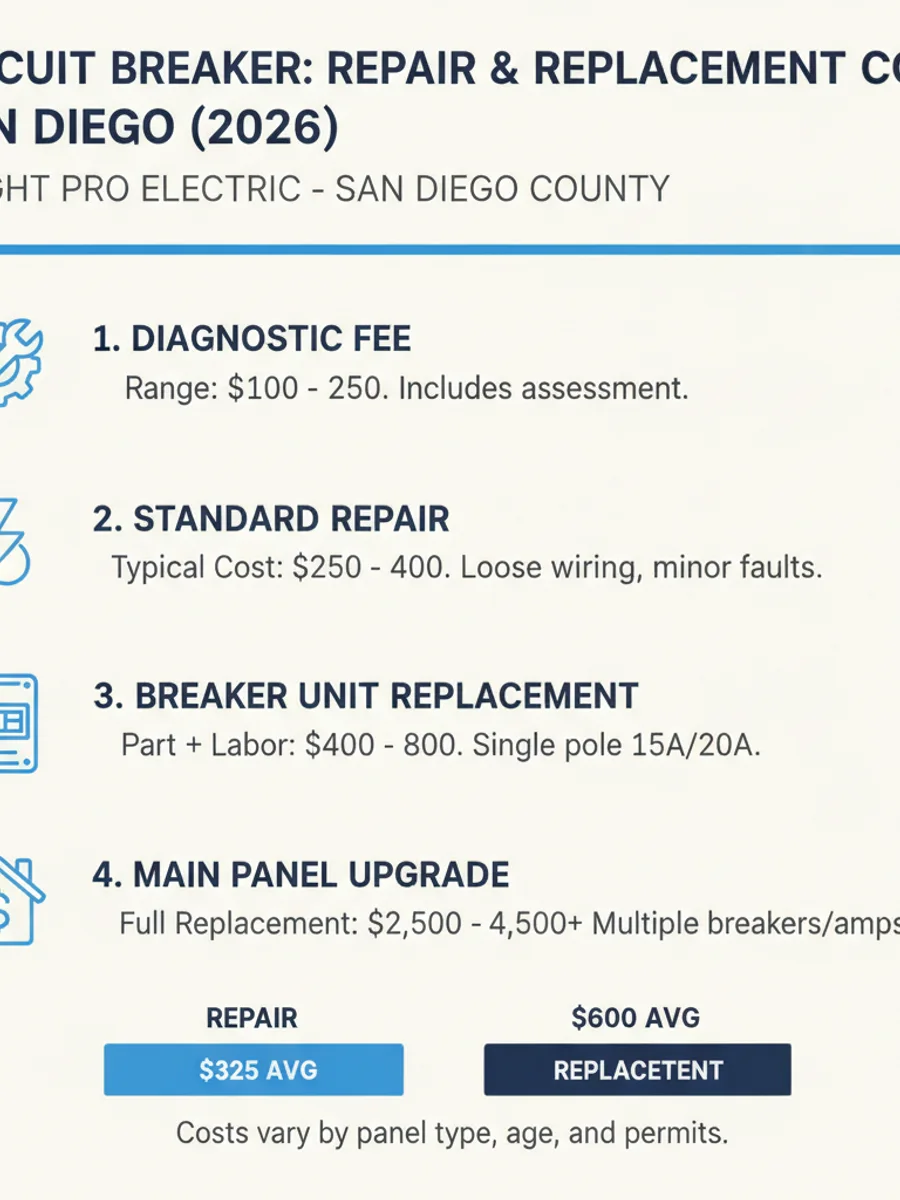
| Breaker type | Typical cost | Why |
|---|---|---|
| Standard single-pole breaker (15A/20A) | $150-$250 | Part costs $5-$15; mostly a labor and diagnostic charge |
| Standard double-pole breaker (30A-50A) | $200-$300 | Larger part, slightly more labor to land two hots |
| AFCI breaker | $250-$400 | Part alone runs $40-$70 |
| GFCI breaker | $250-$450 | Part alone runs $50-$90 |
| Obsolete-panel breaker (FPE, Zinsco, older Bulldog) | $300-$600 | Breakers are discontinued; sourcing costs more, if they can be found at all |
A diagnostic or service-call fee is usually built into that range, so you’re not paying a separate visit charge on top. Our broader electrical repair cost guide covers how that diagnostic fee works across other types of repairs, from outlets to full circuits.
Why some breakers cost so much more than others
A standard thermal-magnetic breaker is a simple, mass-produced part. AFCI and GFCI breakers cost more because they carry electronics inside, a circuit board that monitors for arc faults or ground faults on top of the normal overload protection. That’s real safety technology, and the part price reflects it.
Obsolete-panel breakers are the expensive outlier, and not because the part is more advanced. Federal Pacific, Zinsco, and some older Bulldog Pushmatic panels used proprietary breaker designs that stopped being manufactured decades ago. A licensed electrician has to track down new-old-stock parts or a compatible reproduction, and prices climb because supply is fixed and shrinking. If your panel is one of these brands, a single breaker swap is often the wrong move. Our Federal Pacific and Zinsco panel guide explains why these panels are a known fire risk and when full replacement is the safer call.
When it’s not just the breaker
A breaker replacement solves a bad breaker. It doesn’t solve a full panel that’s failing. Watch for these signs that the problem is bigger than one breaker: multiple breakers in the same panel are tripping or won’t reset, the bus bar looks scorched or discolored when the panel is open, or you’ve already replaced one breaker and a different one starts failing within months. Any of those points to the panel itself, not an isolated part. Our panel replacement cost guide covers forced replacement pricing and how to tell a panel-wide failure from a single bad breaker.
A scorched bus bar or a burning smell from the panel isn’t a schedule-it-for-next-week repair. That’s emergency electrical service territory, and it’s worth getting a licensed electrician out the same day.
Do you need a permit for a breaker replacement?
No, not for a standard like-kind swap. Replacing one breaker with the same type and amperage is routine maintenance in California and doesn’t require a permit. That changes the moment the job grows into something else: adding a new circuit, upgrading a breaker’s amperage, or any panel or service work. Our San Diego electrical permit guide covers exactly where that line sits, so you know before an electrician arrives whether you’re looking at a same-day fix or a permitted job.
Frequently asked questions
How much does it cost to replace a circuit breaker in San Diego?
A standard 15-amp or 20-amp breaker replacement costs $150 to $250, mostly labor. AFCI or GFCI breakers run $250 to $450 because the part itself is more expensive. A breaker for an obsolete panel brand like Federal Pacific or Zinsco can run $300 to $600, when one can be sourced at all.
Why is an AFCI or GFCI breaker so much more expensive than a standard one?
AFCI and GFCI breakers have electronics built in, a circuit board that monitors for arc faults or ground faults, not just overload. That technology adds $40 to $90 to the part cost alone, on top of the labor to install it.
Can I replace a circuit breaker myself?
It’s legal for a homeowner to replace their own like-kind breaker in California, but it’s not something we recommend without experience. The panel stays energized on the main bus even with the breaker off, and a mis-seated breaker or the wrong amperage rating is a fire risk. If your panel is an older or obsolete brand, the wrong replacement can make the fire risk worse, not better.
How do I know if I need a new breaker or a whole new panel?
One breaker failing on its own, especially an old one that’s simply worn out, is usually a straightforward swap. Multiple breakers failing, a scorched or discolored bus bar, or repeated failures right after a replacement all point to the panel itself. At that point a licensed electrician should inspect the panel before you spend money on another single breaker.
Do I need a permit to replace a circuit breaker?
Not for a standard like-kind replacement, the same type and amperage as what’s already there. You need a permit once the work goes beyond that, like adding a circuit or changing the panel’s amperage.
What’s the difference between a breaker that trips a lot and a breaker that’s bad?
A breaker that trips under real overload, too many devices on one circuit, is working correctly and isn’t the problem. A bad breaker won’t reset at all, trips under normal light loads, or feels warm to the touch. Our breaker-tripping diagnostic walks through a 6-step check to tell which one you’re dealing with.
When to call us
A breaker that won’t reset, feels warm, or belongs to an obsolete panel brand isn’t a wait-and-see repair. Bright Pro Electric connects San Diego homeowners, including an electrician in Scripps Ranch and an electrician in Poway, with licensed electricians who diagnose the breaker on-site and tell you honestly whether it’s a same-day swap or a sign of a bigger panel problem. You can verify any contractor’s license at the CSLB license check tool before hiring. Our electrical troubleshooting service covers the diagnostic step, and our panel upgrade service is there if the breaker turns out to be a symptom of the panel itself. Call us at (858) 988-5580 for a same-day estimate.