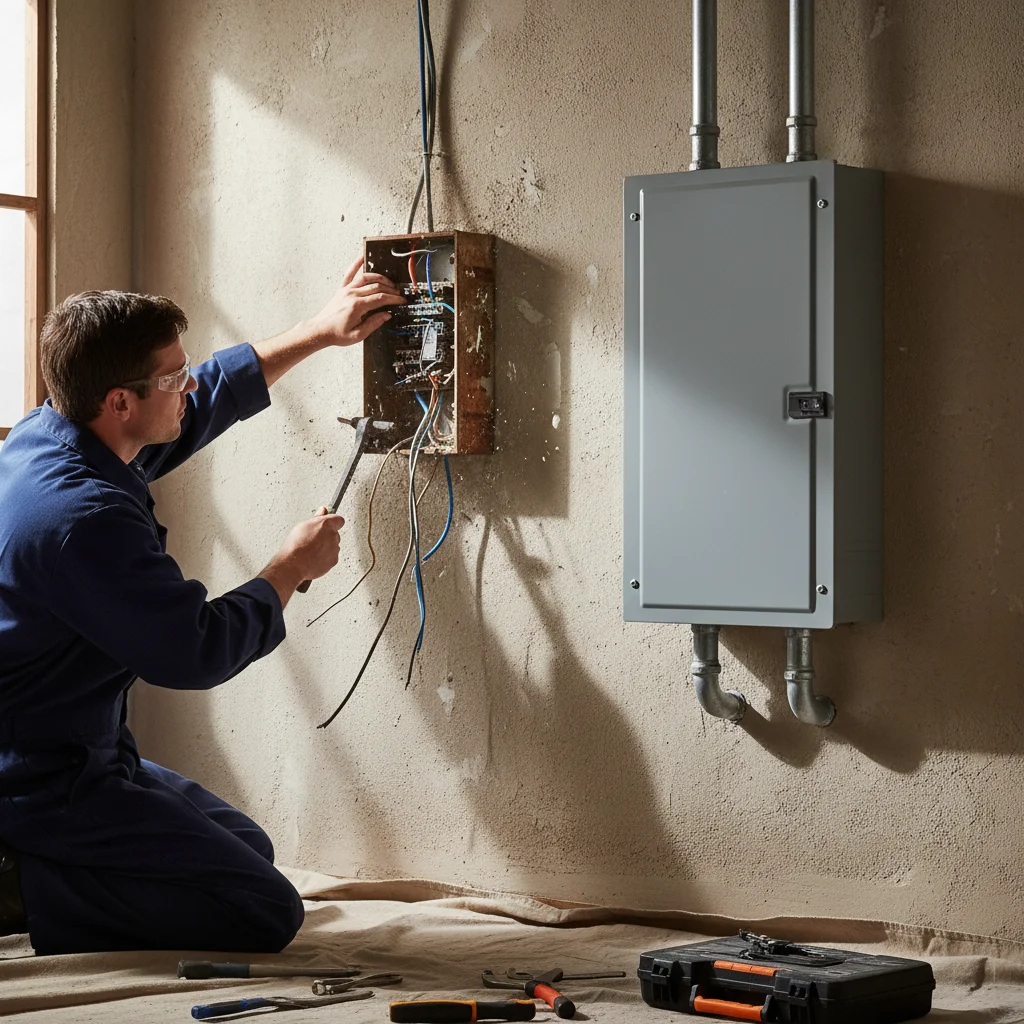
Span replaces the main panel for $6,500-$10,000 on this page. Lumin’s add-on architecture and circuit limits must be read from the current manufacturer sheet; the parked Lumin band is $3,000-$8,000. Compare those listings to the existing panel and the actual load problem (backup circuits vs whole-service replacement). Do not treat “about 12 circuits” as frozen.
TL;DR
- Span is a full panel swap. Lumin is historically an add-on. Confirm both on current manufacturer pages.
- Span costs $6,500-$10,000 installed. Lumin costs $3,000-$8,000 installed. Those are published ranges on this page, not Bright Pro prices.
- Choose from existing-panel condition, circuit limits in the listing, and the load problem you actually have.
- Both typically need a permit. Bright Pro Electric does not install either.
The core difference: replacement vs. add-on
Span and Lumin solve the same problem, circuit-level visibility and control for a home running solar and battery, from opposite directions. Span does it by replacing your main panel entirely. Lumin does it by wiring a controller alongside the panel you already have.
That one architectural choice explains almost every other difference between them: cost, scope of circuits covered, how long the install takes, and whether you need other panel work done at the same time. Neither approach is wrong. They’re built for different starting points.
Side-by-side comparison
| Span | Lumin | |
|---|---|---|
| Install type | Full main panel replacement | Add-on alongside existing panel |
| Installed cost in San Diego | $6,500-$10,000 | $3,000-$8,000 |
| Circuits monitored/controlled | Every circuit in the panel | Subset listed on the current Lumin sheet. Do not freeze a circuit count from this page |
| Best fit | Panel needs replacing anyway, or you want whole-home visibility | Panel is in good shape, want targeted backup control |
| SDG&E meter coordination | Yes, part of the panel swap | Only if other panel work is involved |
| Power-off window | 4-8 hours (full service outage) | Typically shorter, limited to wiring the managed circuits |
| Permit required | Yes | Yes |
Cost breakdown for both
A Span install runs $6,500-$10,000 all-in: roughly $3,500-$4,000 for the hardware, the rest covering labor, the permit, and SDG&E meter coordination. Our full Span Smart Panel cost guide breaks that down line by line, including what pushes a job to the higher end.
A Lumin install runs $3,000-$8,000, with hardware around $1,200-$2,500 and the rest going to labor and the permit. The range depends heavily on how many circuits you’re routing through it and how far they sit from the panel. Our full Lumin Smart Panel cost guide covers the details.
If your existing panel is undersized or on old 60A or 100A service regardless of which smart panel you choose, factor in a standard panel upgrade first. That’s a separate cost neither smart panel price includes unless it’s explicitly part of the scope.
Which one fits a solar-only home
If you have solar but no battery yet, or you’re adding both at once, the decision usually comes down to how much of the house you want visibility into. A whole-home energy picture, tracking exactly what every circuit draws against what your panels produce, points toward Span. A more targeted setup, where you mainly care about a handful of circuits and don’t need full-panel monitoring, points toward Lumin at a lower cost.
Homes doing a first-time solar install often get quoted a panel upgrade anyway, since older San Diego service (60A or 100A) frequently can’t support solar interconnection without it. If a replacement is already on the table, Span is the more efficient path since you’re paying for the swap once, not upgrading the panel now and adding Lumin later.
Which one fits a solar-plus-battery home
This is where the decision gets sharper. A home battery is only as useful during an outage as its ability to prioritize load. Without circuit-level control, the battery backs up the whole panel or nothing, and a whole-panel backup drains fast if the AC or an EV charger keeps pulling from it.
Span gives you that prioritization across every circuit in the house, which matters most for larger battery systems or homes wanting the AC or a well pump included in backup planning. Lumin gives you the same core capability, priority circuits stay powered, the rest waits, but scoped to the circuit count in the current listing. For many households, the fridge, internet, a few lights, and one or two essentials cover what matters during an outage. Confirm that count against Lumin’s current sheet, not a number frozen here.
Which one fits a home that just needs more capacity
If you don’t have solar or a battery and your real problem is an undersized panel, neither smart panel is really the starting point. A standard panel upgrade at $3,500-$6,500 solves the capacity problem for meaningfully less than either smart option. Smart monitoring is a premium feature, not a fix for a panel that’s too small for an EV charger or a hot tub circuit. Our post on when to upgrade an electrical panel covers the signs a standard swap is the right call.
Permits and installation for both
Both Span and Lumin require a city permit and a licensed electrician in San Diego, no exceptions. A Span install goes through the same inspection as any panel replacement: grounding, bonding, SDG&E meter coordination, and a final city sign-off. A Lumin install is inspected for the wiring added to the managed circuits and the controller’s connection to the panel. You can verify any electrician’s license through the CSLB license lookup before signing a contract for either.
Frequently asked questions
Is Span or Lumin cheaper in San Diego?
Lumin is generally cheaper, running $3,000-$8,000 versus Span’s $6,500-$10,000, because it doesn’t require replacing your main panel. The gap comes from scope, not quality. Span monitors and controls every circuit; Lumin manages a chosen subset.
Can I install Lumin now and upgrade to Span later?
Yes, though it means paying for two separate jobs rather than one. If you already know your panel needs replacing within a few years, it’s often more cost-effective to do Span once rather than Lumin now and a full swap later.
Does either option work without solar or a battery?
Both can technically be installed on a home without solar or battery, but the value proposition weakens considerably. Circuit-level monitoring and control matter most when paired with backup power or solar production data to act on.
Which one is better for a whole-house generator setup instead of a battery?
Neither Span nor Lumin is required for a standard whole-house generator with an automatic transfer switch, since the transfer switch already handles whole-panel backup. Smart panels add value mainly when you want selective circuit backup rather than an all-or-nothing switch.
How do I decide between Span and Lumin for my house?
Start with your panel’s condition. If it needs replacing regardless of smart features, Span is the more efficient path. If your panel is fine and you want targeted backup control on your priority circuits, Lumin gets you there for less. A site visit and load calculation settles it in most cases.
When to call us
Both of these are panel-level decisions that touch the home’s entire electrical service, and the right answer depends on the panel’s actual condition, not just what you’d like it to do. A licensed electrician can inspect the panel, talk through solar and battery plans, and give a written recommendation between Span, Lumin, or a standard panel upgrade before you spend a dollar. Bright Pro Electric matches. It does not walk the panel. Get in touch to be matched. There is no same-day estimate and no dispatch guarantee.