A Santa Ana week in Ramona or Escondido is when a solar generator for home backup stops being camping gear and becomes a household plan. Inland heat keeps the fridge working, and a unit that only runs patio lights will not cover a well pump or a medical device. The real choice is not a brand ranking. It is whether the box stays portable, or a licensed electrician feeds selected circuits through approved transfer equipment.
Start with the loads needed during an outage
Write the load list before you shop. Watts printed on a carton do not tell you what has to stay on in El Cajon at 4 p.m. in September.
Start with what cannot fail: the refrigerator, phones, lighting, medical gear, and the garage door if that is how you leave. Inland houses in Poway, Santee, Ramona, and Valley Center often add a well, a booster pump, or an irrigation controller. A coastal condo usually does not. That difference is the whole point of planning here instead of copying a generic packing list.
Keep running watts and starting watts in two columns on your own paper. A fridge motor draws more at start than while it hums. A window air conditioner in an Escondido bedroom is a different problem than a phone charger. The inverter rating on a solar generator is a product spec. Confirm it on the label for the exact model you might buy. This site does not publish a countywide runtime chart, because no verified source gives one that fits every inland house.
When the lights drop, check SDG&E’s outage map from a phone with service. A neighbor with power does not prove your wiring is fine. SDG&E has said different parts of a neighborhood can sit on different circuits, and those circuits do not always restore together. That shows up in canyon pockets around Lakeside and Alpine, where one street can be dark while the next ridge is not. Public Safety Power Shutoff events are an address-level lookup on SDG&E’s side, not proof that every inland parcel sits in a shutoff zone.
If you see smoke, sparks, or a downed line, leave and call 911. From a safe place, report downed lines to SDG&E at 800-411-7343. Use a flashlight, not candles. Do not treat the outage as a time to open a panel, reset breakers as a test, or try a homemade hookup.
How portable use differs from a panel connection
Most products sold as a solar generator for home use are a battery, an inverter, and optional folding panels. You roll the unit to the appliance and plug into the outlets on the box. Nothing in the house wiring has to change. That is the portable path: fridge on an extension cord that is in good shape, CPAP on the nightstand, lamps in one room. It is quiet, it makes no exhaust, and it stays a tool you can move.
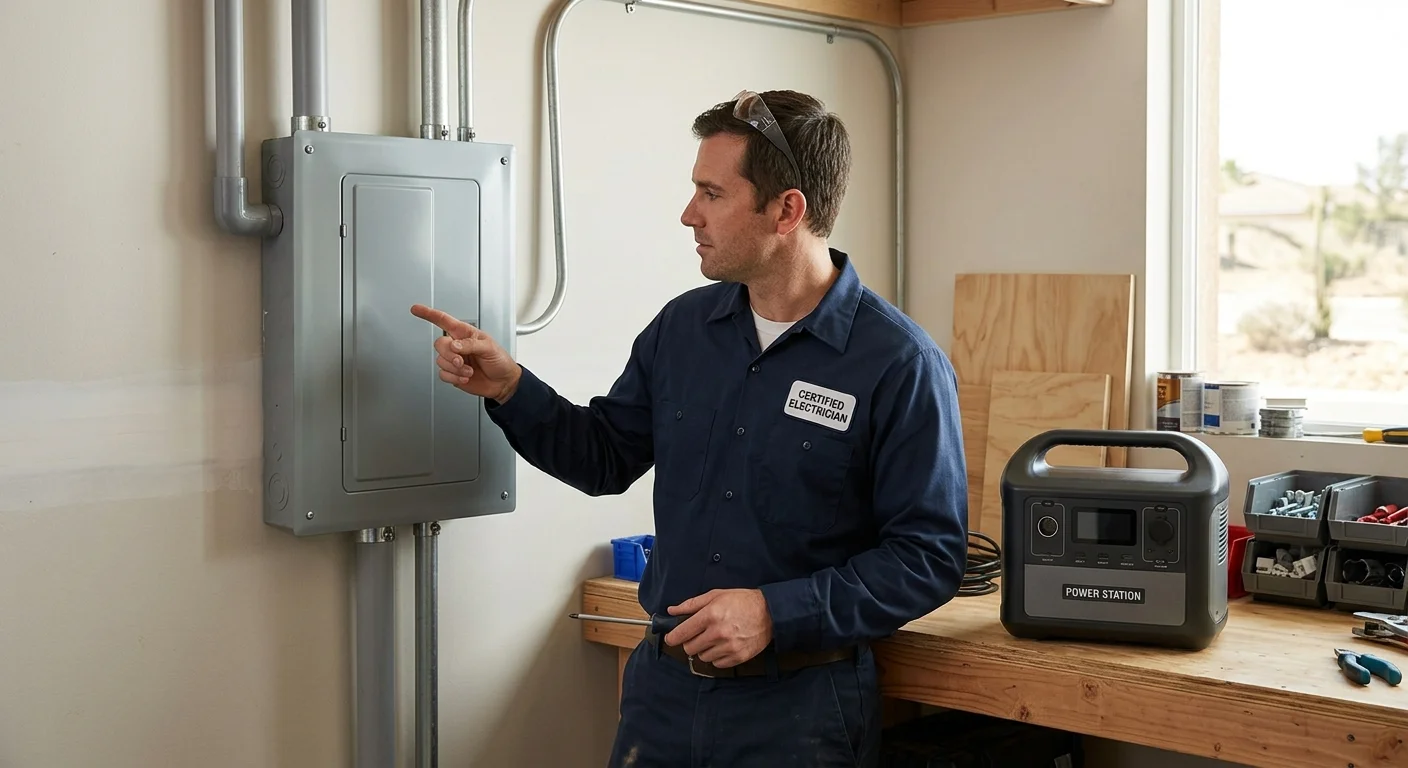
A panel connection is a different job. Selected circuits can be fed through listed transfer equipment so the house cannot send power back onto the street. That work belongs with a licensed electrician. It is not a cord in a dryer outlet, not a suicide cord, and not a YouTube workaround. This page will not give connection steps. If the plan leaves the living-room outlet and touches the panel, stop shopping and start a licensed review.
Can a solar generator power an entire house? A portable station feeding a few cords usually cannot run central air, a well, the range, and the rest of an inland house at the same time. Whole-home coverage is a different project. That often means a permitted home battery or a standby generator, with transfer equipment sized to the loads you actually need. Keep this decision next to that comparison, not mixed into it. Portable solar generators and automatic standby systems solve different nights.
If you want circuits covered without dragging cords through the hall, ask the electrician we connect you with about generator installation and whether your unit is even listed for that kind of use. Many camping-class stations are not. The manual, not the marketing headline, is the document that matters.
What transfer equipment and panel capacity can change
Transfer equipment is what keeps utility power and backup power from meeting in the same wires. An interlock and a transfer switch are not the same hardware. Both exist so a portable or standby source cannot backfeed the grid. Read the difference in our interlock versus transfer switch guide, then have a licensed electrician say which listed option fits the product you own and the panel you have.
Panel capacity is the other gate. Census figures for year built are a proxy for panel age, not a diagnosis of your breaker labels. About 63% of El Cajon housing units predate 1978. Escondido is about 43%, Poway about 49%, Santee about 48%, and Ramona about 42%. Older inland stock is where 100-amp services, crowded breaker spaces, and Federal Pacific or Zinsco equipment still show up. A portable solar generator that only feeds extension cords does not care about that. A transfer setup does. If the panel is already full, the electrician may talk through a subpanel, a service change, or a smaller set of backed-up circuits. None of those costs is a published market statistic on this page. Ask for a written scope on your house.
Do not assume every inland city uses the same permit counter. The City of San Diego’s Development Services Department issues electrical permits inside city limits. Unincorporated places such as Ramona, Lakeside, Alpine, Fallbrook, and Bonsall go through San Diego County Planning and Development Services. Poway runs its own Building Services division and its own fee schedule. Escondido, El Cajon, Santee, and the rest of the inland incorporated cities run their own building departments. Name the agency on the permit, not the city printed on your mail.
A C-10 electrical contractor’s classification covers installing and connecting electrical equipment, including solar photovoltaic cells. That classification does not by itself prove insurance, workmanship, or experience with your exact unit. Check the business on the CSLB license lookup before anyone opens the panel.
How charging and storage limits affect planning
A solar generator does not make electricity from nothing. It stores what you put in, then inverts it for plugs. Inland sun on a clear Ramona or Poway afternoon can refill a station faster than a shaded canyon lot in Harbison Canyon. September heat is not the same as June marine layer that still reaches some inland valleys. Confirm solar input watts, charge time, and temperature limits on the manufacturer sheet. This site has no verified recharge-hour table to quote.
How long will a 3000 watt solar generator run? Treat “3000 watt” as an inverter output rating unless the label also lists watt-hours. Runtime is stored energy divided by the load you actually plug in, after whatever losses the maker publishes. A 3000 watt inverter can still be a small battery. A large battery can still have a modest inverter. We do not have a verified hour figure for a 3000 watt class unit, and a made-up number would not match your fridge anyway. Use the spec sheet and your load list. If the maker will not show watt-hours, keep shopping.
Plan the recharge path for a multi-day inland outage, not a two-hour blink. Wall charging only works while the grid is up. Folding panels only work with sun, space, and a place that is not a fire-risk roof you have not been told to use. Do not place panels or cords where they block egress or sit in standing water. SDG&E’s own safety pages tell people to stay away from water around electrical equipment and to leave smoking or sparking appliances alone.
California’s Self-Generation Incentive Program can support qualifying energy storage. Those rebates attach to eligible storage or generation equipment, not to the panel work that may be needed to support them. A portable power station sold for camping may not qualify. Confirm eligibility with the program administrator before you count on a rebate. Do not treat a shopping-cart bundle as an SGIP project.
Which product, permit, and utility details need confirmation
Three files matter more than a review roundup: the product manual, the permit rules for your address, and whatever SDG&E requires if equipment will tie to the service. Portable cord-and-plug use is one category. Permanently connected backup is another. Do not mix them on a sales page and assume the lighter rules still apply.
In the City of San Diego, electrical installation, alteration, addition, or replacement generally needs an electrical permit unless a narrow Municipal Code exemption applies. A Simple No-Plan route is still a permit. Transfer equipment, new circuits, and panel changes are not a weekend exemption you guess from a blog. Other cities do not inherit San Diego’s list. Unincorporated county work goes through County PDS. Ask the electrician who would pull the permit which counter, which form, and whether plans are required. Fee amounts for Poway and most inland cities are not confirmed here. Call that city’s building division for the current figure. County electrical-only permit fees live on the PDS fee schedule; confirm the line that matches the actual scope before you pay.
The 2025 California Electrical Code (Title 24, Part 3) took effect January 1, 2026. Local departments can add their own requirements. A licensed electrician who works inland San Diego County already has to follow the edition your inspector is using. You do not need to memorize article numbers to hire well. You do need a written scope that says who pulls the permit, who meets the inspector, and what happens if the unit is not listed for the connection you wanted.
Utility interconnection is not a published timeline on SDG&E’s primary pages, so this article will not invent one. If the project adds load or changes service equipment, the electrician typically handles the utility paperwork. Portable indoor use with factory outlets usually never reaches that desk. That is another reason to decide portable versus panel before you buy the larger box.
Warranty language lives with the manufacturer and, for some standby brands, an authorized dealer network. Bright Pro Electric does not warrant equipment and does not hold the trade license. Only the matched electrician’s workmanship terms apply to the electrical work. Ask for those terms in writing.
What to compare before choosing backup equipment
Skip “best rated solar generator for home use” lists that crown a winner without seeing your panel. Compare four things you can actually verify.
First, portable appliance use versus an approved transfer path. If the outage plan is a fridge, phones, and a bedroom, a portable station may be enough. If you want selected house circuits without cords, budget for listed transfer equipment and a licensed electrician, or look at a standby or battery system instead.
Second, watt-hours versus watts. Storage is how long. Output is how much at once. Inland air conditioning and well pumps fail the output test long before they empty a large battery. Read both numbers on the same spec sheet.
Third, your street, not a statewide brochure. Check the outage map habit, PSPS information for your address, and whether the house is in the City of San Diego, Poway, Escondido, or unincorporated county. Shade, heat, and an older panel in El Cajon change the plan more than a camping review will.
Fourth, who is allowed to touch the work. Verify the contractor on CSLB. Ask which licensed business is on the contract, who pulls the permit, and whether a general contractor is subcontracting the electrical portion to a C-10. A business license on a truck is not the same as every person on site holding an individual C-10.
Is a solar generator worth it for inland San Diego? It is worth it when the load list is short, you accept recharge limits, and you will not backfeed the panel. It is the wrong buy when you need automatic whole-home coverage, 240-volt well or HVAC circuits, or a system that starts when you are not home. In that case, compare a permitted battery or standby generator with the electrician, and keep the portable unit as a small, separate tool if you still want one.
Frequently asked questions
Can a solar generator power an entire house?
Usually not, if you mean every circuit at once from a portable station. Whole-home backup needs listed transfer equipment, a load plan, and often a different class of battery or standby generator. Confirm the product listing and have a licensed electrician review the panel.
How long will a 3000 watt solar generator run?
There is no verified hour figure that fits every 3000 watt class unit. Runtime depends on watt-hours stored and the watts you actually draw. Use the manufacturer’s watt-hour rating and your load list. Do not treat inverter watts as a fuel tank.
Is it worth getting a solar generator?
It can be, for a short inland outage and a small set of plugged-in loads. It is a poor substitute for permitted whole-home backup. Match the product to the loads, then confirm permits only if you are connecting through the panel.
What is the best rated solar generator for home use?
There is no single best unit for inland San Diego. Rankings do not see your panel, well pump, or permit counter. Compare watt-hours, inverter watts, listing for transfer use, and a licensed electrician’s written scope.
When to call us
Call when the plan leaves factory outlets and would touch a panel, transfer equipment, or a permit. Bright Pro Electric is a referral service. We connect inland San Diego County homeowners with licensed, independent electricians. We do not install equipment, pull permits, or warrant products. Call us at (858) 988-5580 and we’ll connect you with a licensed local electrician.