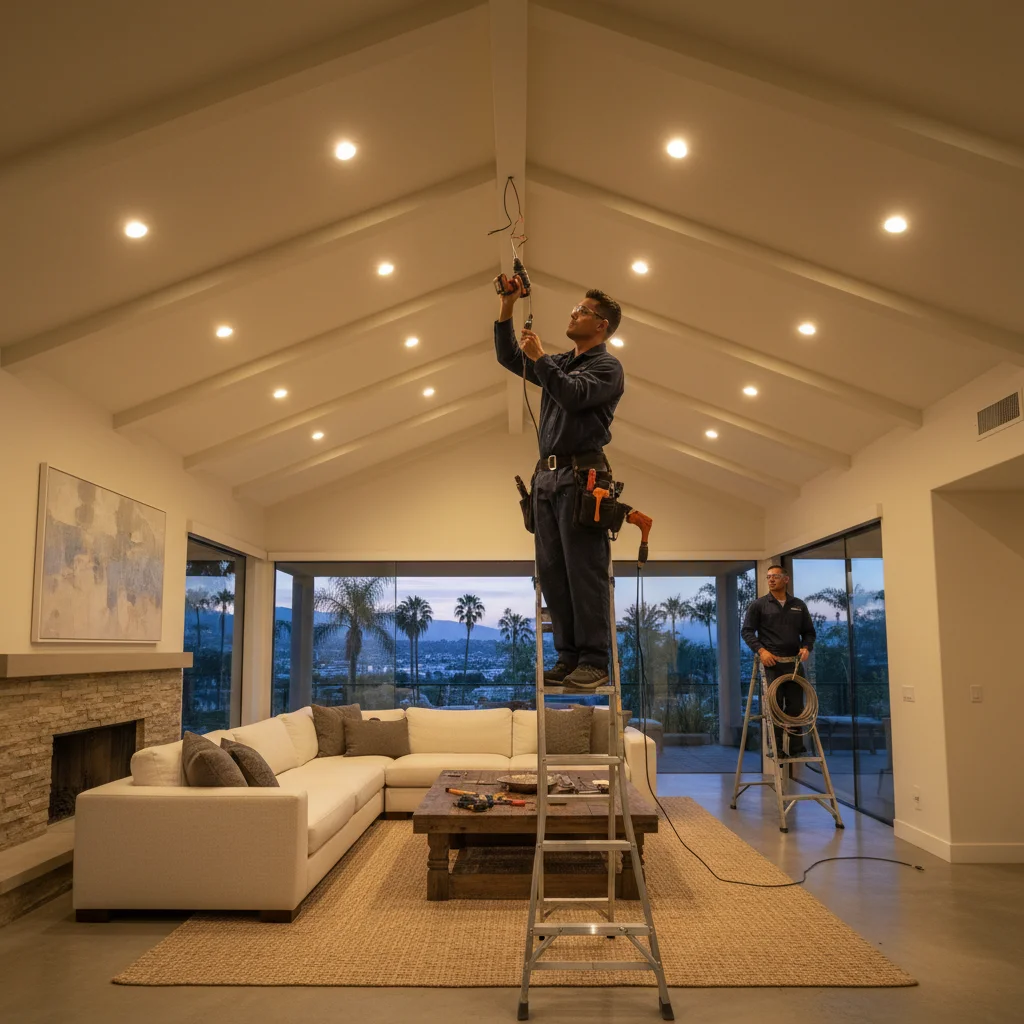
Upgrading to recessed lighting is one of the most effective ways to modernize a home and improve ambiance. It is a layout and listing job, not a resale-value outcome. But before you can enjoy that clean, smooth look, you need a realistic budget. The cost of recessed lighting in San Diego depends on several key factors, from the type of installation to the specific fixtures you choose.
TL;DR
- Retrofit recessed lighting (existing finished ceiling) costs $175 to $350 per light installed in San Diego; new construction (exposed joists) runs $125 to $250 per light. Treat those as published ranges on this page.
- Keep the access-and-finish checklist: attic vs closed ceiling, patching, and paint. Do not treat recessed lighting as an insurance or resale value outcome.
- IC vs canless is a listing and ceiling-assembly check. Use an IC or IC-rated canless fixture where the assembly has insulation, per the fixture listing and the adopted code.
- Drywall patching and ceiling repainting after the install is not included in most electrician quotes; budget an additional $300 to $800+ for a painter.
This guide breaks down the real-world costs you can expect for a professional recessed lighting installation project in San Diego County. We’ll cover per-can pricing, project ranges, and the critical details that separate a quality job from one that fails inspection.
Per-can install cost: new construction vs. retrofit
The single biggest factor influencing your can light installation cost is whether it’s a “new construction” or “retrofit” job. The difference comes down to labor.
New construction pricing
This is the easiest and most affordable scenario. It applies when the ceiling joists are exposed, typically during a major remodel or in a new build. The electrician has clear access to run wires and mount the light housings without having to cut into or repair drywall.
- Typical Cost in San Diego: $125 to $250 per light, installed.
- What’s Included: This price usually covers the fixture (a basic builder-grade LED can or canless wafer light), wiring from a nearby power source, and mounting. The lower end of this range applies to simple, open-joist installations with easy wiring runs. The higher end accounts for more complex wiring, higher ceilings, or premium fixtures.
Retrofit pricing
This is the most common type of installation for existing homes. The electrician must cut precise holes in your finished ceiling, fish wires through walls and joists, and install special “remodel” style housings. It’s a more delicate, time-consuming process.
- Typical Cost in San Diego: $175 to $350 per light, installed.
- Why the Higher Cost: The extra labor is the primary driver. Working around existing structures, insulation, and plumbing requires more skill and time. Attic access can simplify the job and potentially lower the cost, but installations from below (through the ceiling) are standard and require more effort. If your project requires a new dedicated circuit run from the electrical panel, that will also add to the cost.
For a deeper dive into the installation process itself, you can read our guide to recessed lighting installation in San Diego.
Insulated vs. non-insulated ceiling cost difference
Your ceiling type directly impacts the kind of recessed light fixture that can be safely and legally installed. In San Diego, most homes have insulated attics to manage our warm climate. This requires specific fixtures that are rated for direct contact with insulation.
IC-rated fixtures (Insulation Contact)
If you have insulation in your ceiling cavity, California building codes and the National Electrical Code (NEC) mandate the use of IC-rated fixtures. These housings are designed to prevent the heat generated by the light from becoming a fire hazard when buried in insulation.
- Cost Impact: IC-rated housings and canless lights typically cost $10 to $30 more per unit than their non-IC counterparts. While a minor part of the total cost, it’s non-negotiable for safety and compliance. An electrician who suggests using a cheaper, non-IC rated fixture in an insulated ceiling is cutting a dangerous corner.
Non-IC-rated fixtures
These are only suitable for ceilings with no insulation, such as a soffit, a drop ceiling, or the space between two floors of a house where there is at least 3 inches of clearance around the fixture. They are slightly less expensive but have very limited applications in residential San Diego homes.
All modern led recessed lighting is highly efficient and produces less heat than old incandescent bulbs, but the IC rating is still a critical safety standard. It ensures the fixture’s internal electronics don’t overheat, extending the life of the LED and preventing any risk of fire.
Drywall patching, paint touch-up, and what it adds
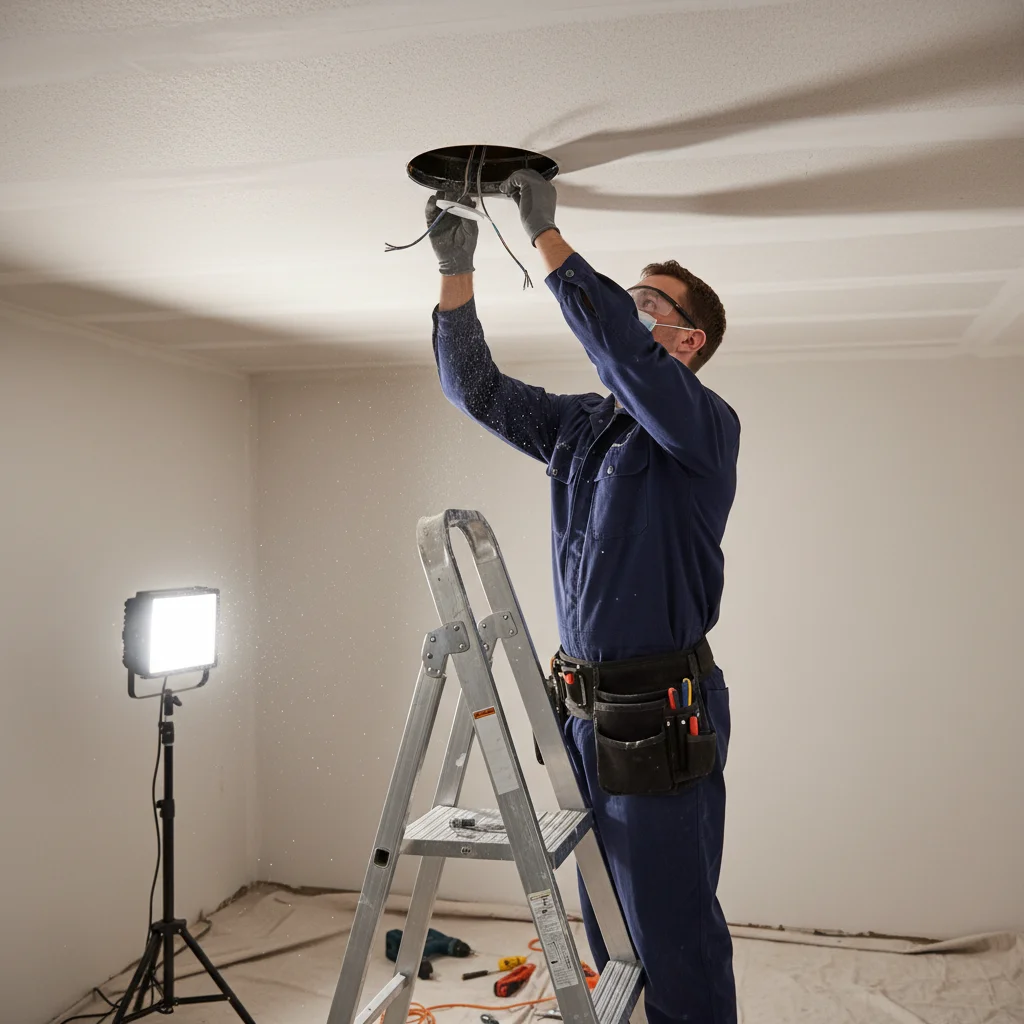
This is often the “surprise” cost for homeowners. Most electricians are experts at wiring, not drywall finishing. A standard quote for recessed lighting installation covers the electrical work only: cutting the holes, running the wire, installing the fixtures, and connecting them to a switch.
It does not typically include repairing the drywall or painting the ceiling.
- The Electrician’s Role: The licensed electrician makes the smallest, cleanest holes possible to get the job done. For canless “wafer” lights, the hole is the exact size of the light, so no patching is needed. For traditional cans or if new switch wiring is required, the electrician may need to cut small access holes to fish wires.
- Drywall & Painting Costs: You will likely need to hire a separate handyman or painter for this finish work.
- Drywall Patching: Expect to pay $75 to $150 per small access hole for patching and texturing to match your existing ceiling.
- Painting: Touching up a few patches is one thing, but it’s often impossible to get a perfect match on an older ceiling. For a smooth look, you’ll likely need to repaint the entire ceiling. This can cost anywhere from $300 to $800+ for an average-sized room.
When getting quotes, always clarify what’s included. Some full-service electrical companies may offer patching as an add-on service, but it’s crucial to ask. Factoring in this finish work gives you a true picture of the total project cost.
LED canless vs. traditional housing pricing
The technology for recessed lighting has evolved. You’re no longer limited to the classic “can” housing. Today, ultra-thin canless LED lights (also called wafer or puck lights) are incredibly popular. Each has its own cost and benefit profile.
Traditional can housing
This is the classic setup: a metal can (the housing) is installed in the ceiling, and a separate bulb and trim are installed inside it.
- Pros: Highly versatile. You can change the bulb’s color temperature or brightness easily. There is a huge variety of decorative trims available to match any style.
- Cost: The materials (housing, bulb, trim) can sometimes be slightly more expensive than an all-in-one canless unit. Labor can also be higher as it’s a multi-step installation process.
LED canless (wafer) lights
These are integrated, all-in-one units. The LED light and “trim” are a single, slim fixture that’s often less than an inch thick. It connects to a remote junction box that sits on top of the drywall.
- Pros: Their slim profile allows installation in tight spaces where a traditional can wouldn’t fit, like under a joist or pipe. Installation is often faster, which can lower the overall labor cost. Many models come with a switch that lets you select the color temperature (e.g., warm white, neutral white, daylight) on the spot.
- Cost: The fixture itself is competitively priced, and the reduced labor time can make the total can light installation cost lower than a traditional can. This has made them the go-to choice for most retrofit projects in San Diego.
For most homeowners, the flexibility and potentially lower cost of canless LED lighting make it the superior choice. However, if you want highly specific or decorative trims, the traditional can housing still has its place.
Typical whole-room and whole-house project totals
While per-can pricing is helpful, it’s more practical to think in terms of total project cost. Here are some common project scopes and their typical all-in electrical cost ranges in San Diego County. These estimates assume a standard retrofit installation in a home with 8-9 foot ceilings.
Living room or master bedroom (6-8 lights)
A common layout involves placing 6 to 8 lights to provide even, ambient illumination. This can completely change the feel of a room, making it feel larger and more inviting.
- Estimated Cost: $1,400 - $2,800
Kitchen (8-12 lights)
Kitchens require layered lighting for both general tasks and focused work. This often includes a grid of recessed lights for overall brightness, supplemented by other fixtures. Proper kitchen island lighting design is key to a functional and beautiful space.
- Estimated Cost: $1,800 - $4,200
Whole-house project (20-30 lights)
For homeowners looking to eliminate all dated “boob lights” and dark corners, a whole-house recessed lighting project is a major upgrade. This would typically cover the main living areas, kitchen, hallways, and master bedroom.
- Estimated Cost: $4,500 - $10,500+
These prices reflect professional lighting installation services and can vary based on your home’s specific construction, ceiling height, and the features you choose (e.g., dimmer switches, smart lighting controls). If you’re remodeling a kitchen and want recessed lights alongside under-cabinet strips, read our under-cabinet lighting installation guide for how those two systems coordinate.
What drives a low quote to fail inspection
Getting a quote that seems too good to be true should be a major red flag. In California, electrical work is strictly regulated for safety and energy efficiency. A suspiciously low bid often means the contractor is cutting corners that will cost you more in the long run.
Here’s what a low-ball quote might be hiding:
- Unlicensed and Uninsured Work: The single biggest reason for a low price is often an unlicensed handyman doing the work. This means they carry no insurance to cover potential damages to your home and have not proven their competency to the state. Always verify a contractor’s license on the California Contractors State License Board (CSLB) website.
- No Permit Pulled: Significant electrical work like adding new circuits for lighting requires a permit from your local San Diego jurisdiction. An installer who doesn’t pull a permit is avoiding inspection, which means their work isn’t being checked for safety or code compliance. This can cause major problems when you try to sell your home.
- Ignoring Title 24 Requirements: California’s energy code, Title 24, has specific requirements for lighting installations, including the use of high-efficacy fixtures (like LEDs) and, in many cases, vacancy sensors or dimmers. Non-compliant installations will fail inspection. You can learn more about these standards from the California Energy Commission.
- Using the Wrong Materials: A cheap quote might rely on using non-IC-rated fixtures in an insulated ceiling or using wiring that isn’t rated for the circuit’s amperage. These are serious fire hazards.
A professional, licensed electrician’s quote includes the cost of proper licensing, insurance, pulling permits, and using high-quality, code-compliant materials. It’s the only way to ensure your project is safe, legal, and built to last.
Frequently asked questions
How many recessed lights do I need for a room?
A common starting point is a 4-foot grid (sometimes 3 to 6 feet depending on ceiling height and how you use the room), not one light per few square feet of ceiling. A 12 by 14 foot living room typically works well with 6 to 8 lights in a grid pattern. Rooms with vaulted ceilings or darker finishes may need more. An electrician or lighting designer can suggest a layout based on your room’s dimensions, ceiling height, and how you use the space.
Do recessed lights in San Diego require a permit?
Yes, when new wiring is involved. Replacing an existing recessed fixture in the same location does not require a permit. Adding new lights that require new wiring runs or a new circuit from the panel does require an electrical permit. California also requires compliance with Title 24 energy code, which mandates high-efficacy fixtures (LEDs qualify) and, in many cases, dimmer switches or vacancy sensors in newly wired rooms. The licensed electrician doing the work pulls the permit and handles the Title 24 documentation. Bright Pro Electric does not pull permits.
What is the difference between IC-rated and non-IC-rated recessed lights?
IC stands for Insulation Contact. IC-rated fixtures are designed to have insulation placed directly against them without creating a fire hazard from heat buildup. Non-IC fixtures must have at least 3 inches of clearance from insulation on all sides. Most San Diego homes have insulated attics, so most recessed lighting installations require IC-rated fixtures. Using a non-IC fixture in an insulated ceiling is a code violation and a fire risk, and it will fail inspection.
Will I need to repaint my ceiling after a recessed lighting install?
Possibly. The electrician makes the smallest, cleanest cuts possible. Canless LED wafer lights leave a hole exactly the size of the fixture, with no patching needed. If the project requires small access holes for wire fishing or a new switch, those holes need to be patched by a drywall contractor. Matching the texture and paint color of an existing ceiling often requires repainting the entire ceiling for a uniform look. Budget $300 to $800+ for a painter in addition to the electrical quote.
When to call us
Planning and budgeting for a recessed lighting project involves more than just picking a fixture. It requires understanding your home’s construction, electrical code, and the best layout for your needs. This is not a DIY project; working with your home’s electrical system is dangerous and requires a licensed professional.
For a clear, detailed estimate on your recessed lighting project in San Diego, Bright Pro Electric matches you with a licensed electrician. Use contact to get matched.