A new electrical project can lead to two very different proposals. One may add a subpanel, while another recommends an electrical service panel upgrade. The right choice depends on the new loads, existing service, project location, and future plans.
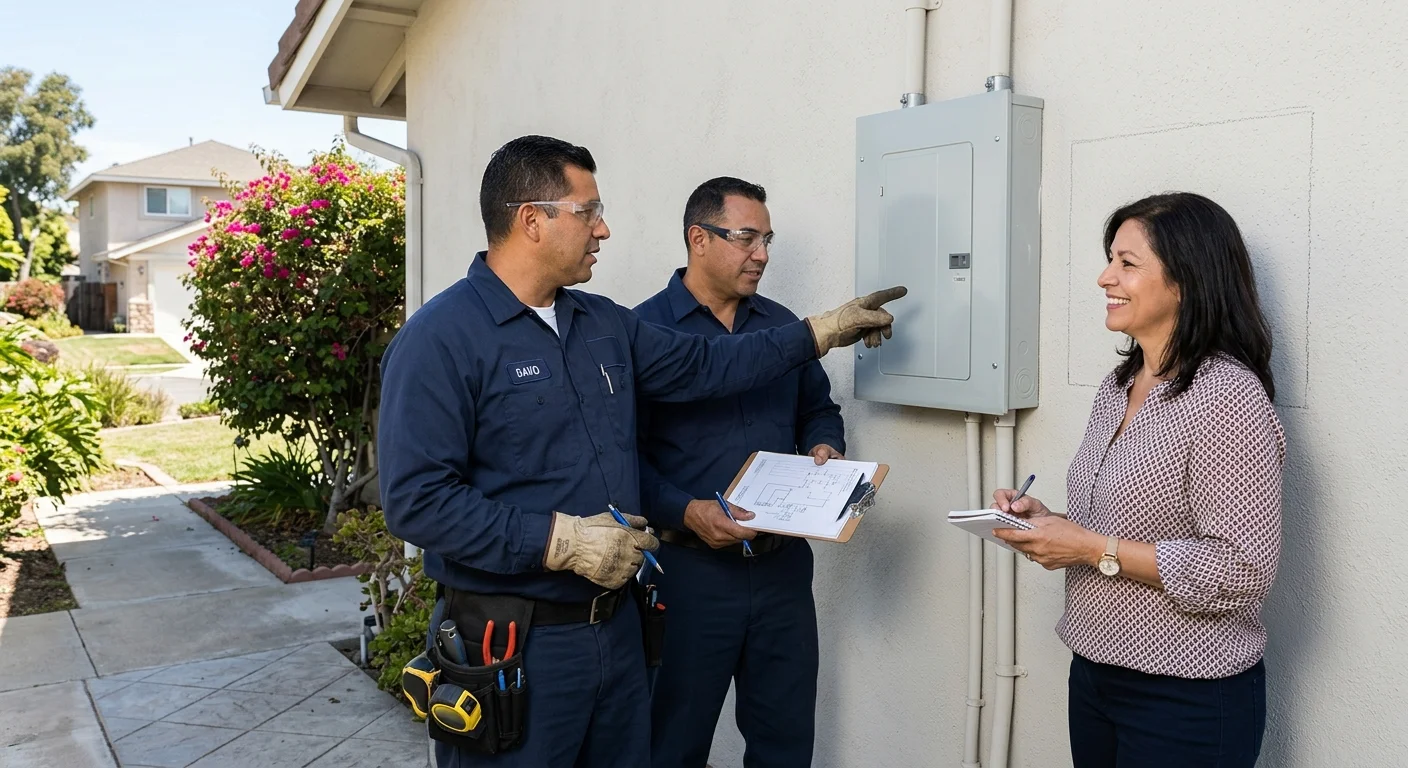
Start with the new loads the project must serve
Begin with the equipment the project needs to support. That list matters more than the number of empty breaker spaces.
Include every confirmed addition. Common examples include an EV charger, heat pump, spa, workshop, battery system, or new living space. Also identify equipment that may arrive during a later phase. A future load doesn’t automatically require work today, but the electrician needs to know it exists.
Separate the list into three groups:
- Equipment included in the current project
- Existing equipment that must remain
- Possible additions planned for later
Location belongs on that list too. An EV charger beside an attached garage presents a different layout than equipment near a detached structure. An ADU project in Chula Vista may also require a different distribution plan than a workshop outside Ramona.
Ask the electrician to document how the proposed loads were evaluated. For an EV charger added to an existing panel, NEC 220.87 is a standard practice reference for the load calculation. The proposal should explain the calculation used without relying only on breaker counts.
This process frames the real decision. A subpanel may solve a distribution or location problem. A service upgrade may be needed when the existing electrical service can’t support the planned demand. Sometimes a project involves both.
How a main panel and subpanel serve different roles
The main panel is the home’s primary electrical distribution point. It receives the utility service and supplies the home’s circuits. A subpanel sits downstream and receives power through a feeder from the main panel.
That distinction explains the main panel versus subpanel decision. A subpanel can create more circuit positions and place distribution closer to new loads. It doesn’t, by itself, increase the capacity supplied by the utility.
A main panel project can have several purposes. It may replace existing equipment, support a change in service capacity, or prepare the property for planned electrical loads. Those are related scopes, but they aren’t interchangeable.
A detached garage illustrates the difference. The main panel may have enough usable capacity, while the garage still needs a practical distribution point. A subpanel could fit that planning goal. If the added garage equipment pushes demand beyond what the existing service can support, the proposal may instead include broader service work.
Avoid treating panel size, panel replacement, and service capacity as one decision. Ask each electrician to name the exact scope being proposed. The answer should clearly identify whether the plan changes the main equipment, adds downstream distribution, changes the utility service, or combines those tasks.
Our electrical panel upgrade service connects San Diego County homeowners with independent licensed electricians who can assess that scope.
What existing service capacity can change
An electrical panel can have open spaces and still need closer evaluation. A crowded panel can also require a subpanel without automatically requiring a larger service. Breaker spaces alone don’t settle the question.
The electrician should review the existing service, current loads, planned loads, equipment condition, and proposed circuit layout. Labels inside the panel are useful, but they aren’t a substitute for examining what the circuits actually serve.
Housing age adds local context, though it doesn’t diagnose a panel. U.S. Census Bureau ACS 2023 five-year data shows that 68.7% of La Mesa housing units predate 1978. The figure is 69% in Lemon Grove, 40.8% in Chula Vista, and 27.5% in Carlsbad. That spread shows why one countywide assumption doesn’t work.
Older housing may have passed through several electrical changes. Newer housing may still face added demand from an EV charger, heat pump, battery, or ADU. Either property needs an address-specific review.
Comparable housing-age figures couldn’t be confirmed for San Diego neighborhoods such as Clairemont, North Park, La Jolla, or Scripps Ranch. Census place-level data doesn’t provide an approved figure for those neighborhoods. The electrician should inspect the actual equipment instead of guessing from the neighborhood name.
The final proposal should state whether existing capacity supports the new load. If it doesn’t, ask which part of the plan changes and why.
When location and future expansion affect the choice
Panel planning isn’t only about electrical demand. The physical path between the panel and the new equipment can change the design.
A subpanel may place distribution closer to a garage, workshop, ADU, or concentrated group of loads. That can make the layout easier to understand and give those circuits a defined distribution point. The main panel still supplies that subpanel, so the existing service must remain part of the review.
Access also matters. Show the electrician gates, narrow side yards, finished walls, storage areas, and planned construction. Point out any place that shouldn’t be disturbed. If another contractor is handling an ADU, solar project, heat pump, or remodel, share the current plans before accepting an electrical scope.
Future projects deserve specific names. “More power later” doesn’t tell an electrician enough. “A second EV charger near the driveway” or “a detached office behind the garage” gives the proposal a real planning target.
Don’t assume every possible project needs capacity reserved immediately. Ask what the present design supports and what would need to change later. That keeps future planning separate from work that isn’t part of the current contract.
San Diego County properties vary widely. Coastal Carlsbad, central San Diego, East County, and rural North County don’t share one layout. Equipment location, available routes, and the distance between structures all belong in the site review.
Which utility and permit details need confirmation
The permitting authority depends on the property address. San Diego County doesn’t use one building department for every community.
Within the City of San Diego, the Development Services Department issues electrical permits. The city confirms that a 200-amp panel upgrade requires an electrical permit. Other project classifications should be checked through the city’s electrical permit information before work begins.
Unincorporated communities such as Ramona, Lakeside, Fallbrook, Alpine, and Bonsall use San Diego County Planning & Development Services. Incorporated cities run their own building departments. Poway, for example, has its own Building Services division and fee schedule. The exact Poway fee wasn’t confirmed for this page, so homeowners should request the current amount directly from that division.
Utility coordination is a separate issue. SDG&E evaluates load requirements, meter location, and existing system capacity for service upgrades. Applications route through My Project Center or the Builder Services Portal. Upgrades without added load may request Express Program processing.
No verified project timeline applies to every SDG&E service upgrade. Timing and utility costs depend on the individual project. Check the current process through SDG&E service planning, then ask whether the proposal includes the required coordination.
A useful proposal names the correct permitting authority and identifies any expected utility involvement. It shouldn’t treat City of San Diego, county, and incorporated-city procedures as identical.
What to compare in electrical proposals
Compare the scope before comparing the total. Two proposals may describe different projects even when both use the phrase “panel upgrade.”
Each proposal should identify:
- Every new load included in the evaluation
- The existing equipment being retained or replaced
- Whether the plan adds a subpanel
- Whether utility service capacity changes
- The proposed equipment locations
- Known permit and utility coordination
- Work excluded from the contract
- Assumptions about future expansion
Ask for clarification when a proposal uses “upgrade” without defining it. A replacement main panel, larger utility service, and new subpanel aren’t the same scope. The written plan should tell you which one you’re buying.
Also confirm who handles each outside step. The electrician may coordinate permit and utility tasks, but the proposal should say so. Don’t assume an application, inspection, wall repair, trench, or related project work is included unless it appears in writing.
Most electrical installation, alteration, or extension work in California requires a licensed contractor regardless of price. Verify the contractor’s classification and current status through the CSLB license lookup. Bright Pro Electric is a referral service, not the contractor performing the work.
A strong comparison leaves fewer unanswered questions. You should understand the new loads, proposed distribution, service impact, project boundaries, and outside coordination before choosing a plan.
When to call us
Call when a project may need a main panel, subpanel, or broader service review. Panel alterations and new electrical distribution need a licensed electrician who can assess the property and define the scope.
Call us at (858) 988-5580 and we’ll connect you with a licensed local electrician.