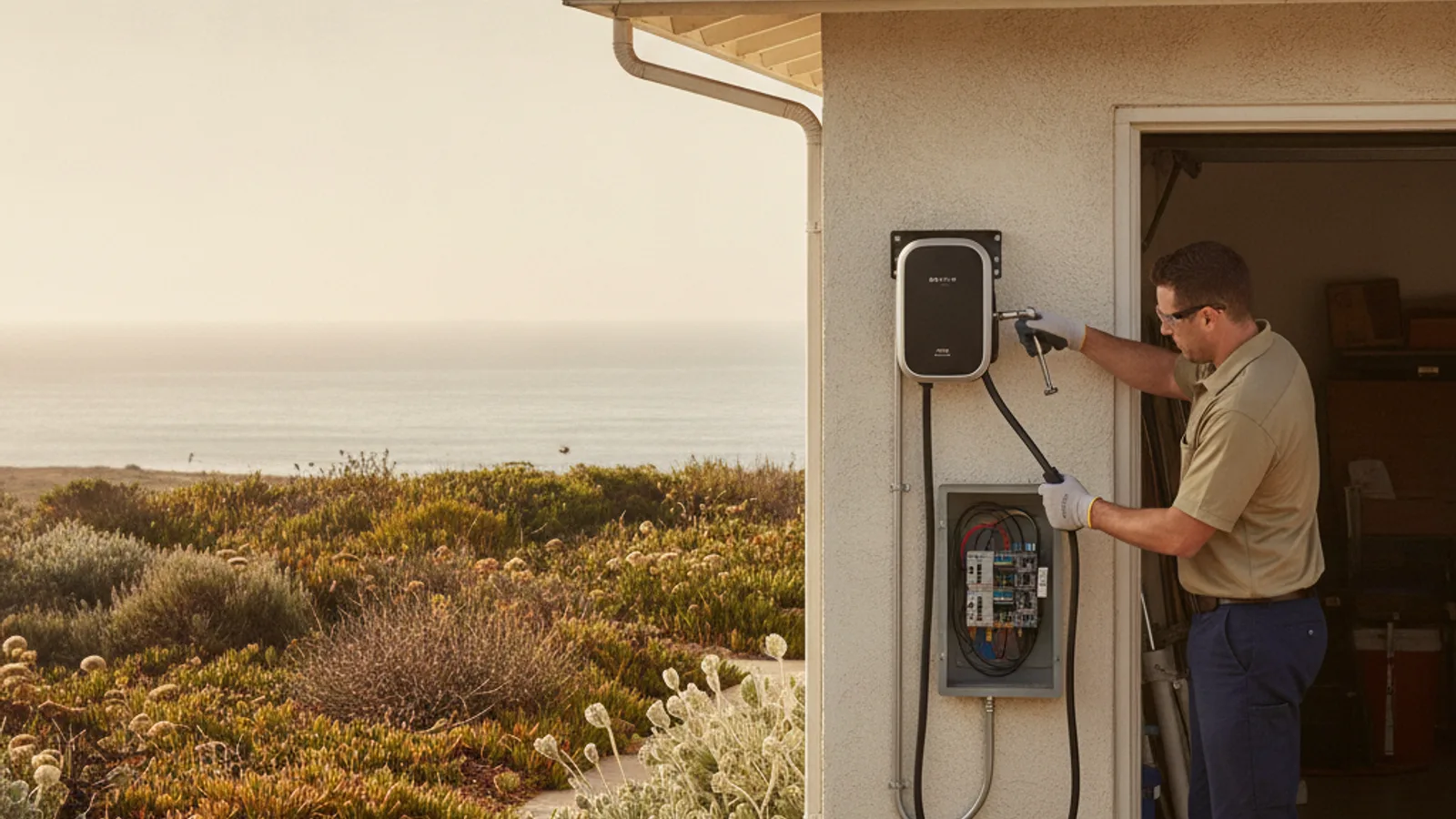
La Jolla’s electric vehicle owners run into a version of this project that looks different from the rest of San Diego County. Ocean exposure, older housing stock climbing Mount Soledad and the Village, and parking situations that range from a private three-car garage to a shared carport all change what an EV charger install actually involves here. Get the site-specific details right before you compare quotes, not after.
Start with parking location and charger use
Where the car actually parks drives most of the decisions that follow. An estate along La Jolla Farms Road or Bird Rock with an attached three-car garage gives an electrician a straightforward, protected spot to mount a charger close to the panel. A bluff-top property with a detached garage, common on the older lots around Hidden Valley and parts of Muirlands, means a longer wire or conduit run outdoors, which changes both the scope of work and the exposure that run has to deal with.
Village properties around Prospect Street, Girard Avenue, and the older apartment stock along Pearl and Draper add a third pattern: on-street parking or a shared carport with no dedicated space at all. That last category doesn’t get solved with a simple wall-mount job, and it’s worth being upfront about before scheduling a site visit.
How you’ll actually use the charger matters too. A daily commuter charging every night wants a dedicated circuit sized for regular full charges. A second car that only needs a top-up a few times a week has more flexibility in charger size and circuit design. Tell your electrician both, not just where the car will park. Our EV charger installation service page covers the charger types and circuit options that connect to a licensed local electrician, worth a look while you’re still sorting out where the car parks.
How an electrician checks panel and circuit capacity
Older La Jolla homes, particularly around the Village and the original construction on Mount Soledad, may still be on the smaller electrical service they were built with. A 100-amp service was common in that era generally, but the only way to know a specific property’s service size is to read the label on its panel and have its capacity reviewed. Adding a 40 to 50-amp EV circuit to a panel that’s already close to capacity is exactly the kind of addition that requires a proper load calculation before anyone commits to a plan, not after.
That calculation is what tells an electrician whether the existing panel can safely take the new circuit, whether a load management device could make it work without a bigger change, or whether the panel itself needs to be upgraded first. Skipping that step and just installing a charger on a full panel is the kind of shortcut that shows up later as tripped breakers or, in the worst case, a genuine fire risk. Our electrical panel upgrade service covers that upgrade path when the load calc points that way.
Newer construction generally tends toward larger electrical service, but the panel itself is the answer for any given La Jolla property. Age is a starting clue here, same as anywhere else in the county. It’s not a substitute for the electrician actually checking your panel. For the broader mechanics of hardwired versus plug-in chargers and panel sizing that apply countywide, our San Diego EV charger installation guide walks through those choices in more detail.
That check matters even more when a household is planning more than one EV. Two chargers on the same property multiply the load question, and a panel that comfortably handles one dedicated 240-volt circuit might not have room for a second without a load management device or an upgrade. Bring up future plans, including a second vehicle or a planned addition like a pool or a standby generator, during the initial site visit rather than after a single-charger install is already finished. Adding load-sharing hardware or a larger panel later, after the wiring is already in and finished, generally costs more than planning for it up front.
When shared parking or an HOA changes the plan
Not every La Jolla property answers to a homeowners association, and it’s worth not assuming one applies just because a home sits in a desirable coastal neighborhood. Many of La Jolla’s single-family lots, including the older bluff-top and Village-adjacent properties, have no HOA governing exterior electrical work at all. Some of the newer condo developments and planned communities do.
HOA and condo parking can add a board packet before the city will look at a permit. See EV charger in a San Diego HOA or condo for that process. Bright Pro does not file the board packet.
Shared or assigned parking without an HOA, common in some of the older Village multi-unit buildings, raises a different question: whether a dedicated circuit can even reach the assigned space, and who’s responsible for that wiring if the space is shared among units. That’s a property-specific answer, and it’s worth getting from the building’s ownership structure before assuming either way.
Renters and long-term tenants in that same Village stock face an extra layer: the landlord, not the tenant, generally controls whether a permanent dedicated circuit gets added to the building’s wiring. If you don’t own the unit, start that conversation with the property owner before an electrician ever visits the site, so the scope of the visit matches what’s actually possible to approve.
Which permit and utility details need address-level confirmation
Any new 240-volt circuit for an EV charger needs a permit, and in La Jolla that means the City of San Diego’s Development Services Department, since La Jolla is a neighborhood within city limits rather than an unincorporated part of the county. The City publishes a fee schedule for electrical permits, including a straightforward simple-permit fee for adding circuits and a separate published bulletin (IB 187) specifically covering EV charging system permits. Confirm the current fee amount for your exact scope directly with the city or through your electrician, since fee schedules are revised periodically and a general estimate here would be exactly the kind of guess this whole planning process is meant to avoid. Our EV charger permit guide for San Diego covers the simple-versus-standard permit distinction and the typical inspection timeline in more depth.
SDG&E publishes EV time-of-use plans on its site. Confirm the current table at SDG&E EV plans before you treat a bill as matching this page. CCA customers pay different delivery plus generation. This page does not publish a rate table.
What to compare in installation proposals
A written proposal for a La Jolla install should specifically address the site conditions above, not read like a generic template. Does it name whether your property needs a panel upgrade based on an actual load calculation, or does it just assume your existing panel is fine? Does it specify the conduit route and material for any outdoor run, given how much of La Jolla sits close enough to the water that ordinary hardware corrodes faster than it would inland? Does it state who’s pulling the city permit and confirm that HOA approval, if your property has one, has already been secured or is accounted for in the timeline?
A proposal that skips those specifics and jumps straight to a price is one you should ask more questions about before signing. Verify any contractor’s license directly through the CSLB license lookup as part of that comparison, regardless of how the quotes stack up against each other.
When to call us
An EV charger install in La Jolla usually comes down to three site-specific questions: does the panel have capacity, does an HOA or shared parking situation apply, and what does the coastal exposure mean for the outdoor portion of the run. A licensed electrician should answer all three before you commit to a plan.
Use contact.