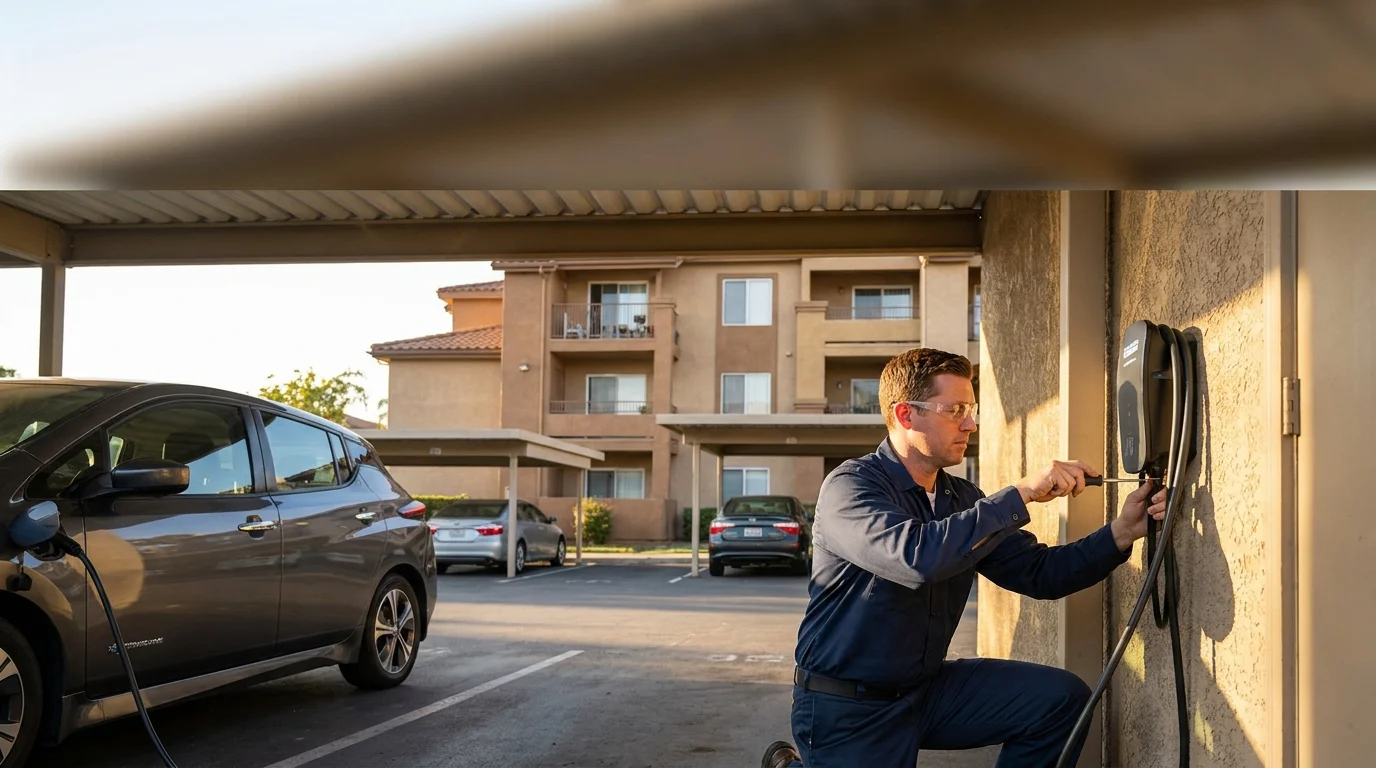
California Civil Code 4745 is the Right to Charge statute. An association may not unreasonably restrict a charging station in an owner’s designated space. It can still deny a complete application in writing and can still impose reasonable conditions. If an application is not denied in writing within 60 days of receipt, Civil Code 4745(e) treats it as deemed approved. The homeowner pays installation and electricity (4745(f)(1)(D)) and must use a licensed contractor (4745(f)(1)(B)). A certificate of insurance is due within 14 days of approval (4745(f)(1)(C)). A board can still deny in writing. Bright Pro does not run the HOA process or install the charger.
TL;DR
- Civil Code 4745: an HOA may not unreasonably restrict a charger in your designated space. It can still deny in writing and can impose reasonable conditions.
- If a complete application is not denied in writing within 60 days of receipt, it is deemed approved (4745(e)).
- The homeowner pays installation and electricity, uses a licensed contractor, and provides a certificate of insurance within 14 days of approval.
- Additional-insured HOA demands are a policy-and-statute question for your attorney. Confirm SB 770 against current Civil Code text before you rely on it.
- A load calculation before you file keeps the application from bouncing as incomplete.
- HOA approval and a city electrical permit are separate. Bright Pro matches electricians. Bright Pro does not file the board packet or pull the permit.
Can my San Diego HOA say no to an EV charger?
No, not as a blanket veto. Civil Code 4745 voids rules that prohibit or unreasonably restrict a charging station in the owner’s designated parking. The board can still require a licensed contractor and reasonable safety or aesthetic conditions. It can deny a complete application in writing. If 60 days pass with no written denial, 4745(e) deems the application approved. That is not the same as “the board cannot refuse.”
What the HOA application actually needs
Submit the request the same way you would any architectural modification. A complete application includes a site plan showing where the charger goes, the electrical specs for the circuit, and proof you’re using a licensed contractor. That last point matters twice. It’s required by law, and it’s also what keeps your application from being sent back as incomplete, which is the one thing that resets the 60-day clock.
Most delays we see aren’t the board stalling. They’re a homeowner submitting a request with no load calculation or circuit diagram attached, so the board comes back asking for more information and the clock pauses until you provide it. Coming in with a load calculation and a wiring plan already prepared by a licensed electrician turns a paperwork problem into a straightforward yes.
Who pays, and what insurance is required
You do, on every line. Civil Code 4745 puts installation cost, the electricity itself, ongoing maintenance, and any damage caused by the charger squarely on the homeowner who requests it. If the board later requires removal, restoring the common area is also on you.
Civil Code 4745(f) puts installation, electricity, maintenance, and damage costs on the requesting owner. You need a liability policy and a certificate within 14 days of approval (4745(f)(1)(C), (f)(3)). Whether an HOA can require the association as an additional insured is a current-statute question. Confirm SB 770 in the Civil Code with your attorney or the association’s counsel before you buy a rider.
Panel capacity is the real bottleneck in older San Diego condos
Paperwork rarely kills an EV charger project in an older San Diego condo or townhome. Panel capacity does. Buildings from the 1970s through the 1990s, which make up a lot of San Diego’s condo stock, were built with modest per-unit electrical service, sometimes a shared meter room feeding subpanels sized for lights and a kitchen, not a 40-amp charging circuit on top of everything else.
An electrician runs a load calculation on your unit’s panel before you file the HOA paperwork, so you know whether you’re looking at a straightforward circuit addition or a panel upgrade first. The mechanics of that calculation, and how often San Diego panels come up short, are in the EV charger panel-upgrade bottleneck guide. Finding this out before you submit means your HOA application arrives complete on the first try.
Assigned space vs. common area: where you’re allowed to install
| Situation | What the law allows |
|---|---|
| Your own deeded or assigned parking space | You install there. The HOA reviews for safety and aesthetics. It can still deny a complete application in writing. If 60 days pass with no written denial, 4745(e) deems it approved. |
| Shared or unassigned common-area parking | Installation is allowed only if using your own space is impossible or unreasonably expensive. The HOA can designate a new EV-ready space instead. |
| Attached garage you own | Treated the same as a deeded space. Standard architectural review, same 60-day clock. |
Most San Diego condo and townhome owners fall into the first row: a deeded space, a standard application, and a 60-day clock that works in their favor.
You still need a city permit, separately from HOA approval
HOA approval and a city electrical permit are two different processes, and you need both. The HOA governs whether you’re allowed to install the charger at all. The City of San Diego, or your local jurisdiction, still has to inspect the actual electrical work for code compliance, same as any other Level 2 charger install. Independent licensed electricians walk through what the city requires, and how long it takes, in our guide on EV charger permits in San Diego. Line up both approvals before an electrician starts pulling wire.
Frequently asked questions
Can a California HOA deny my EV charger request?
The board can still deny a complete application in writing. Civil Code 4745 voids rules that prohibit or unreasonably restrict a charger in your designated space, and it allows reasonable contractor, safety, and aesthetic conditions. If 60 days pass with no written denial, 4745(e) deems the application approved. That is not the same as “the board cannot refuse.”
How long does an HOA have to approve an EV charger in California?
60 days from a complete written application. If the board doesn’t deny it in writing within that window, state law deems the application automatically approved, regardless of whether the board formally voted on it.
Who pays for an EV charger installed in an HOA community?
The homeowner pays for everything: the electrician, the wiring, the electricity the charger uses, ongoing maintenance, and any damage it causes. If the HOA later requires removal, restoring the common area is also the homeowner’s cost.
Does my HOA have to carry insurance for my EV charger?
No, you do. You need a liability insurance policy and must give the HOA a certificate within 14 days of approval, renewed annually. Whether the association can require itself as an additional insured is a current-statute question. Confirm SB 770 in the Civil Code with your attorney or the association’s counsel before you buy a rider.
Can I install an EV charger if I only have shared parking?
Only if using your own assigned space isn’t reasonably possible. In that case the law allows a common-area installation, and the HOA can also choose to designate a dedicated EV-ready space instead of handling it case by case.
Do I still need a city electrical permit if my HOA approves the charger?
Yes. HOA approval and a city permit are separate. The HOA decides whether you can install the charger at all; the city still inspects the electrical work itself for code compliance, same as any other Level 2 charger install.
Licensed electricians handle HOA and condo EV charger installs: the load calculation your application needs, the wiring and circuit, and a plan the board can review. They serve HOA and condo communities across San Diego County and will tell you if your panel needs an upgrade before you file. Use contact. See EV charger installation and panel upgrade. Bright Pro does not offer a free load-capacity check and does not pull the permit.