A Level 2 charger in Escondido has to reach the stall you actually use, on a panel that may still be 100 amps, in a valley that runs hotter than the coast. Parking, heat, and capacity decide the job before anyone opens a box. Get those three right and the rest of EV charger installation follows.
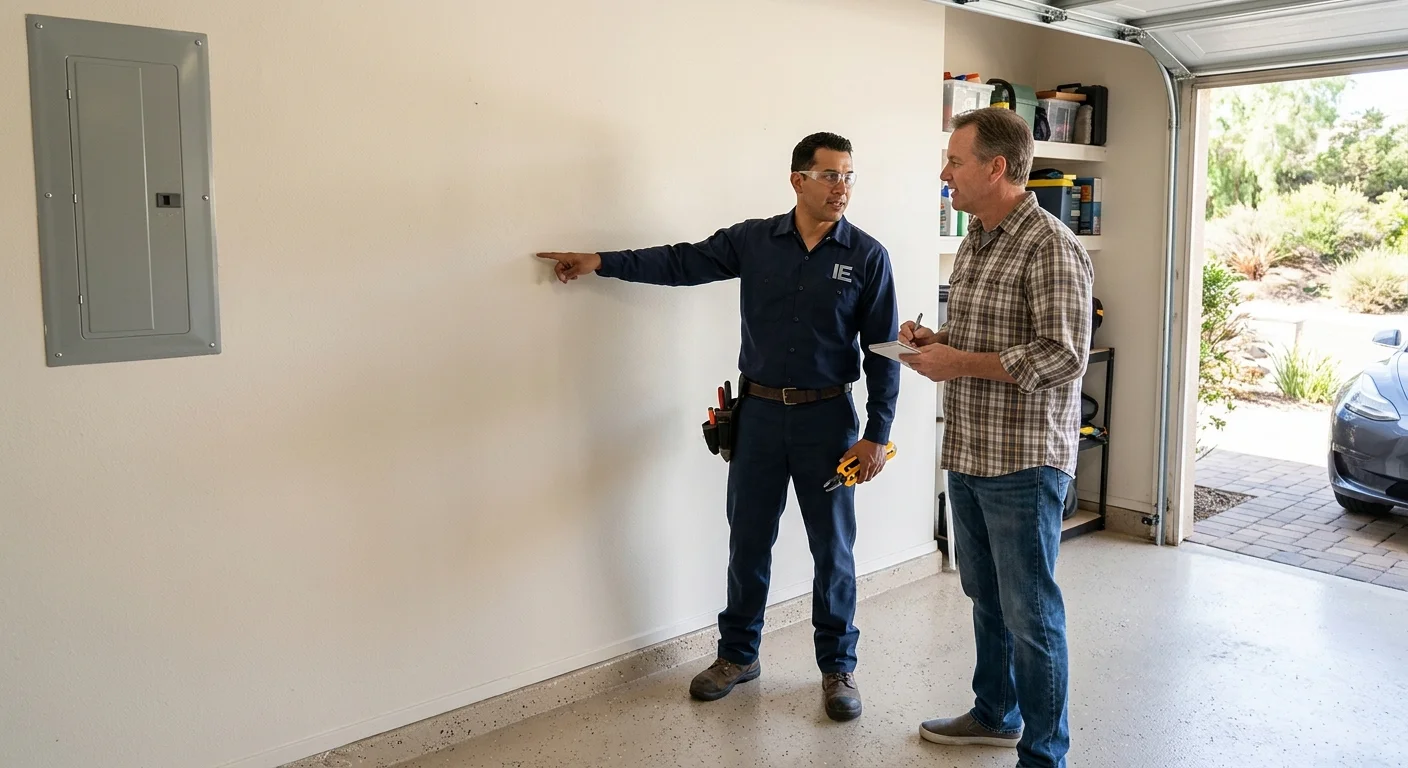
Start with parking location and daily charging use
Walk the garage the way you park, not the way a floor plan looks. An attached stall off Centre City Parkway is a short wall run. A detached shop on a larger lot toward Valley Center or Hidden Meadows is a feeder problem as much as a charger problem. Inside versus driveway changes weather rating, cable droop, and whether the unit sits in afternoon sun.
Park the car as you will at night. Note which side the charge port sits on. Measure from that port to the wall you want, then from that wall to the panel. Share those two distances with the electrician. A pretty mount that the cord cannot reach is a wasted circuit.
Say how you drive. A short in-town loop to Grand Avenue is not the same overnight load as a daily I-15 commute. Two EVs in one household is a second stall, a second circuit, or a shared plan. None of that is a speed rating. It is hours on the clock and how much the house already draws when you plug in.
Tell the electrician what else lives in that garage. Freezers, welders, shop lights, a dryer, and ADU feeders all sit on the same service. Escondido has a lot of 1970s ranch houses with the panel in the garage. That can make the run short. It can also mean the charger, the AC condenser, and the laundry share one aging bus.
If a 240-volt outlet already exists, ask whether it is dedicated and whether it can be reused. Do not assume every charger needs a brand-new circuit. Do not assume a dryer receptacle is ready either. The electrician confirms that on site.
Clean Energy Alliance supplies generation for Escondido. SDG&E still delivers the power and still sends the bill. Overnight charging only saves money if your actual rate plan rewards those hours. Bring a recent bill to the walkthrough so the plan matches the meter you have, not a generic coastal example.
How inland heat and garage conditions affect the plan
Escondido sits inland, east of the marine layer that cools Encinitas and Carlsbad. Summer heat stacks in closed garages, on west stucco, and on detached shops with thin insulation. A charger planned for a La Jolla carport is the wrong picture here.
Ask for equipment rated for the actual location. Indoor-only gear on an open carport toward Lake Hodges is a miss. Direct sun on a west wall cooks plastic and shortens cord life. Shade, a north wall, or a spot inside the overhead door line is usually kinder. The electrician picks a listed outdoor or indoor unit for that wall. You do not need a brand lecture. You need the listing to match the weather.
Heat also changes how the house uses power while the car charges. Inland AF and heat pumps already lean on the panel on summer afternoons. A charger that starts at 4 p.m. stacks on that peak. Weeknight charging after 9 p.m., or in the published super off-peak windows, is a rate decision and a load decision.
Attic and soffit routes in older ranch attics get hot. Surface conduit on a garage wall can be the cleaner, cooler path when the electrician can use it. Do not open walls or drill a feeder yourself. Note the path you prefer and let the licensed electrician judge fill, heat, and support.
SDG&E may use public safety power shutoffs in high-fire-risk weather. Different parts of a neighborhood can sit on different circuits, and restoration is not a promised clock. Check SDG&E for your address. A hillside parcel near Daley Ranch is not automatically in a shutoff zone, and a valley lot is not automatically out of one.
If you smell burning insulation, see discoloration at a receptacle, or the garage feels wrong when a heavy load runs, stop using that circuit. That is inspection work, not a charger add-on. Electrical Safety Foundation International publishes general home electrical safety guidance. A licensed electrician still has to look at this house.
What panel capacity can change before a charger is added
Census ACS 2023 5-year data puts 52,662 housing units in Escondido. The largest share went up in the 1970s (26.9%). About 43.2% of units predate 1978. That older stock is where 100-amp services, crowded garage panels, Federal Pacific Stab-Lok and Zinsco equipment, aluminum branch wiring, and ungrounded two-prong circuits concentrate.
Read the main breaker rating. If it still says 100 amps, treat that as the starting fact. A Level 2 charger is a continuous load. The electrician should run a load calculation before promising a new breaker will fit. NEC 220.87 is the standard-practice reference for adding a charger to an existing panel. Ask to see the calculation, not a glance at empty slots.
Empty slots are not spare capacity. The bus rating, the service size, the existing air conditioner, range, and dryer, and any solar backfeed all count. A detached garage subpanel may have been sized for lights and a freezer, not a charger. Replacing that feeder can be the real job.
Some homes take the charger on the existing service with a dedicated circuit. Some need a load-management device so the charger yields when the AC starts. Some need a panel or service upgrade before anything mounts on the wall. None of those paths is a citywide average. They are outcomes of this panel.
If the service itself has to grow, the electrician coordinates with SDG&E through the utility’s project tools. SDG&E does not publish a single timeline for that review. Do not plan around a promised week. When to upgrade an electrical panel and a panel upgrade sit next to charger work when the math says the bus is full.
Our Escondido electrician guide covers how older inland houses in this city actually get hired and permitted. Use it before you treat a charger quote as the whole electrical picture.
Confirm Escondido permits and utility steps for the address
The City of Escondido runs its own building department. It is not the City of San Diego Development Services desk, and it is not County Planning & Development Services. County figures, including the unincorporated EV charging station permit fee, do not apply inside city limits. Do not borrow a San Diego “simple no-plan” story and paste it onto an Escondido garage.
Ask the City of Escondido building department what this address needs for a Level 2 charger, a new circuit, a subpanel, or a service change. A published Escondido fee for that work could not be confirmed in the claims ledger used for this page, so confirm the current amount with the city before you pay. The electrician you hire should say who pulls the permit and who meets the inspector. Bright Pro Electric does not pull permits and does not perform the work.
California’s 2025 Electrical Code (Title 24, Part 3) took effect January 1, 2026. Local staff can still layer city procedures on top of that. The electrician writes the scope to the authority on the permit, which is Escondido for addresses inside the city.
If the panel or service changes, SDG&E reviews load and metering. The contractor typically files that. You still own the customer-side equipment after it is in.
For bundled (non-CCA) residential customers, SDG&E EV-TOU-5 rates effective August 1, 2026 are 13.1¢/kWh super off-peak, 49.6¢/kWh off-peak, and 80.2¢/kWh on-peak. Super off-peak is weekdays 12 a.m.–6 a.m. and 10 a.m.–2 p.m., and weekends 12 a.m.–2 p.m. On-peak is every day 4 p.m.–9 p.m. On-peak is about 6 times super off-peak. Those figures exclude the monthly residential Base Services Charge. The dollar amount of that charge is not published on SDG&E’s EV plans page, so it is not stated here.
CEA customers pay different generation and different delivery pieces than bundled customers. Do not run the table above as your bill if CEA is on it.
A 40-amp Level 2 charger at about 7.7 kW continuous, used 9 hours a week, is about 3,600 kWh/year. At 13.1¢ that energy is about $470/year. At 80.2¢ it is about $2,880/year. The spread is about $2,400/year. Those are energy-only figures on the published EV-TOU-5 periods, not a whole-bill promise.
HOA and condo rules are separate. California Civil Code 4745 is the Right to Charge statute. An application not denied in writing within 60 days is deemed approved. The homeowner pays installation and electricity and must use a licensed contractor. Since January 1, 2026, an association cannot require the homeowner to name the HOA as an additional insured. A liability policy, a certificate within 14 days of approval, and annual certificates still apply. See our HOA and condo charger guide if a board packet is in play.
Countywide paperwork context lives on our EV charger permit page. Use it for the region, then confirm Escondido’s own counter for this lot.
What to compare in charger installation proposals
Ask for the same scope in writing from more than one licensed electrical contractor. CSLB recommends at least three written bids on the same work. A much cheaper number is a prompt to ask what was left out, not proof of a bargain.
Each proposal should name the charger location, indoor or outdoor listing, hardwired versus receptacle, the circuit rating, the load calculation method, and any panel, subpanel, or feeder work. It should say who pulls the Escondido permit and who is on site for inspection. If SDG&E service work is possible, that belongs in the quote as a separate path, not a surprise.
Verify the business on the CSLB license lookup. Match the name on the bid to the name on the license. A C-10 classification covers installing and connecting electrical equipment that uses electrical energy. A license is not a warranty of workmanship, insurance payment, or a passed inspection. Ask for insurance evidence and warranty terms from the contractor who will do the work. Bright Pro Electric does not warrant the installation.
Skip testimonials as a deciding tool. Compare the paper: calculation, permit, path, and exclusions. If the garage is detached, make the feeder size explicit. If the panel is 100 amps, make the “charger only” versus “upgrade first” fork explicit.
For how dollars usually stack across San Diego County, use our EV charger installation cost guide. That page is the cost discussion. This page is the Escondido plan: stall, heat, panel, city desk, utility. Do not treat a coastal or countywide number as this house.
Frequently asked questions
How much should it cost to install an EV charger in Escondido?
There is not a verified single Escondido install price in the claims ledger for this page. Run length, attached versus detached garages, 100-amp services, and whether the panel changes all move the number. Use the San Diego EV charger cost guide for the pieces, then get a written bid on this address.
Can a 100-amp panel take a Level 2 charger?
Sometimes, after a load calculation. Sometimes the charger needs load management. Sometimes the service has to change first. Empty breaker slots do not answer it. Ask the electrician to show the NEC 220.87-style calculation for your panel, AC, and other large loads.
Does Escondido require a permit for a home EV charger?
Confirm with the City of Escondido building department for the exact scope at your address. Do not apply City of San Diego or unincorporated county permit rules here. A published Escondido charger permit fee could not be confirmed for this article. The electrician you hire should tell you who pulls it.
What is the 80/20 rule for EV charging?
Searchers usually mean circuit headroom. A charger that runs for hours is a continuous load, so the electrician sizes wire and breaker above the charger’s continuous draw instead of running a breaker at its full mark all night. That is not an Escondido fee rule and not a charging-speed promise. Ask the electrician to show the sizing they used against the current California Electrical Code.
When to call us
Call when you need a licensed electrician to walk an Escondido garage, read a 100-amp or older panel, and write a charger plan the city can inspect. Bright Pro Electric matches you with independent licensed local pros. We do not install equipment, pull permits, or set contractor prices. Call us at (858) 988-5580 and we’ll connect you with a licensed local electrician.