A Level 2 charger in El Cajon only works if it reaches the stall you actually use. That might be a Fletcher Hills garage, a carport off Main Street, or a driveway that faces afternoon sun. Daily miles on I-8 and SR-67, plus summer air conditioning on the same panel, set the electrical plan before anyone mounts a box.
Start with parking location and daily charging use
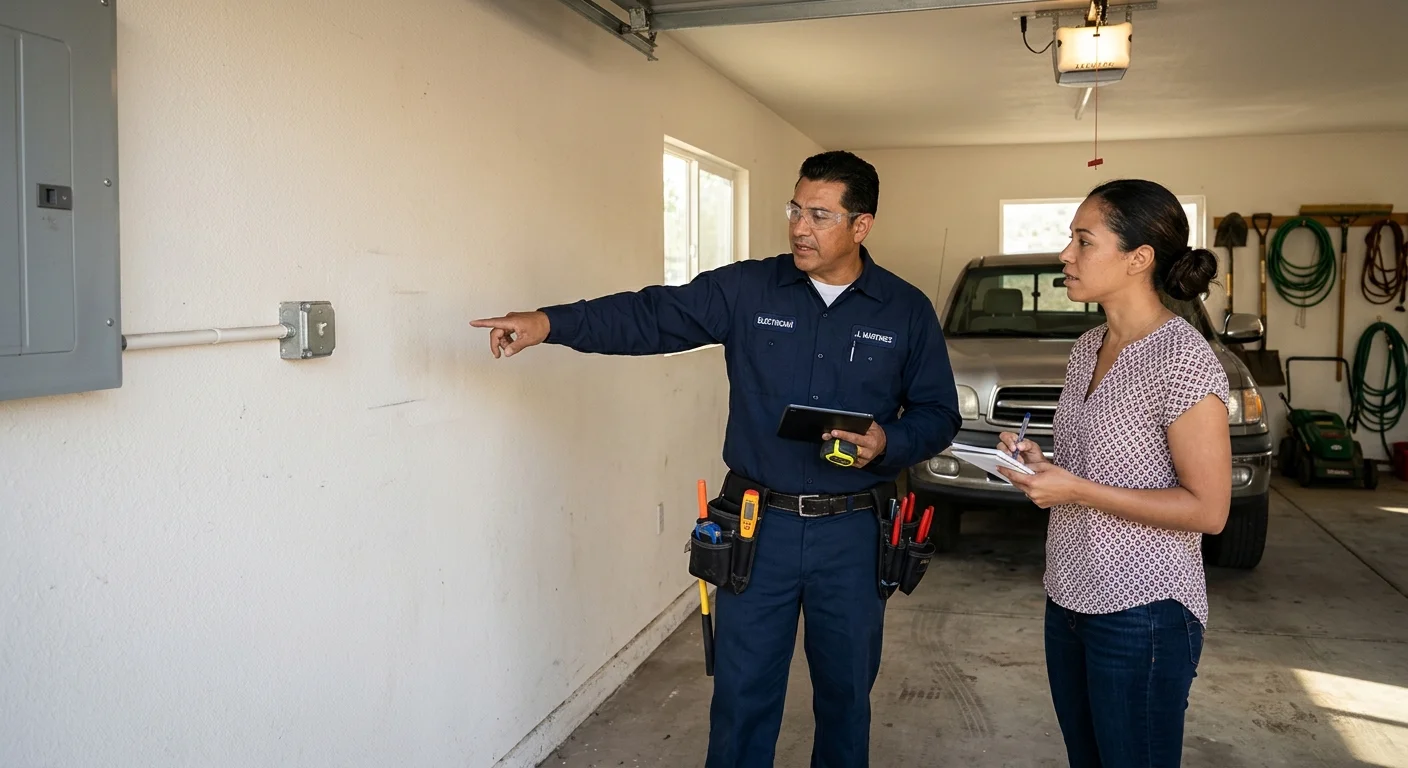
Start at the parking stall. The electrician we connect you with walks from that stall back to the panel. Cable route, wall type, and indoor or outdoor mounting all follow that path.
Fletcher Hills lots often sit on a slope. The garage may sit below the living space, with the panel on a side wall that does not face the car. Downtown El Cajon and older Bostonia blocks still have carports and single-bay garages from the 1950s and 1960s. Ranch houses along Jamacha and toward Rancho San Diego more often have a two-car attached garage. Each layout changes the run.
Write down where the car sleeps on a school night. Note which side the charge port sits on. A wall that looks close on a listing photo can still leave the port on the far fender.
Daily use matters as much as the wall. A short hop to Grossmont or Parkway Plaza is a different overnight need than a round trip toward downtown San Diego. Skip the public charging-speed charts. Use your usual miles, your usual arrival time, and whether a second car will share the stall.
Level 2 home charging is the usual request for daily driving. A 120-volt cord that came with the car can cover light use. A dedicated 240-volt circuit is still the core of most EV charger installation jobs. Every charger does not need a brand-new circuit. An existing 240-volt outlet is only a candidate after a licensed electrician confirms the circuit, the receptacle, and the load. A dryer outlet is not automatically free to share.
If you rent or live in a condo, parking may sit in a common garage. California’s Right to Charge rules can apply when an HOA is involved. The homeowner still pays for the work and the electricity. For a house you own, the parking stall is still the first drawing on the page.
How inland heat and summer AC loads change the plan
El Cajon sits in an inland valley. The marine layer that cools the coast often stops west of the hills. Summer afternoons here run hotter, and the air conditioner runs longer. That cooling load is already on the same service the charger wants.
A Level 2 charger is a continuous load. It can sit on the panel for hours. In East County, those hours often overlap the hours the compressor is already working. Plug in at 5 p.m. after a commute on I-8, and you land in SDG&E’s on-peak window.
For bundled (non-CCA) residential customers on EV-TOU-5, rates effective August 1, 2026 are published on SDG&E’s electric vehicle plans page. Super off-peak is weekdays midnight to 6 a.m. and 10 a.m. to 2 p.m., and weekends midnight to 2 p.m., at 13.1¢ per kWh. Off-peak is weekdays 6 to 10 a.m., 2 to 4 p.m., and 9 p.m. to midnight, plus the matching weekend shoulders, at 49.6¢ per kWh. On-peak is every day 4 p.m. to 9 p.m. at 80.2¢ per kWh.
On-peak is about six times super off-peak. Those figures exclude the monthly residential Base Services Charge. SDG&E does not publish that charge on the EV plans page, so this article does not state one. If your bill shows a community choice aggregator, generation rates differ. Check the bill before you treat these numbers as yours.
A 40-amp Level 2 charger at about 7.7 kW, used nine hours a week, is about 3,600 kWh a year. At 13.1¢ that energy is about $470 a year. At 80.2¢ it is about $2,880 a year. The spread is about $2,400. Those are the published rate inputs applied to that usage sketch, not a promise of your bill.
For an El Cajon ranch that already cools hard from late afternoon through evening, delay charging into super off-peak when you can. A smart charger or the car’s own schedule can do that. Scheduling does not shrink the amps the panel must be able to carry. The electrician still sizes the circuit for the load.
Pool equipment, a second compressor, an electric dryer, and a charger stacked on a 1970s service is a common combination here. The load calculation has to see summer, including a hot stretch in the valley, rather than a mild March afternoon.
What panel capacity can change before a charger is added
About 63% of El Cajon housing units predate 1978, based on Census ACS 2023 figures (the precise share is 62.5%). The peak building decade is 1970 to 1979, with a strong 1950s second wave. That age mix is a real electrical proxy. Federal Pacific Stab-Lok and Zinsco panels, aluminum branch wiring, and ungrounded two-prong circuits concentrate in that stock.
That mix does not prove your panel cannot take a charger. It does mean the electrician should read the bus rating, count spare spaces, and run a load calculation. NEC 220.87 is the standard-practice reference for adding a charger to an existing panel. A leftover breaker slot is not the same as spare capacity.
If the calculation does not fit, options include a panel upgrade in El Cajon, a subpanel, or a load-management device that sheds other loads while the car charges. This site does not publish a market-average price for those paths. Ask for a written scope that separates charger work from service work.
Look at the panel label with the electrician. Note the main breaker size and the manufacturer. If the cover says Federal Pacific or Zinsco, treat replacement as part of the conversation. Our Federal Pacific and Zinsco guide explains why those names matter.
Size the circuit to the vehicle, the stall, and the service you actually have. Some homes take the charger on the existing service. Some need more work first. The visit is what settles it.
If a service upgrade is on the table, SDG&E reviews load and meter location through its service-planning process. No public timeline is posted. Skip any plan that hangs on a promised utility date.
Confirm El Cajon permits and utility steps for the address
El Cajon is an incorporated city. Building Safety issues electrical permits for addresses inside city limits. San Diego County Planning & Development Services covers unincorporated pockets. Some East County homes use an El Cajon mailing address and still sit in the county. Confirm the agency on the actual parcel before anyone files.
City of San Diego fee tables and the county’s unincorporated EV-station fee belong to other jurisdictions. This page could not confirm El Cajon’s current charger permit fee from the approved claims ledger. Ask Building Safety, or have the electrician who will pull the permit quote that line from the city’s schedule.
Electrical work of this kind belongs with a licensed contractor. Check the license on the CSLB lookup before you sign. A C-10 classification covers installing and connecting electrical equipment. A license is not a guarantee of workmanship or insurance. Ask for the written scope, who pulls the permit, and proof of insurance.
Countywide permit context lives on our EV charger permit in San Diego guide. That page does not replace El Cajon Building Safety. Inspection, if required, is scheduled with the same office that issued the permit. Keep the work accessible until it passes.
HOA or condo parking adds Civil Code 4745. The homeowner uses a licensed contractor, pays for installation and electricity, and must keep a liability policy. If the board does not deny the application in writing within 60 days, the application is deemed approved. The board can still deny in writing and can still set reasonable conditions. Since January 1, 2026, SB 770 removed the extra rule that the policy name the association as an additional insured. The liability policy, the 14-day certificate, and the annual certificate still apply.
If the electrician finds that SDG&E must enlarge service, that utility step is separate from the city permit. The contractor typically handles the interconnection paperwork.
What to compare in charger installation proposals
Ask for the same scope on every bid. CSLB recommends at least three written bids on the same plans. A much cheaper number is a reason to ask what was left out.
Compare parking stall and mounting location, indoor or outdoor. Compare the load calculation and whether summer air conditioning is in the model. Compare panel findings, including manufacturer and spare capacity. Confirm whether a new circuit is actually required. Confirm the permit agency is El Cajon Building Safety or County PDS, matching the address. Confirm who applies for the permit and who meets the inspector.
Hardwired versus plug-in should follow the equipment listing. Ask how charging will be scheduled on EV-TOU-5 so on-peak hours are avoided when you can. Warranty on the work belongs to the electrician’s business, in writing. Bright Pro Electric is a referral service. We do not warrant the install, and the matched electrician pulls the permit.
For a countywide cost picture, read EV charger installation cost in San Diego. Treat that page as county context. Run length, wall finish, panel work, and outdoor hardware change the job on this side of the county.
Verify the business name and classification on CSLB. The license belongs to the business entity. Ask which licensed company is on the contract, and how the crew on site relates to that company.
Skip any bid that files El Cajon work as a City of San Diego permit, quotes a county unincorporated fee for a city lot, or skips the load calculation. Those proposals were written for a different map.
Frequently asked questions
Do I need a permit to install an EV charger in El Cajon?
El Cajon Building Safety is the authority inside city limits. County PDS is the authority in unincorporated areas. Confirm which one governs your parcel. This article does not state a city fee. A licensed electrician should tell you whether the scope needs a permit before work starts.
How much does home EV charger installation cost?
There is no verified El Cajon market average in the claims we can publish, so this page does not invent one. Use the San Diego cost guide for county context, then compare written scopes for your stall and panel.
Does my electrical panel need an upgrade first?
Only a load calculation on your service answers that. Older El Cajon housing makes the question more common. An upgrade is still a house-by-house finding.
When to call us
Call when you want a Level 2 charger planned around an El Cajon stall, an inland summer load, and the right permit office. The electricians we connect you with assess the panel and perform the installation. Call us at (858) 988-5580 and we’ll connect you with a licensed local electrician.