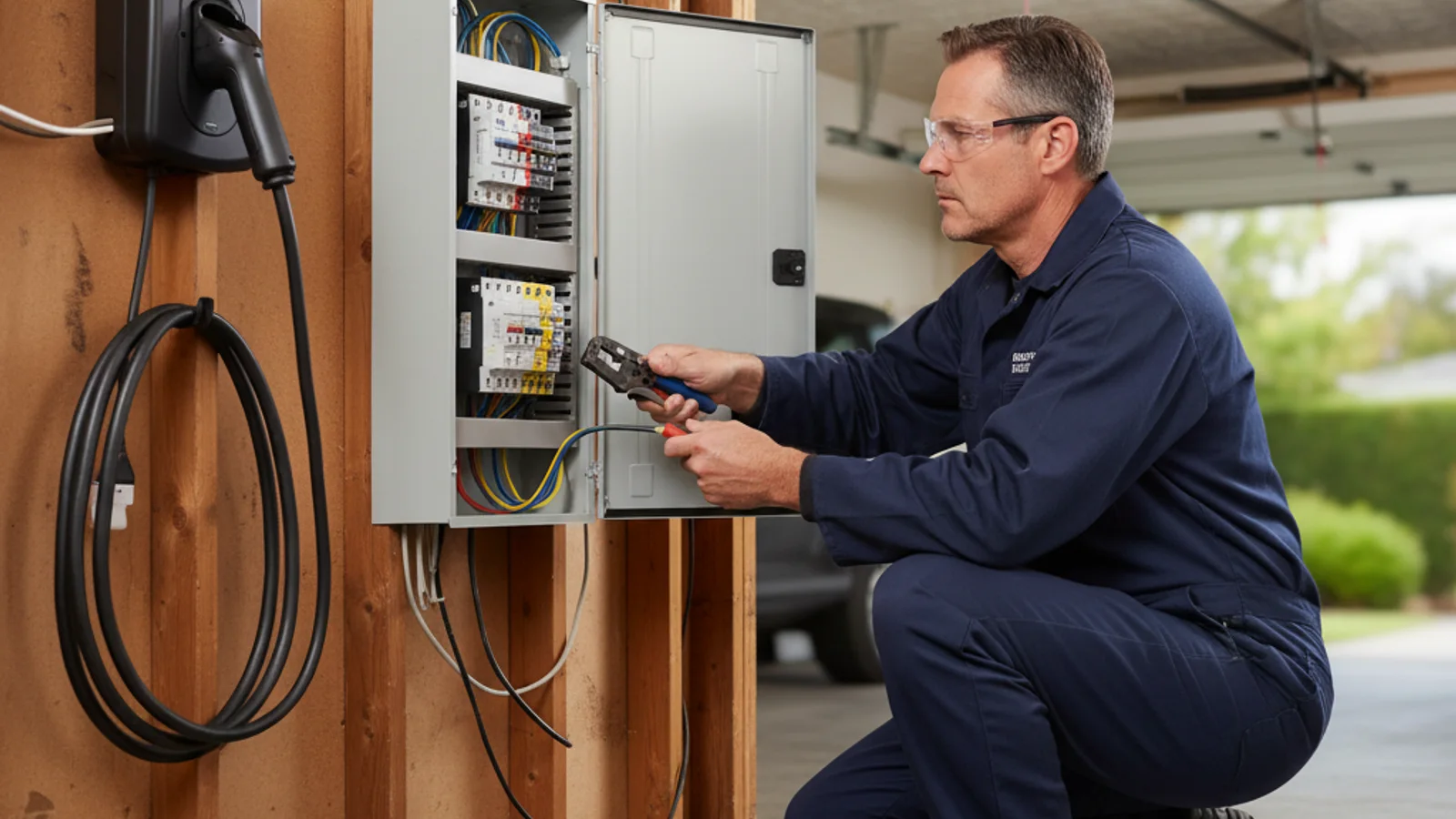
Spring Valley’s housing stock tells the story of east-county San Diego development: hillside tracts built decades ago, a dense rental inventory, and a community that runs practical rather than precious. For an electrician, that means a steady stream of insurance-driven panel replacements, aluminum wiring remediation, and 200-amp service upgrades on homes that have been carrying the same 60 or 100-amp panels since the Eisenhower administration. If you own or rent in Spring Valley and need electrical work done, here’s what to expect.
What Spring Valley homeowners pay for common jobs
Costs in Spring Valley track close to the county average, but the age of the housing stock means scope tends to be heavier than a newer neighborhood. A lot of projects that look like single-line items end up uncovering additional work once the panel is open.
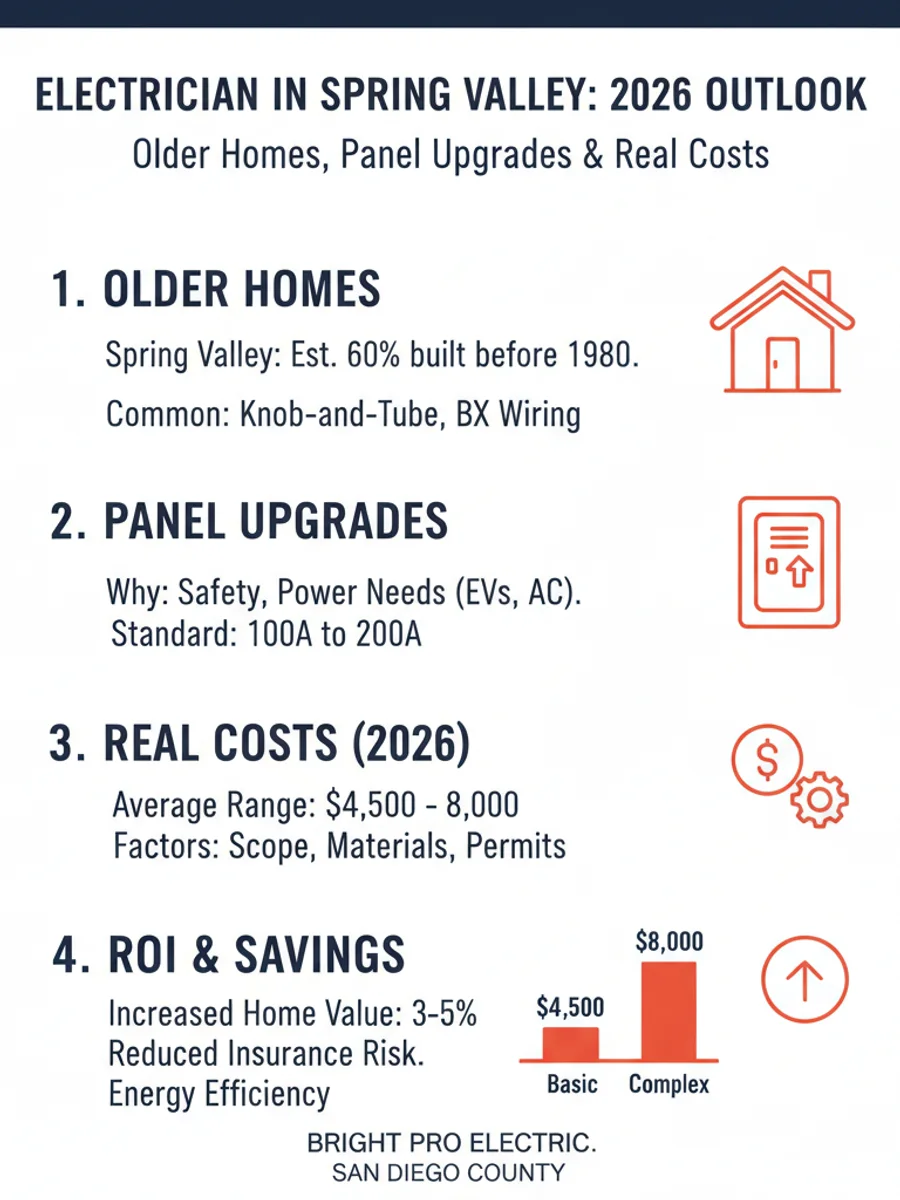
- Panel replacement (Federal Pacific or Zinsco, existing 100-amp service): $2,200 to $3,200, including permit, new Square D or Eaton main breaker panel, and reconnection of existing circuits.
- 200-amp service upgrade with new panel: $2,800 to $4,200, including SDG&E coordination, new service entrance conductors, meter base work if needed, and permit.
- Aluminum wiring remediation (COPALUM crimp method): $1,800 to $3,500 for a typical 3-bedroom home, depending on circuit count.
- GFCI and AFCI retrofit (whole-home, older panel): $600 to $1,400.
- EV charger install on existing 200-amp panel with capacity: $800 to $1,400 for a dedicated 50A circuit and Level 2 charger.
- Panel upgrade plus EV charger (combined scope): $4,000 to $5,600.
If you want a broader look at how these numbers compare county-wide, the electrical panel replacement cost guide has detailed breakdowns. For an overview of full-service upgrade pricing, panel upgrade costs in 2026 is worth reading.
The Federal Pacific and Zinsco panel problem
This is the most urgent issue in Spring Valley. Both Federal Pacific Stab-Lok panels and Zinsco panels have a documented failure mode: the breakers can fail to trip during an overcurrent event. That means a circuit carrying too much load doesn’t get interrupted, heat builds in the wiring, and the fire risk becomes real. It’s not a theoretical problem.
Most California homeowners insurance carriers have caught up to this. If your Spring Valley home has either panel, there’s a reasonable chance your insurer has already flagged it, or will when you renew. The common outcomes are non-renewal, required replacement as a condition of continued coverage, or a steep surcharge. If your insurance company has sent you a letter about your panel, that’s what’s happening.
Replacement typically takes one day. The electrician pulls the permit, swaps to a modern Square D, Eaton, or Siemens panel, moves existing circuits, adds AFCI and GFCI breakers where current code requires, and provides written documentation the insurance carrier can use for the renewal file. Ask your carrier what they require. A page cannot promise the policy will renew.
Aluminum wiring in Spring Valley’s 1965-73 homes
The pocket of Spring Valley built between roughly 1965 and 1973 often has aluminum branch-circuit wiring. Builders used aluminum during that period because copper prices spiked. The wiring itself isn’t inherently bad, but aluminum expands and contracts more than copper, and over decades that movement loosens the connections at outlets, switches, and fixtures. Loose connections generate heat, and heat at a connection is where electrical fires start.
The correct remediation is COPALUM crimping. A licensed electrician uses a special tool to crimp a short copper pigtail onto each aluminum wire end at each device location, creating a permanent copper-to-aluminum connection that doesn’t loosen over time. It’s the method the Consumer Product Safety Commission endorses. Some contractors offer AlumiConn connectors as an alternative; independent licensed electricians use COPALUM because the long-term track record is better.
A typical Spring Valley 3-bedroom with aluminum branch wiring runs about 25 to 35 device locations. Budget $1,800 to $3,500 for the full remediation depending on access and circuit count. You can read more about how aluminum wiring behaves in San Diego’s climate in the aluminum wiring repair guide.
Permits in Spring Valley: County of San Diego, not a city
This is one of the practical differences between Spring Valley and cities like La Mesa or El Cajon. Spring Valley is an unincorporated community. It doesn’t have its own city permit office. Electrical permits here go through the County of San Diego Planning and Development Services, not a city building counter.
That matters because the process and timeline are different from what you’d experience in an incorporated city. County permits for standard residential electrical work typically take two to five business days for approval, sometimes faster. Inspections are scheduled through the county’s system. The licensed electrician runs the permit, including application, documentation, and scheduling the inspection walkthrough.
One thing to know: work done without a permit in an unincorporated area creates title problems. When the property eventually sells, the appraiser or buyer’s inspector finds unpermitted work and it either needs to be demolished, retrofitted, or permitted after-the-fact at a higher cost and with more scrutiny. Permits exist to protect the homeowner as much as anything else.
What Spring Valley’s older homes actually need
If you own a Spring Valley home built before 1975, here’s a realistic assessment of what’s worth addressing versus what can wait.
The non-negotiables if you have them: a Federal Pacific or Zinsco panel needs to go, regardless of insurance pressure. Aluminum branch wiring with no prior remediation needs COPALUM crimping. Ungrounded two-prong outlets throughout the house are a code and safety problem, especially in kitchens, bathrooms, and garage.
The practical upgrades worth planning: a panel upgrade to 200-amp service if you’re still on 60 or 100 amps, particularly if you’re adding an EV charger or running a home office. AFCI breakers on bedroom circuits if your panel is being replaced anyway. GFCI protection at all wet-area locations.
What can often wait: fixtures, switches, and outlets that work fine and aren’t in hazard-prone locations. Cosmetic wiring work. Adding circuits for convenience rather than capacity.
If you’re buying a home in Spring Valley and want to understand what you’re getting into before closing, the electrical troubleshooting service page explains what a pre-purchase electrical inspection covers.
Multi-generational housing and rental property scope
Spring Valley has a high proportion of multi-generational households and rental properties. Both drive a specific type of electrical work that’s different from a standard single-family owner project.
For multi-generational setups with converted garages or bonus-room additions, the right scope almost always includes a permitted sub-panel install in the converted space, dedicated 240V circuits for a second kitchen range or laundry, and proper bonding and grounding throughout the new living area. Doing this without permits creates the title problem described above, plus it’s genuinely unsafe to run a full second-kitchen load off an extension cord or overtaxed circuit.
For rental property turnover, the weekly volume in Spring Valley is consistent. Between tenants, independent licensed electricians handle kitchen, bathroom, garage, and outdoor GFCI replacement to current code, AFCI breaker addition where current code requires it, smoke and CO detector hardwiring per current standards, and cover-plate compliance. They coordinate with property managers for access and provide written documentation for the property management file.
For a broader look at whole-home rewiring scope, the whole-home rewiring service page has a useful overview of when rewire becomes the right call versus targeted remediation.
Frequently asked questions
My Spring Valley insurer says I need to replace my Federal Pacific panel to renew my policy. How fast can this happen?
Most panel replacements in Spring Valley are a one-day job for the electrician: county permit, the swap, inspection, and paperwork the carrier asked for. Timeline is that electrician’s and the county’s. Bright Pro does not compress it for a renewal deadline. Ask your carrier what they require. A page cannot promise the policy will renew.
I have aluminum wiring. Do I need to rewire the whole house?
Not usually. COPALUM crimp remediation at every device location is the accepted solution, and it is significantly less expensive than a full rewire. Full rewire makes sense when you are also dealing with a Federal Pacific panel, undersized service, and other systemic issues at once. The electrician quotes that comparison. Bright Pro does not.
Do I need a permit for panel replacement in Spring Valley?
Yes. Panel replacement requires a permit through the County of San Diego Planning and Development Services. Independent licensed electricians handle the permit application, inspection scheduling, and the county documentation. You don’t need to do anything except be available for the inspection.
How much does a 200-amp upgrade cost if I also want an EV charger?
Combined scope for a 200-amp service upgrade, new main panel, AFCI and GFCI breaker coverage, dedicated 50A EV circuit, Level 2 charger install, permit, SDG&E coordination, and rebate paperwork typically runs $4,000 to $5,600 in Spring Valley. Doing both as one project is meaningfully cheaper than two separate contracts.
My Spring Valley home has two-prong outlets throughout. Is that a problem?
Ungrounded two-prong outlets are a real limitation, not just cosmetic. Modern electronics and appliances expect a ground. Without it, you get no surge protection path and no GFCI protection on ungrounded circuits. The full fix is running a ground conductor back to the panel. A partial code-compliant fix is GFCI outlets or GFCI breakers with “No Equipment Ground” labels. The electrician walks both options. Bright Pro does not.
If your Spring Valley home has an older panel, aluminum wiring, or you are planning an EV charger that needs a service upgrade, use contact. Coverage includes Spring Valley and nearby east-county communities. Quote timing is the electrician’s.