You shut off the breaker marked kitchen, and the hallway lights die instead. The card on your breaker panel still lists a garage freezer that left with the last remodel. Those labels no longer match the house, and a licensed electrician should sort the directory before anyone guesses at the next switch.
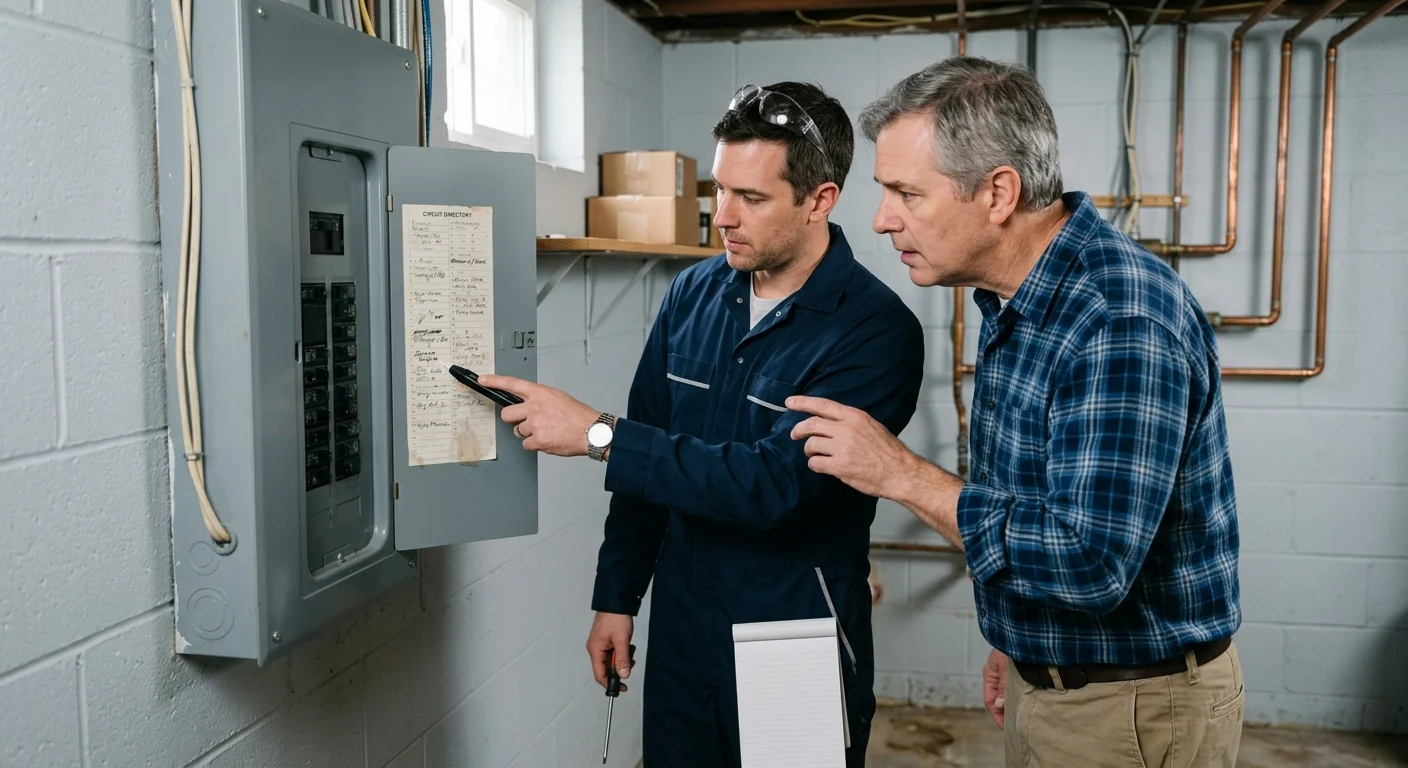
Start with which labels appear wrong or incomplete
The first useful step is naming what looks wrong. You don’t need to prove which wire goes where. You only need to describe the mismatch on a mislabeled electrical panel.
Blank slots are common. So are faded pencil marks. Some cards list two kitchens and no bathrooms. Others stamp lights on four breakers with no room names.
A label can be complete and still be false. The breaker marked A/C may feed a bedroom added years later. A 240-volt slot may still say dryer after laundry moved upstairs. Marker on the cover can disagree with the paper card behind it.
East County leftover labels show up for a reason. In El Cajon, 62.5% of housing units predate 1978. Lemon Grove is 69%, and La Mesa is 68.7%. Those decades are where Federal Pacific Stab-Lok and Zinsco panels, aluminum branch wiring, and ungrounded two-prong circuits concentrate. Encinitas is 45% pre-1978. Carlsbad is 27.5%, and San Marcos is 23.8%, with more 2000s construction. Newer tracts still pick up unlabeled circuits after kitchen work, ADUs, and chargers.
Clairemont and North Park have plenty of mid-century houses too. Census doesn’t publish a place-level figure we can quote for those neighborhoods, so treat the age as a local pattern, not a percentage.
If you also notice a burning odor, a discolored switch, or a warm outlet, stop using the affected equipment. Don’t touch it to test temperature. That’s a hazard sign, not a labeling puzzle.
Why homeowners shouldn’t map circuits through risky testing
A messy directory tempts people to map the house by flipping breakers one by one. Skip that.
Cycling unrelated breakers isn’t a safe diagnostic test. It can drop a refrigerator, medical gear, or a home office mid-save. It also doesn’t prove the only problem is a bad sticker. If a breaker has already tripped, unplug appliances on that circuit if you can reach them safely. Don’t use resets to hunt for rooms.
Don’t remove the screwed-on panel cover. Don’t take off outlet faceplates to peek at wires. Don’t put test probes into a receptacle. A dead lamp isn’t proof the wiring is de-energized.
Stay away from water around the panel or any outlet. Don’t handle equipment with wet hands. If you see smoke, sparks, or fire, leave the house and call 911 from a safe place. City of San Diego Fire-Rescue says to leave immediately for fire or smoke and not re-enter.
The Electrical Safety Foundation International lists frequent trips, flickering lights, arcs, buzzing, a hot-insulation odor, hot or discolored covers, shocks, and damaged insulation as warning signs that need a licensed electrician. None of those should wait for a weekend labeling project.
SDG&E says only qualified people should repair or maintain electrical equipment. The electrician we connect you with is that person. Your job is to note what you already saw: which label looks wrong, which room went dark by accident, and whether neighbors lost power too. That note sheet helps. A homemade circuit map doesn’t.
What an electrician checks before changing the directory
Before anyone rewrites the card, the electrician should decide whether the directory is the only problem.
They start with what you can already see. That means the closed panel, the existing labels, and the rooms that don’t match. They look for the same warning signs you wouldn’t touch. They ask what changed in the house. A new ADU, a heat pump, a Level 2 charger, or a garage conversion often explains a blank or leftover name.
Then they identify circuits as licensed electrical work. California’s C-10 class covers placing, installing, and connecting electrical wires, fixtures, appliances, raceways, and associated equipment. A license doesn’t guarantee workmanship, insurance, permit approval, or experience with this exact panel. It does mean this isn’t a sticker job for someone advertising contractor services without the right classification.
The electrician shouldn’t rebuild the directory from memory or from your last guess. They confirm which breaker feeds which load, then write a card that matches that confirmation. If they find mixed wiring or equipment that belongs in a replacement talk, the directory waits. The map is the last step, not the first.
Ask for findings in writing. Ask which licensed business holds the contract. A contractor license belongs to the business entity, not every person on site. Check the number on the CSLB license lookup before you approve a rewrite that might turn into larger repairs.
When additions and remodels broaden the assessment
Label errors cluster after the house grows.
East County ranches in El Cajon often picked up shop circuits and kitchen additions on panels that never got a new card. Coastal Encinitas is a different house. Remodels there more often add EV charging, induction ranges, and ADUs onto panels that looked fine at purchase. Chula Vista sits between those stories, with 40.8% of units pre-1978 and newer work that still needs a real directory after a garage conversion.
If the visit is really about adding load, not stickers, the electrician may need a load calculation. NEC 220.87 is the standard-practice reference for adding an EV charger to an existing panel. No published number comes with that citation. The point is assessment, not a worksheet you fill out at the panel.
Permits follow the work, not the label. In the City of San Diego, electrical installation, alteration, addition, or replacement needs an electrical permit unless San Diego Municipal Code 129.0303 exempts that exact scope. Adding circuits and relocating outlets appear as Simple No-Plan examples on the City’s electrical permit page. No-Plan still means a permit. Authorized California-licensed contractors or property owners and lessees can obtain those permits. Don’t assume only a C-10 can pull every permit. Don’t assume a C-10 is optional either.
That City rule doesn’t travel. El Cajon Building Safety, Chula Vista Utility Permits, Poway Building Services, and County Planning & Development Services each run their own counter. Unincorporated places such as Ramona, Lakeside, Fallbrook, Alpine, and Bonsall go through the County. Confirm the agency for the address, not the mailing city.
A statewide rule that every directory rewrite needs a permit, or that none does, could not be confirmed from the claims we can publish. Ask the electrician and the department that actually issues permits for that address.
How labeling work differs from a panel upgrade
Correcting a directory isn’t a panel upgrade.
A label job tries to make the existing breaker panel readable. An upgrade changes capacity, equipment, or both. If the electrician finds an obsolete panel type, damaged equipment, or no room for a needed circuit, the conversation shifts. Our Electrical Panel Upgrades page is the service path for that work. The electrician we send performs it. Bright Pro Electric matches you with that pro. We don’t do the install.
San Diego County isn’t one housing market for this decision. A 1970s El Cajon service may already be tight after a heat-pump water heater. A 2000s San Marcos panel may only need an honest card after a lighting remodel. Read the 200-amp electrical panel guide when capacity is the question. Use when to upgrade an electrical panel when the visit uncovers more than stickers.
If someone quotes an upgrade during a labeling visit, ask them to separate the directory work from the replacement. You want to see which problem they actually found.
What to compare in an inspection proposal
Ask for a written proposal that names the task of hiring an electrician to label a breaker panel, inspect it, or both.
A whole-house electrical safety inspection in San Diego typically runs $150 to $300. That is this site’s published range for a full-panel, whole-house safety walkthrough, not a third-party statistic. A short directory-only visit may be narrower. We don’t publish a labeling fee, because contractor pricing varies and no government source sets it. Confirm the number on the written quote.
The Contractors State License Board recommends at least three written bids on the same scope. A much cheaper bid deserves a question about missing work. It isn’t proof of illegal work by itself.
Compare these items, not slogans. What will they inspect, and what will they leave alone. Whether they will produce a confirmed directory or only advice. Who holds the license. Who pulls a permit if they find alteration work. Insurance evidence, checked with the carrier, because a license isn’t a policy. Warranty terms on any repairs, which belong to the electrician, not to Bright Pro Electric.
Keep a simple table: the mismatch you noticed, the electrician’s note, who owns the fix, and the result after the visit. Contractor-complete isn’t the same as a city inspection approval. If a City of San Diego permit is in play, approval is recorded on an inspection record, approved plans, or a door-hanger card. County jobs use County PDS tools instead. Don’t mix those processes.
When to call us
If the directory on your breaker panel no longer matches the house, stop mapping it yourself. The licensed electricians we connect you with can identify circuits, flag hazards, and tell you whether you need a new card, a repair, or a panel upgrade. Use the contact page and we’ll connect you with a licensed local electrician.