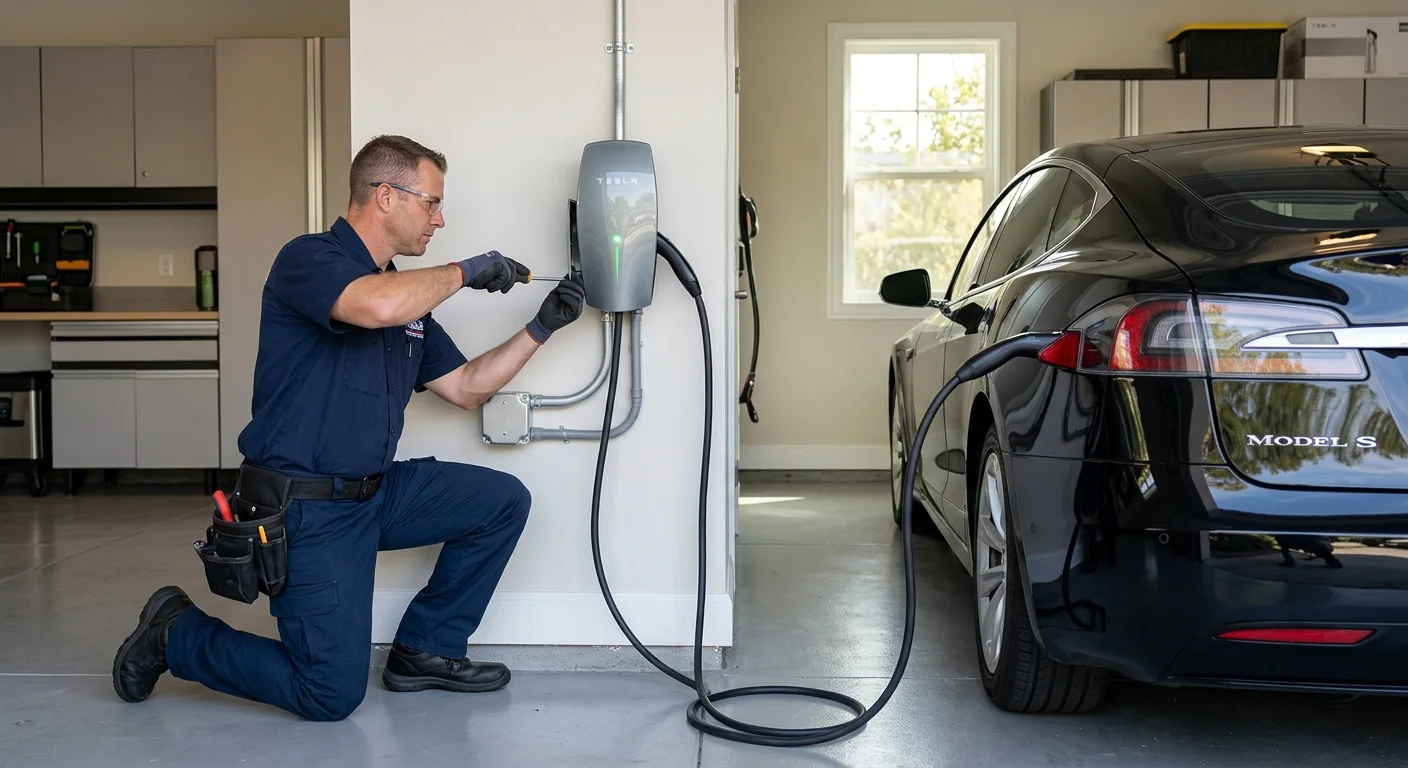
EV charger installation in Oceanside costs $400 to $2,500, and in this city the number that decides where you land is usually distance, not panel size. Oceanside has more detached garages and longer conduit runs than most of San Diego County, and that geography shows up directly in the quote.
TL;DR
- Attached garage, panel within 15 ft: $400-$850.
- Detached garage or a 40-80 ft run, common in older beach-area Oceanside homes: $1,100-$2,500.
- Panel upgrade required first: add $2,500-$4,500.
- Federal 30C tax credit covers 30% of install cost, up to $1,000, for eligible addresses.
- SDG&E Power Your Drive can offset $500 or more.
- Coastal salt air is a real factor here; conduit and connector material choice matters more near the water.
Why Oceanside quotes skew toward the higher end
Oceanside’s older beach-area neighborhoods, the streets closest to the pier and along Coast Highway, were built with detached garages sitting well away from the house, often with the electrical panel on the opposite side of the property. That layout is charming and completely impractical for a short EV charger run. A 40-80 foot conduit path, sometimes crossing a driveway or a section of yard, is the norm rather than the exception in these blocks.
Further inland toward San Luis Rey and around College Boulevard, the housing stock skews newer with more attached garages, which pulls the cost down toward the lower end of the range. Oceanside genuinely has both scenarios in play, more so than most San Diego cities, which is why getting a load calculation and a site visit before assuming a price matters here.
Cost table: three Oceanside scenarios
| Scenario | Cost |
|---|---|
| Attached garage, panel within 15 ft, room on the panel | $400-$850 |
| Detached garage, 40-80 ft run, or trenching (common in older coastal blocks) | $1,100-$2,500 |
| Panel upgrade needed first (100A to 200A) | add $2,500-$4,500 |
| Oceanside permit fee | set by the city’s building division |
The detached-garage row is where Oceanside differs most from inland cities. Trenching under a driveway or running conduit along a fence line adds labor hours a straightforward attached-garage job never sees. Underground PVC conduit is usually the more economical route for these runs compared to surface conduit that would otherwise sit exposed to salt air for years.
Salt air and conduit choice near the coast
This is worth calling out specifically for Oceanside. Homes within a mile or two of the coast see accelerated corrosion on exposed outdoor electrical components, older panels, connectors, and any conduit that wasn’t rated for it. If your electrician recommends PVC conduit or corrosion-resistant fittings for an outdoor run instead of standard EMT, that’s not an upsell. It’s the material choice that keeps the install from needing repair work in five years instead of twenty.
Older coastal panels themselves sometimes show this wear too, corroded lugs or a panel enclosure that’s seen better days. If that’s the case at your address, the electrician doing your EV charger load calculation will flag it, and it may factor into whether a panel upgrade makes sense to bundle in now rather than later.
The federal 30C tax credit and SDG&E rebate
The federal 30C tax credit covers 30% of your total EV charger install cost, up to $1,000, for eligible residential addresses, based on census tract. That applies to labor, permit, and materials together, not just the charger hardware. Save every line-item receipt for tax time.
SDG&E’s Power Your Drive program can add $500 or more on top for qualifying customers, though program terms and dollar amounts shift year to year, so confirm current details directly with SDG&E before assuming a figure. Our SDG&E EV charger rebate guide for 2026 and our 30C tax credit breakdown cover how to stack both. One important note for rebate eligibility across the board: the work needs to be permitted and done by a licensed contractor.
The Oceanside permit step
Oceanside’s building division sets its own permit fee schedule, separate from the City of San Diego. Rather than quote a number we can’t verify, the reliable answer is that your electrician handles the application and knows the current fee when they price your job. What holds true countywide is that any new 240V circuit for an EV charger requires a permit, and the inspection checks breaker size, wire gauge, and GFCI protection before you’re cleared to charge.
If a panel upgrade is part of your project, expect that to run through its own permit alongside the charger circuit, typically coordinated as one project by your electrician.
Getting an accurate number for your address
Because Oceanside spans both tight coastal lots with detached garages and newer inland construction with attached garages and modern panels, a phone quote here is close to a guess. A load calculation and a look at the actual run from panel to parking spot tells you which row of the cost table applies to your home.
For install approach, hardwired versus plug-in chargers, and how to read a quote line by line, our complete San Diego EV charger installation guide covers that in full. This page is about the Oceanside cost picture specifically. For the service itself, see our EV charger installation page, or start with our Oceanside electrician page if you’re not sure which service you need yet.
Frequently asked questions
How much does EV charger installation cost in Oceanside?
Most homes fall between $400 and $2,500. Attached garages with an available panel slot run $400-$850. Detached garages or longer runs, common in Oceanside’s older coastal blocks, run $1,100-$2,500. A required panel upgrade adds $2,500-$4,500 on top.
Why are Oceanside quotes often higher than other San Diego cities?
Oceanside has a higher share of detached garages and longer panel-to-garage distances, especially in the older neighborhoods near the coast. Trenching or a longer conduit run adds labor and materials that a straightforward attached-garage job doesn’t need.
Does salt air actually affect an EV charger installation?
Yes, for outdoor conduit and connectors specifically. Homes near the coast see faster corrosion on exposed electrical components, so an electrician may recommend PVC conduit or corrosion-resistant fittings for outdoor runs instead of standard materials. It costs a little more upfront and saves a repair later.
Do I qualify for the federal tax credit and the SDG&E rebate at the same time?
Often, yes, they’re separate programs. The federal 30C credit is based on your address’s census tract and covers 30% of install cost up to $1,000. SDG&E’s Power Your Drive rebate has its own eligibility rules and can add $500 or more. Confirm both directly since terms change.
Is a permit required for an EV charger in Oceanside?
Yes. Oceanside’s building division requires a permit for any new 240V circuit, and skipping it can also disqualify you from rebate programs that require permitted, licensed work.
When to call us
Oceanside’s mix of detached garages, older coastal panels, and newer inland homes means the right number for your address depends on seeing the actual layout. Bright Pro Electric matches Oceanside homeowners with independent licensed electricians. Use contact. Leave a message any time. Same-day estimates are not guaranteed.