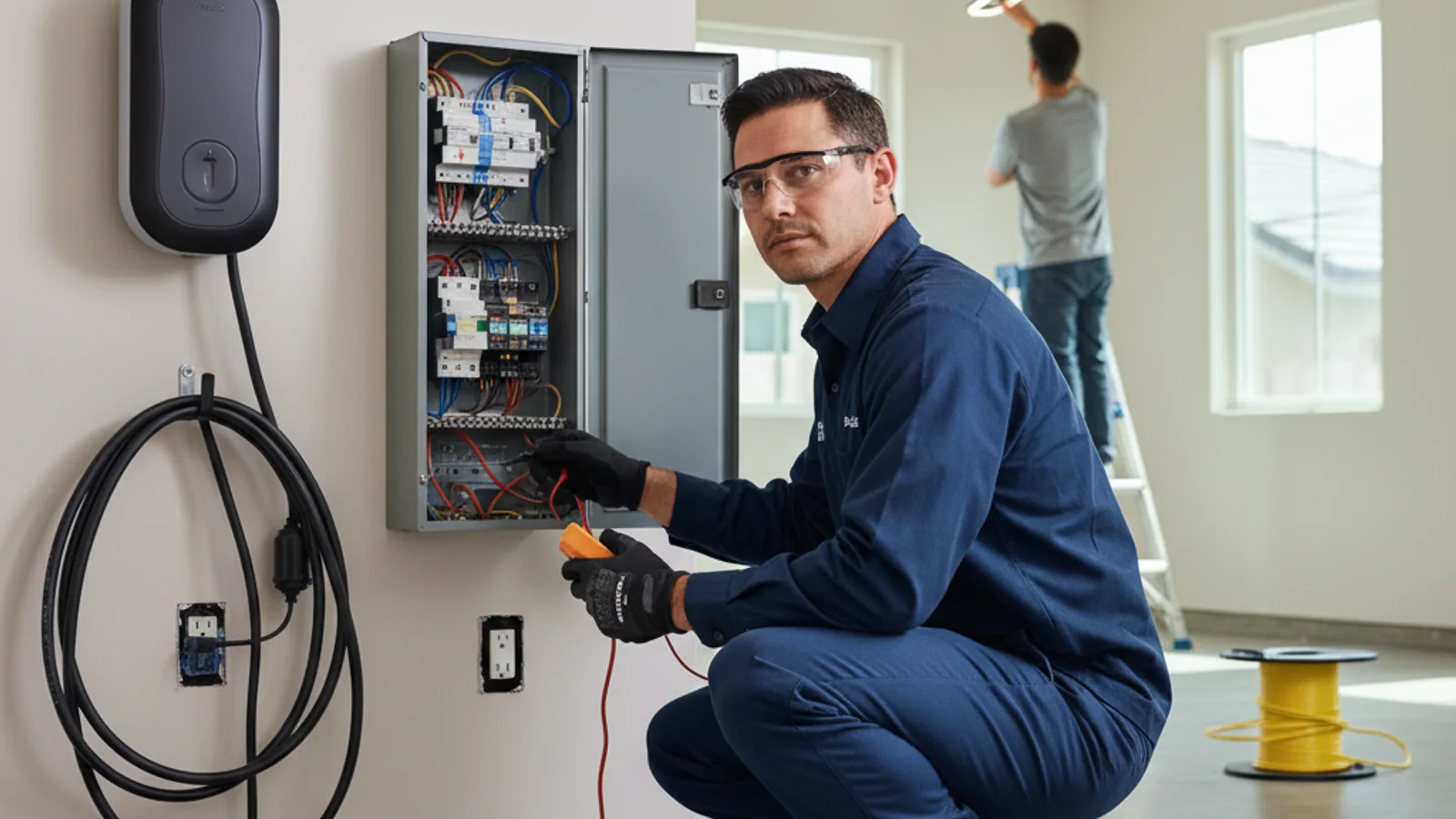
Rancho Bernardo is one of San Diego’s most established communities, built largely between the 1960s and 1990s as a master-planned residential destination. That means a lot of the original electrical infrastructure is now at or past replacement age. Whether you’re in Oaks North dealing with an overloaded 100-amp panel, in Westwood adding a Level 2 charger for a new EV, or navigating HOA architectural review for a service equipment relocation, knowing what to expect from an electrician in Rancho Bernardo helps you move through the project faster and with fewer surprises.
Common jobs and what they cost in RB
Most of what independent licensed electricians handle in Rancho Bernardo falls into a handful of categories. Typical 2026 pricing for common projects:
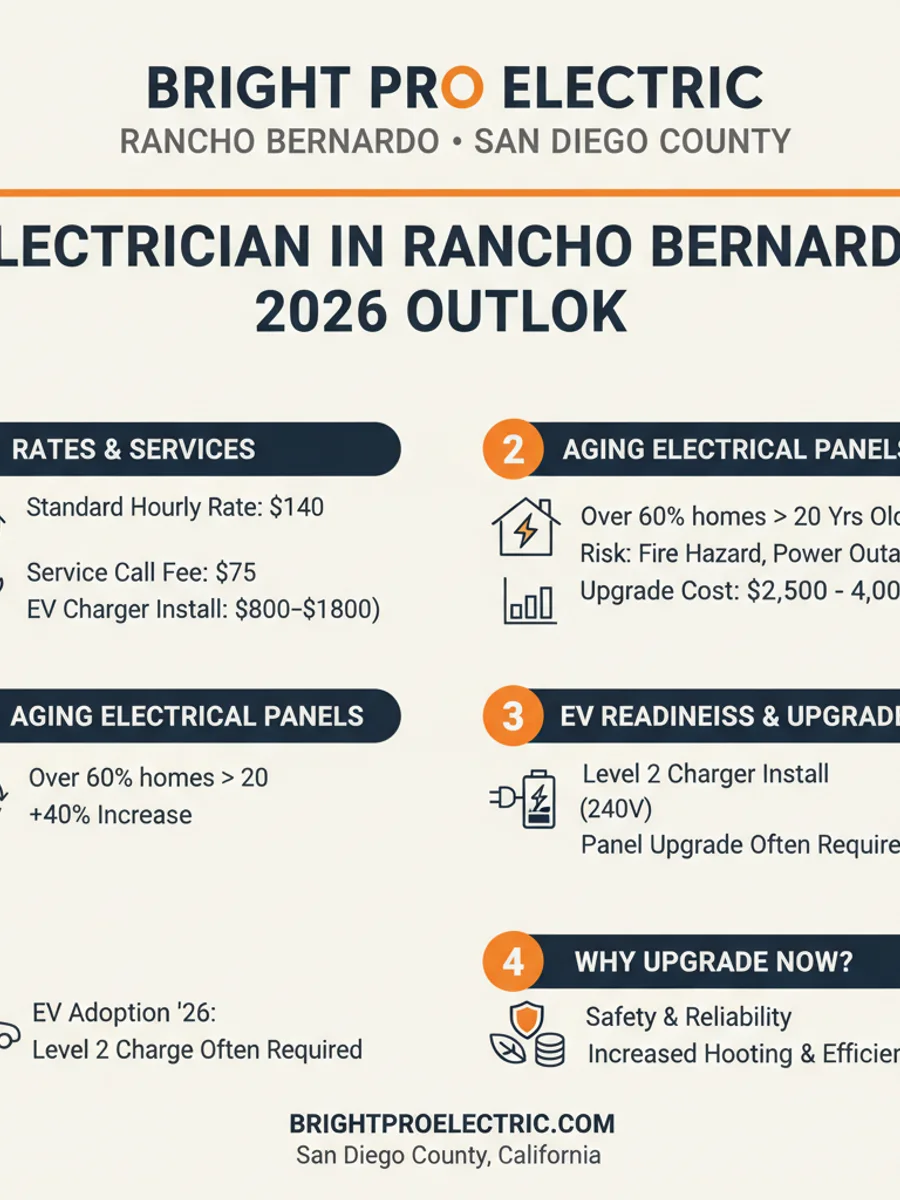
- 200-amp service upgrade: $2,800 to $4,500. This is the most frequent project type in the community, particularly in Oaks North homes still on original 100-amp or 125-amp service.
- Federal Pacific or Zinsco panel replacement: $2,500 to $4,200. Includes permit, inspection, and proper disposal of the hazardous equipment.
- Level 2 EV charger installation: $800 to $2,200, depending on panel capacity, conduit run length, and whether a sub-panel or service upgrade is required first.
- Dedicated 240V circuit for heat pump or HVAC: $650 to $1,400, depending on distance from panel and conduit requirements.
- AFCI and GFCI breaker retrofit: $1,200 to $2,800 to bring an older panel up to current NEC standards across all required circuits.
- Standby generator install (14-22kW with natural gas): $9,500 to $18,000. Natural gas infrastructure is available throughout most of RB, which keeps install cost below propane equivalents.
These ranges reflect current San Diego County labor rates and materials cost. Your actual quote depends on the specific panel location, available breaker space, conduit routing complexity, and HOA requirements. For a broader county-level view of what electrical work costs, see our San Diego panel upgrade cost guide.
Aging service panels: the RB situation
The most pressing electrical concern in Rancho Bernardo isn’t complex wiring or unusual load profiles. It’s simple age. Homes built decades ago across Oaks North, Westwood, and The Trails were typically equipped with 100-amp or 125-amp service panels sized for the appliance loads of the era.
Some of those panels are Federal Pacific Electric (FPE) Stab-Lok equipment. FPE panels have a documented failure mode: the breakers can fail to trip during an overcurrent event, allowing wires to overheat without the circuit ever going dark. This isn’t a repair situation. Any FPE panel in an RB home should be replaced. If you’re not certain what brand your panel is, look at the breaker faces. Stab-Lok breakers have a distinctive tab-style design. For a full breakdown of why these panels are a problem, see our post on Federal Pacific and Zinsco panel replacement.
Beyond specific hazardous brands, any panel more than 35-40 years old is worth a professional inspection. Bus bars corrode. Connections loosen. The panel box itself can develop rust or water intrusion, especially on north-facing exterior walls. Combine that wear with modern household load, including central AC, EV charging, and modern appliances, and what was a functioning system in 1985 can become a liability today.
An electrical panel upgrade to a modern 200-amp panel with current AFCI and GFCI breaker coverage is typically the correct answer for most original-era Oaks North and Westwood homes.
EV charger installation, solar interconnection, and load management
Rancho Bernardo has strong EV adoption, particularly in the active-adult communities and among the 4S Ranch and Bernardo Heights households. Most EV charger installs start with a load calculation.
The NEC 220.87 load calc looks at your existing service capacity, current load, and the proposed EV circuit demand. For homes on original 100-amp service, the math almost always comes out in favor of a combined panel upgrade and EV install rather than squeezing a Level 2 charger onto an already-loaded system. The combined project typically runs $3,800 to $5,500 for a 200-amp service upgrade plus Level 2 EV charger install.
Solar interconnection adds another layer of coordination. RB has meaningful solar penetration, and most solar-plus-EV projects require careful backfeed breaker placement, proper load side vs. supply side interconnection, and confirmation that the combined generation and EV load won’t exceed service capacity. For a detailed breakdown of what this coordination looks like, see our post on EV charger installs and panel upgrade bottlenecks in San Diego.
Smart panel options, specifically Span and Lumin units, are worth considering for RB households combining solar, battery backup, and EV charging. These panels give circuit-level load monitoring and priority controls, useful if medical equipment is on the list. The electrician walks through smart-panel options when that is the scope. Bright Pro does not.
Smart-home and device wiring retrofits
Many RB homes are seeing their first smart-home upgrades alongside electrical work. If the electrician is already in the panel for a service upgrade or EV charger, adding neutrals to switch boxes or dedicated office circuits can be cheaper than a second visit. Bright Pro does not combine those jobs.
Most smart switches from Lutron, Leviton, or Kasa need a neutral in the switch box. Older RB homes often have switched-leg wiring only. A licensed electrician can add neutrals, which may mean attic access or opening a wall. Smart home wiring covers that. Bright Pro does not pull neutrals.
Home office circuit work is particularly common in Bernardo Heights and The Trails, where the work-from-home population is high. Dedicated 20-amp circuits for workstation equipment, UPS systems, and secondary monitors keep home office load off shared general-use circuits and prevent the nuisance trips that come from running a desktop, two monitors, and a laser printer on a bedroom circuit.
Permits: City of San Diego jurisdiction and HOA review
Rancho Bernardo falls within the City of San Diego’s jurisdiction, not a separate incorporated city. That means electrical permits are pulled through the City of San Diego’s Development Services Department. Most significant electrical work requires a permit: panel upgrades, new circuit installations, service changes, and generator installs all qualify.
The permit process for common projects like panel upgrades is generally straightforward. The City of San Diego offers over-the-counter approval for standard work, and inspection timelines are typically predictable once the permit is issued. The licensed electrician pulls the permit, including application, inspection scheduling, and closeout.
The additional layer in Rancho Bernardo is HOA architectural review. Most of the master-plan communities, including Oaks North, Westwood, and Seven Oaks, require architectural committee approval before visible exterior electrical work can begin. This includes service equipment relocation, new conduit runs visible from the street, exterior generator placement, and EV charger conduit on exterior walls in common-view areas.
The licensed electrician provides the documentation packages HOA architectural committees require: equipment cut sheets, proposed conduit routing diagrams, and photos of the work area. Ask that electrician whether the equipment is already approved for the RB master-plan. HOA review time is the association’s, not a Bright Pro two-to-four-week window.
Neighborhoods we serve across Rancho Bernardo
Rancho Bernardo covers a range of sub-communities with different electrical profiles:
Oaks North is the original 55-plus active-adult community. This is where original 100-amp service panels and FPE or Zinsco equipment show up most often. Medical equipment load is an extra question for many households.
Westwood sits adjacent to Oaks North and has similar vintage construction. Homes here are a mix of original single-story builds and additions. Panel age and undersized service are the common threads.
The Trails and Lomas Verdes are primarily older construction with 200-amp service standard but increasingly maxed-out breaker space. EV charger demand and GFCI/AFCI retrofit work are the most frequent calls here.
Bernardo Heights includes older tract construction with stronger broadband and smart-home adoption, driving more smart-home wiring and dedicated circuit work alongside the EV and solar scope.
Licensed electricians also bid commercial work in RB, including the Bernardo Center corridor along Bernardo Heights Parkway and tenant improvements near I-15. Bright Pro matches. It does not run that commercial crew.
For the full list of cities we serve across San Diego County, see the Bright Pro Electric service area.
Frequently asked questions
My Oaks North home is still on original 100-amp service. Should I upgrade before adding an EV charger?
Yes, almost certainly. The NEC 220.87 load calc on a typical Oaks North home with central AC and modern appliances usually comes in close to or over the 80% continuous load limit on 100-amp service before the EV circuit is even added. A combined 200-amp service upgrade and Level 2 EV charger install is the right scope. Budget $3,800 to $5,500 for the combined project depending on service mast work, conduit routing, and HOA review timeline.
How does HOA review affect my project timeline?
HOA architectural review for visible exterior work typically adds two to four weeks to the project schedule. Independent licensed electricians submit the documentation package after you authorize the project and coordinate permit pull in parallel so the two approval tracks don’t stack. In practice, the permit is often ready before the HOA letter, so the project can start promptly once HOA approval arrives.
Do you replace Federal Pacific Stab-Lok panels in Rancho Bernardo?
FPE panel replacement is licensed electrician work across the RB master-plan communities. The electrician pulls the permit, removes the old panel, installs a new listed panel with AFCI and GFCI coverage as required, and meets inspection. Typical published range on this page is $2,500 to $4,200. If the home is in an HOA, that electrician coordinates architectural-review paperwork. Bright Pro does not pull the permit.
Do licensed electricians install standby generators in Rancho Bernardo?
Natural gas is available throughout most of the RB community, which makes standby generator installation straightforward from a fuel standpoint. Typical published range on this page for a 14-22kW Generac or Kohler unit with automatic transfer switch is $9,500 to $18,000 depending on critical-load scope and HOA placement rules. HOA architectural review is the association’s timeline, often two to four weeks. Bright Pro does not install generators.
What’s involved in a heat pump conversion circuit install?
Heat pump conversion is common in RB as original gas furnace and AC systems reach replacement age. The electrical scope typically includes a dedicated 240V circuit for the compressor, coordination with the HVAC contractor, and a load calculation. If an EV charger is also on the list, the electrician may combine both circuits in one visit. Bright Pro does not.
Use contact. Independent licensed electricians pull permits, coordinate HOA review, and handle load calc through final inspection. Bright Pro does not.